
Chapel of the Holy Cross
780 Chapel Rd
Sedona, AZ
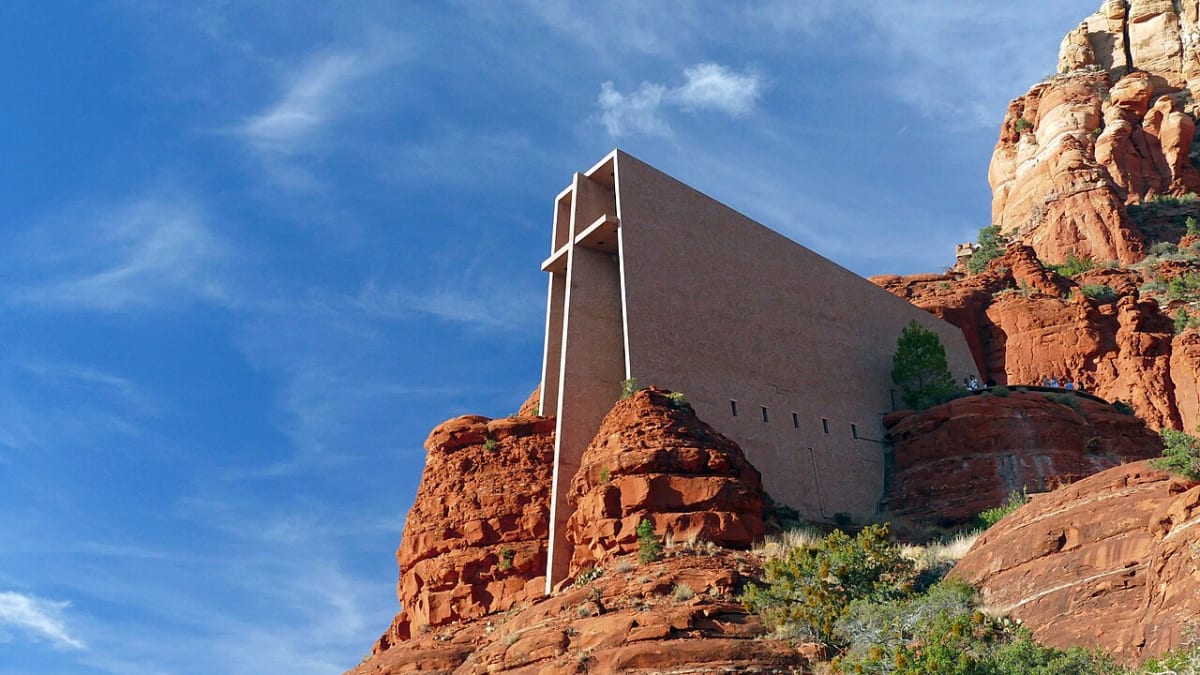
A slender concrete chapel with a great cross for a spine, planted right into the red rock so it looks like it grew there.
The Chapel of the Holy Cross is one of those places that stops you in the parking lot. A tall, narrow slab of concrete rises out of a shoulder of red rock between two buttes, and down its face runs an enormous cross, ninety feet of it, that seems to hold the whole building up. It does not sit on the rock so much as grow out of it, and from a distance you might mistake it for another strange sandstone formation until you see the glass and the doors.
It was the dream of one woman, the artist and sculptor Marguerite Brunswig Staude, who spent more than twenty years trying to build a church that found God through art. When she finally raised it in the red rock of Sedona in the mid-1950s, she gave the desert a landmark that draws hundreds of thousands of people a year, believers and sightseers alike, up the little road to stand inside it and look out.
What Travelers Love
- A chapel that seems to rise straight out of the red rock, with a tall cross running down its face
- The huge glass wall behind the altar that frames the buttes and the valley beyond
- Free to enter, welcoming people of every faith and none, in a hush that quiets a busy day
- The short walk up the ramp for one of the most photographed views in all of Sedona
Worth Knowing
- It is a real working chapel, so keep voices low and dress and behave respectfully inside
- Parking at the chapel is small and fills fast, so come early in the day or plan to walk up from the lot below
- The walk to the doors is a steady uphill ramp, which some visitors find a bit of a climb
- There are no big services on the spur itself, so bring water, especially in the desert heat
Learn about Chapel of the Holy Cross
An idea sparked by a skyscraper
The story starts, oddly, with the Empire State Building. In 1932 Marguerite Brunswig Staude, the daughter of a wealthy pharmaceutical family and a trained artist, looked at the new New York skyscraper from a certain angle and thought she saw a cross in its lines. The image would not leave her. She became set on building a church shaped by that same modern, soaring feeling, a place where art itself would carry the worship.
Her first plan was for a great church in Budapest, and she worked on it with Lloyd Wright, a son of Frank Lloyd Wright. The Second World War ended that idea before it began, so she brought the dream home to Arizona, where her family owned ranch land. It took her until the 1950s and the help of the San Francisco firm Anshen and Allen to find the right site and finally build it.
Built into the living rock
The chapel was raised between 1954 and 1956 on a red rock spur in what is now the Coconino National Forest. The design is bold and simple: a wedge of reinforced concrete driven straight into the stone, with that ninety-foot cross as its structural spine, front and back, so the whole thing reads as one great crucifix standing in the desert. Behind the altar a wall of glass looks straight out at the buttes and the valley, so the view becomes part of the sanctuary.
Staude meant it as a memorial to her parents and as a gift open to everyone. There is no admission charge, and the doors welcome people of any faith or none at all. Inside it is small, plain, and quiet, with the desert light pouring through the glass, and many visitors say the hush and the framed red rock move them whether or not they came for a church.
A landmark of the red rock country
Over the years the chapel has become one of the signature images of Sedona and of Arizona itself, praised as a small masterpiece of mid-century modern design set in an unforgettable landscape. It sits among the region's most famous formations, with Bell Rock and Courthouse Butte just down the road and a pair of spires nearby that locals call the Two Nuns, so the setting is as much a draw as the building.
It is also simply a beautiful place to look out from. The great glass wall and the terrace outside frame a sweeping view across the Verde Valley, and the red rock glows warmest in the early and late light. Come in the morning to beat the crowds and the parking crunch, walk up the ramp, sit for a while, and let the desert and the quiet do their work.
Visiting the Chapel of the Holy Cross
The chapel is just south of Sedona, off State Route 179 up a short side road called Chapel Road. It is free to visit and open to the public most days, though hours can shift with the seasons and holidays, so it is worth checking before a special trip. Because it is a working chapel, dress and act as you would in any place of worship, and keep voices down inside.
The little parking area at the top is small and fills quickly, especially at midday in busy seasons, so arriving early or being ready to walk up from the lower lot saves a lot of frustration. The approach is a steady uphill ramp, an easy walk for most but a real climb for some. Give yourself time to linger at the glass, step outside to the view, and take the classic photo from below of the chapel and its cross rising out of the red rock.
Closest Boutels
The closest Boutel™ stays, so you can turn this stop into an overnight. Each is a place we chose through independent editorial review, never a paid placement.
The Iron Horse Inn
Boutel1034 N Main St, Cottonwood, AZ 86326, Cottonwood, AZ
16 miles away|Learn More ›
Details
Sedona, AZ
Frequently asked questions
What is the Chapel of the Holy Cross?
The Chapel of the Holy Cross is a striking modern chapel built dramatically into the red rocks of Sedona, Arizona, appearing to rise directly out of the towering sandstone. Completed in the 1950s and inspired by a vision to blend faith, art, and the natural landscape, its bold design and enormous cross-shaped window make it an architectural marvel and a beloved Sedona landmark. Open to visitors of all faiths, it offers a peaceful place for reflection and breathtaking views over Sedona's red-rock country.
Can anyone visit the Chapel of the Holy Cross?
Yes, the chapel welcomes visitors of all faiths and backgrounds, and admission is free, though donations are appreciated to help maintain it. As an active place of worship and quiet reflection, visitors are asked to be respectful, keep noise low, and mind any guidelines during services or prayer. Many come simply to admire the remarkable architecture, light a candle, or take in the spectacular views. Its welcoming, contemplative atmosphere makes it a meaningful stop whether you visit for spiritual or architectural reasons.
What can you see at the Chapel of the Holy Cross?
You can admire the chapel's dramatic modern architecture set into the red rocks, step inside its serene, light-filled sanctuary beneath the towering cross-shaped window, and take in sweeping panoramic views of Sedona's stunning red-rock formations from its elevated perch. The short walk up to the chapel and the surrounding grounds offer wonderful photo opportunities. The combination of bold design, spiritual atmosphere, and jaw-dropping scenery makes even a brief visit memorable and moving for nearly everyone who comes.
When is the best time to visit the Chapel of the Holy Cross?
The chapel is beautiful year-round, but visiting earlier in the day or later in the afternoon helps avoid the largest crowds, since parking is limited and the popular site can get busy, especially at midday and around sunset. The light on the red rocks is especially gorgeous in the golden hours near sunrise and sunset. Checking current visiting hours before you go is wise. A weekday or an early visit offers the most peaceful experience of this serene, scenic landmark.
What is near the Chapel of the Holy Cross?
The chapel is in Sedona, near the iconic red-rock formations of Cathedral Rock, Bell Rock, and Courthouse Butte, with the town's art galleries, shops, restaurants, vortex sites, and scenic Oak Creek Canyon drive all close by. The surrounding red-rock country offers abundant hiking and sightseeing. That makes the Chapel of the Holy Cross an easy and inspiring stop on a Sedona visit, perfect for combining with the area's stunning rock formations, trails, and vibrant arts scene.
Nearby
Red Rock Scenic Byway
0.8 miles away
Red Rock Scenic Byway follows AZ-179 for about seven miles between the Village of Oak Creek and Sedona, threading past some of the most photographed red rock in the Southwest.

Bell Rock
1.4 miles away
Bell Rock is one of Sedona's most iconic butte formations, and one of the few where scrambling on the rock itself is allowed and common.

Cathedral Rock
1.5 miles away
Cathedral Rock is the most-photographed rock formation in Arizona. The classic shot is from the Red Rock Crossing area of Oak Creek, with the twin spires reflected in the water.

Red Rock State Park
3.8 miles away
Red Rock State Park is a quieter alternative to Slide Rock, with guided creek hikes, ranger programs, and a riparian cottonwood corridor along Oak Creek.
Slide Rock State Park
7.5 miles away
The main feature at Slide Rock State Park is a natural water slide worn smooth by Oak Creek flowing over sandstone slabs for centuries.
Boynton Canyon
8.1 miles away
Boynton Canyon is one of Sedona's premier day hikes - 6 miles round-trip through a lush canyon that ends in a box with high red walls. The Enchantment Resort sits midway through the canyon.
Oak Creek Canyon
9.6 miles away
Oak Creek Canyon runs from Sedona north to the Mogollon Rim, dropping 3,400 feet in 16 miles.
Oak Creek Canyon Overlook
9.9 miles away
The first overlook on US-89A heading south from Flagstaff into Oak Creek Canyon appears after the switchbacks at 6,400 feet and gives a full view into the canyon before the road descends.

Montezuma Well
12 miles away
Montezuma Well is a detached unit of Montezuma Castle NM - a 350-foot-diameter limestone sinkhole fed by a subsurface spring at 1.5 million gallons per day.

Tuzigoot National Monument
15 miles away
Tuzigoot is a hilltop pueblo of 110 rooms occupied by the Sinagua people for nearly 300 years.
Dead Horse Ranch State Park
16 miles away
A cool, green riverside state park on the Verde River just outside Cottonwood, with three fishing lagoons, shady cottonwood trails, and some of the best birding in Arizona.

Montezuma Castle National Monument
16 miles away
Montezuma Castle is one of the best-preserved cliff dwellings in North America.
Verde Canyon Railroad
18 miles away
Verde Canyon Railroad runs a 4-hour, 40-mile excursion through the Verde Canyon, which has no road access - train is the only way in.

Fort Verde State Historic Park
19 miles away
Fort Verde preserves several original 1870s adobe buildings from an Apache Wars era army post, arranged around a parade ground you can cross in a few minutes.

Sycamore Canyon Wilderness
19 miles away
Sycamore Canyon is a 21-mile wilderness canyon with a perennial creek, sycamore-cottonwood gallery forest, and red rock walls.
Palatki Heritage Site, Sedona area
20 miles away
Palatki has two adjacent sites: a Sinagua cliff dwelling occupied 1150-1350 CE, and a shelter with 6,000 years of painted pictographs in overlapping layers.
Historic Route 66, Flagstaff to Winslow
43 miles away
The Route 66 alignment east of Flagstaff passes through Winona (you need to know it) and ends at the famous Standin' on the Corner park in Winslow.