

Montezuma Well
4954 Goss Dr, Rimrock, AZ
Rimrock, AZ
A great limestone sinkhole brimming with warm spring water, ringed by ancient cliff dwellings and home to tiny creatures found nowhere else on Earth.
Montezuma Well is a natural wonder hidden in the Verde Valley, a huge limestone sinkhole filled with warm, blue-green water and ringed by the ruins of ancient cliff dwellings. Though it carries the same misleading name as the nearby Montezuma Castle, and is part of the same national monument, it is a very different place, quieter and stranger, fed by a constant flow of spring water welling up from deep underground.
For the Sinagua people who farmed this valley centuries ago, the well was a lifeline and a sacred place. They built their homes into its walls, carried its water to their fields through a carved stone ditch, and left the dwellings that still cling to the rock above the water. Today the well is treasured both for that ancient story and for the tiny creatures that live in its unusual waters, found nowhere else in the world.
What Travelers Love
- A striking round sinkhole filled with warm, blue-green spring water
- Ancient cliff dwellings tucked into the walls of the well
- A stone irrigation ditch the Sinagua carved to water their fields
- The peace of a quiet, less-crowded site with its own strange ecology
Worth Knowing
- The trail includes some stairs down toward the water and back up, a short but real climb
- This is a sacred ancestral place, so treat the well and its dwellings with respect
- Summer days in the valley are hot, so early or late visits are more pleasant
- It pairs naturally with nearby Montezuma Castle, part of the same monument
Learn about Montezuma Well
A sinkhole fed from below
Montezuma Well formed when the roof of an underground limestone cavern collapsed, leaving a great round basin. What fills it is remarkable: a spring deep below pours an enormous volume of warm water into the well continuously, day and night, keeping the water at a steady level and a steady temperature all year. The water is rich in dissolved carbon dioxide and other minerals, which makes it inhospitable to fish but perfect for a strange community of other creatures.
That constant spring is what made the well so precious in this dry country. In a land where water can be scarce and seasonal, here was a reliable, warm, ever-flowing source, welling up out of the earth as it had for ages. The water drains out through an outlet and once watered the fields below, a natural gift that shaped how people lived here for a very long time.
The Sinagua and their ditch
The Sinagua, the same farming people who built Montezuma Castle down the valley, settled around the well and made the most of its water. They built dwellings into the alcoves and ledges of the well's rim, small stone rooms perched above the water, and they farmed the land nearby with corn, beans, and squash.
Their most impressive work is an irrigation ditch, carved and lined with stone, that carried water from the well's outlet to their fields. Parts of that ancient ditch still hold water and still run, so well made that they have functioned for centuries. It stands as a testament to the skill and ingenuity of the people who lived here, coaxing farmland out of the desert with careful engineering long ago. Their descendants remain among the Hopi, Yavapai, and other Native peoples of the region, who hold the well sacred.
Life found nowhere else
The waters of Montezuma Well are so unusual that they support living things found in no other place on Earth. Because the high levels of dissolved carbon dioxide keep fish out, a distinct little world of creatures has evolved here in isolation, including a tiny water scorpion, a particular amphipod, a leech, and a diatom, several of them known only from this single well.
Scientists study the well as a rare natural laboratory, a closed and constant environment where life has adapted to conditions found nowhere else. For a visitor it adds a quiet marvel to the place: the still, warm, green water holding an ecosystem all its own, a whole community of small creatures that exists only in this one sunken pool in the Arizona desert.
Visiting the well
A short trail leads from the parking area up to the rim of the well and down toward the water, past overlooks of the sinkhole, the cliff dwellings in its walls, and the outlet where the water drains away. A branch of the path follows the old Sinagua ditch and the creek below, shaded by sycamores, where you can see the ancient waterworks still doing their job.
The well is quieter than the more famous Montezuma Castle, and that solitude is part of its charm, a chance to take in the still water, the ruins, and the strange stillness of the place at your own pace. Set in the green Verde Valley between the desert and the high country, it makes a rewarding companion to the castle and a memorable stop on any tour of central Arizona's ancient sites.
Closest Boutels
The closest Boutel™ stays, so you can turn this stop into an overnight. Each is a place we chose through independent editorial review, never a paid placement.
Lantern Light Inn & Wedding Gardens
Boutel+3085 W State Rte 89A, Sedona, AZ
15 miles away|Learn More ›
The Iron Horse Inn
Boutel1034 N Main St, Cottonwood, AZ 86326, Cottonwood, AZ
16 miles away|Learn More ›
Details
Rimrock, AZ
Frequently asked questions
What is Montezuma Well?
Montezuma Well, a detached unit of Montezuma Castle National Monument near Camp Verde, Arizona, is a remarkable natural limestone sinkhole filled by a constant flow of spring water, ringed by cliffs that hold ancient dwellings. Fed by an underground spring producing over a million gallons of water daily, the well supported ancestral peoples who built cliff dwellings around its rim and dug irrigation canals still visible today. This unique blend of geology, rare aquatic life, ancient ruins, and desert oasis makes Montezuma Well a fascinating and lesser-known treasure.
What can you see at Montezuma Well?
You can walk short trails around the rim to overlook the striking water-filled sinkhole, see the ancient cliff dwellings and pueblo ruins built into and around it, and view the outlet where spring water flows into a historic irrigation canal used by ancestral farmers, portions of which still function. Interpretive signs explain the geology, the rare species found only in the well, and the peoples who lived here. The combination of natural wonder and ancient human history makes for a rewarding, uncrowded stop.
Why is Montezuma Well special?
Montezuma Well is special for its unusual geology as a constantly spring-fed limestone sinkhole in the desert, its rare aquatic creatures found nowhere else on Earth that survive in its unique high-carbon-dioxide waters, and its rich human history, with cliff dwellings and ancient irrigation canals showing how ancestral peoples harnessed the reliable water source. This rare convergence of a natural oasis, endemic wildlife, and ancient engineering, all in a quiet desert setting, gives Montezuma Well a distinctive fascination beyond a typical archaeological or scenic site.
When is the best time to visit Montezuma Well?
Spring and fall offer the most comfortable weather for walking the rim trails, while summer in the Verde Valley is hot, so early morning visits are best then, and winter is mild and pleasant. The site is small and the trails short, so a visit takes under an hour, making it easy to fit in any time of day, though morning light and cooler air are nicest. The milder months make exploring the well and its ruins most enjoyable.
What is near Montezuma Well?
Montezuma Well is a short drive from the main Montezuma Castle cliff dwelling near Camp Verde, with the Verde Valley towns of Cottonwood and Clarkdale, Tuzigoot National Monument, the Verde Canyon Railroad, historic Jerome, and Fort Verde State Historic Park all nearby, and Sedona's red rocks within easy reach. That makes Montezuma Well an easy and intriguing addition to a Verde Valley itinerary, naturally paired with Montezuma Castle and the region's other ancient sites and scenic attractions.
Nearby
Red Rock Scenic Byway
2.9 miles away
Red Rock Scenic Byway follows AZ-179 for about seven miles between the Village of Oak Creek and Sedona, threading past some of the most photographed red rock in the Southwest.

Montezuma Castle National Monument
4.8 miles away
Montezuma Castle is one of the best-preserved cliff dwellings in North America.

Fort Verde State Historic Park
7.8 miles away
Fort Verde preserves several original 1870s adobe buildings from an Apache Wars era army post, arranged around a parade ground you can cross in a few minutes.

Bell Rock
11 miles away
Bell Rock is one of Sedona's most iconic butte formations, and one of the few where scrambling on the rock itself is allowed and common.

Cathedral Rock
12 miles away
Cathedral Rock is the most-photographed rock formation in Arizona. The classic shot is from the Red Rock Crossing area of Oak Creek, with the twin spires reflected in the water.

Red Rock State Park
12 miles away
Red Rock State Park is a quieter alternative to Slide Rock, with guided creek hikes, ranger programs, and a riparian cottonwood corridor along Oak Creek.
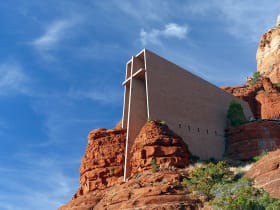
Chapel of the Holy Cross
12 miles away
A modernist chapel built straight into the red rock buttes just south of Sedona, with a ninety-foot cross for a spine and a glass wall framing the Verde Valley.
Dead Horse Ranch State Park
16 miles away
A cool, green riverside state park on the Verde River just outside Cottonwood, with three fishing lagoons, shady cottonwood trails, and some of the best birding in Arizona.

Tuzigoot National Monument
17 miles away
Tuzigoot is a hilltop pueblo of 110 rooms occupied by the Sinagua people for nearly 300 years.
Verde Canyon Railroad
18 miles away
Verde Canyon Railroad runs a 4-hour, 40-mile excursion through the Verde Canyon, which has no road access - train is the only way in.
Boynton Canyon
19 miles away
Boynton Canyon is one of Sedona's premier day hikes - 6 miles round-trip through a lush canyon that ends in a box with high red walls. The Enchantment Resort sits midway through the canyon.
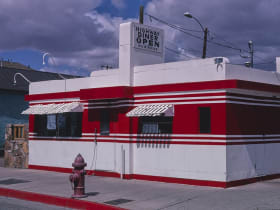
Historic Route 66, Flagstaff to Winslow
50 miles away
The Route 66 alignment east of Flagstaff passes through Winona (you need to know it) and ends at the famous Standin' on the Corner park in Winslow.