
Boynton Canyon
Bear Mountain trail/Oski approach, Sedona, AZ
Sedona, AZ
A box canyon that narrows from open red rock into cool pine forest, held sacred by the Yavapai and Apache and prized by seekers as a Sedona vortex.
Boynton Canyon is one of the most beloved of Sedona's red rock canyons, a deep, cliff-walled recess that draws hikers, seekers, and lovers of scenery alike. What sets it apart is the way it transforms as you walk into it. The trail begins in open, sun-baked red rock country, then works steadily back and up into the canyon until the walls close in and the vegetation shifts to cool pine and fir, a small pocket of high forest hidden in the desert rock.
The canyon is layered with meaning. It is sacred to the Yavapai and Apache peoples, who have deep ties to this land and hold it as a place of origin and reverence. It is also one of the most famous of Sedona's energy vortexes, a site many believe holds a special concentration of the earth's energy. Whether you come for the geology, the forest, the history, or the vortex, Boynton Canyon leaves an impression.
What Travelers Love
- A canyon that shifts from open red rock into shaded pine and fir forest
- Towering red-and-white sandstone walls closing in on both sides
- Its fame as one of Sedona's most powerful vortex sites
- The deep ancestral and living Native connections to the canyon
Worth Knowing
- The trail runs several miles round trip with some elevation gain, so bring water and good shoes
- This is sacred land to Native peoples, so treat it with respect and stay on the trail
- The trailhead lot fills early, so arrive in the morning on busy days
- There is limited shade on the lower trail, so sun protection matters in warm months
Learn about Boynton Canyon
Sacred to the Yavapai and Apache
Boynton Canyon holds deep significance for the Yavapai and Apache peoples, whose descendants live in the region today as the Yavapai-Apache Nation. In their tradition the canyon is bound up with stories of creation and origin, a place of profound importance rather than mere scenery. That sacred character is part of why visitors are asked to treat the canyon with respect, staying on the trail and leaving the land undisturbed.
The wider red rock country was long home to the Sinagua, an ancestral culture whose stone dwellings and rock art survive throughout the region, and the Yavapai and Apache who followed. The canyon's history reaches back countless generations, and its meaning to the living peoples of the area is a reminder that this is not empty land but a place woven into cultures still present today.
A canyon that changes as you climb
The Boynton Canyon trail is famous for its transformation. It sets out across open desert scrub and red rock, exposed to the sun, with the great walls of the canyon rising ahead. As it works back into the canyon and gains elevation, the character changes. The walls draw closer, shade deepens, and suddenly you are walking through cool forest of pine, fir, and oak, a world away from the desert where you started.
That shift happens because the deep, shaded canyon holds moisture and cooler air than the open country outside, allowing a high-country forest to grow far below its usual elevation. The trail ends against the canyon's back wall, hemmed in by cliffs on three sides. The journey from hot red rock to cool green forest and back is a large part of the hike's appeal.
The vortex and the seekers
Boynton Canyon is counted among Sedona's most powerful energy vortexes, sites where many believe the earth's energy is especially concentrated. Since the idea took hold in the later twentieth century, Sedona has drawn seekers from around the world, and Boynton is one of the canyons they most often visit to meditate, reflect, and feel the vortex energy.
A knoll near the canyon's mouth, sometimes called Kachina Woman for a nearby spire, is a favored spot for those seeking the vortex. Whatever one makes of the vortex idea, the canyon has a genuine power of place, its towering walls and deep quiet inspiring awe in visitors of every kind. That blend of natural grandeur and spiritual reputation is central to the canyon's fame.
The red rocks of Sedona
Boynton Canyon is carved from the same brilliant red sandstone that makes all of Sedona famous. The rock was laid down as ancient dunes and floodplains and stained deep red by iron, then cut by water and weather into the buttes, spires, and canyons that ring the town. The canyon's walls rise in bands of red and white, glowing at sunrise and sunset.
The surrounding red rock country is one of the most celebrated landscapes in the American Southwest, drawing travelers, artists, and seekers to its trails and viewpoints. Boynton Canyon, at once beautiful, storied, and sacred, is one of its treasures, a place where scenery and meaning run together as deeply as anywhere in Sedona.
Closest Boutels
The closest Boutel™ stays, so you can turn this stop into an overnight. Each is a place we chose through independent editorial review, never a paid placement.
The Iron Horse Inn
Boutel1034 N Main St, Cottonwood, AZ 86326, Cottonwood, AZ
14 miles away|Learn More ›
Details
Sedona, AZ
Frequently asked questions
What is Boynton Canyon?
Boynton Canyon is one of Sedona's most beautiful and revered red-rock canyons, a lush box canyon framed by towering sandstone cliffs and dotted with pinyon, juniper, and pine. Considered one of Sedona's famous energy vortex sites, it holds deep spiritual significance and stunning natural beauty. A popular trail leads into the canyon past dramatic formations like the Kachina Woman spire, and the area blends serene wilderness with the luxury of a secluded resort. Boynton Canyon offers hikers and seekers a memorable, scenic, and contemplative Sedona experience.
What is the Boynton Canyon Trail like?
The main Boynton Canyon Trail runs roughly six miles round trip, starting relatively level and open before entering the forested canyon and climbing gently to a scenic end point with views of the surrounding cliffs. A short but steep spur leads up to the Vista knoll near the Kachina Woman formation, a noted vortex spot. The trail is moderate overall, with some rocky and uneven sections, so wear sturdy shoes, carry plenty of water, and allow a few hours to enjoy it fully.
What safety precautions should I take at Boynton Canyon?
The Arizona sun and heat are intense, especially on the open early portion of the trail, so carry ample water, wear sun protection and a hat, and hike in cooler morning hours in the warm months to avoid heat exhaustion. Wear good footwear for the rocky, uneven terrain, and use caution on the steep spur trails and any scrambling near drop-offs. Stay on established trails, watch your footing, and turn back if you tire, keeping enough water and energy for the return.
When is the best time to hike Boynton Canyon?
Spring and fall offer the most comfortable temperatures for the hike, while summer is hot, so an early morning start is essential then to beat the heat, and winter is cool and pleasant, occasionally with a dusting of snow on the red rocks that is stunning. Early morning also means better parking at the popular trailhead and softer light for photos. For comfort and beauty, the milder shoulder seasons are ideal, but any season rewards early starts and good preparation.
What is near Boynton Canyon?
Boynton Canyon is in the red-rock country northwest of central Sedona, near other famous formations and vortex sites, with Cathedral Rock, Bell Rock, and the Chapel of the Holy Cross a short drive away, along with Sedona's galleries, shops, and the scenic Oak Creek Canyon drive. That makes Boynton Canyon a rewarding hike to combine with Sedona's other stunning trails, red-rock landmarks, and vibrant arts scene on a visit to one of Arizona's most beautiful destinations.
Nearby

Red Rock State Park
6.7 miles away
Red Rock State Park is a quieter alternative to Slide Rock, with guided creek hikes, ranger programs, and a riparian cottonwood corridor along Oak Creek.
Slide Rock State Park
7.2 miles away
The main feature at Slide Rock State Park is a natural water slide worn smooth by Oak Creek flowing over sandstone slabs for centuries.

Cathedral Rock
7.6 miles away
Cathedral Rock is the most-photographed rock formation in Arizona. The classic shot is from the Red Rock Crossing area of Oak Creek, with the twin spires reflected in the water.
Red Rock Scenic Byway
7.8 miles away
Red Rock Scenic Byway follows AZ-179 for about seven miles between the Village of Oak Creek and Sedona, threading past some of the most photographed red rock in the Southwest.
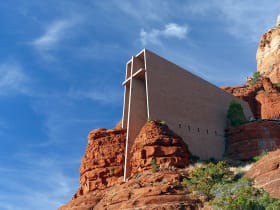
Chapel of the Holy Cross
8.1 miles away
A modernist chapel built straight into the red rock buttes just south of Sedona, with a ninety-foot cross for a spine and a glass wall framing the Verde Valley.
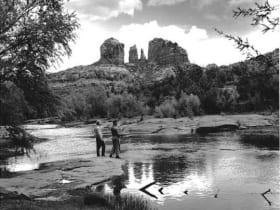
Oak Creek Canyon
8.2 miles away
Oak Creek Canyon runs from Sedona north to the Mogollon Rim, dropping 3,400 feet in 16 miles.
Oak Creek Canyon Overlook
9.0 miles away
The first overlook on US-89A heading south from Flagstaff into Oak Creek Canyon appears after the switchbacks at 6,400 feet and gives a full view into the canyon before the road descends.

Bell Rock
9.1 miles away
Bell Rock is one of Sedona's most iconic butte formations, and one of the few where scrambling on the rock itself is allowed and common.

Sycamore Canyon Wilderness
12 miles away
Sycamore Canyon is a 21-mile wilderness canyon with a perennial creek, sycamore-cottonwood gallery forest, and red rock walls.

Tuzigoot National Monument
13 miles away
Tuzigoot is a hilltop pueblo of 110 rooms occupied by the Sinagua people for nearly 300 years.
Palatki Heritage Site, Sedona area
14 miles away
Palatki has two adjacent sites: a Sinagua cliff dwelling occupied 1150-1350 CE, and a shelter with 6,000 years of painted pictographs in overlapping layers.
Dead Horse Ranch State Park
14 miles away
A cool, green riverside state park on the Verde River just outside Cottonwood, with three fishing lagoons, shady cottonwood trails, and some of the best birding in Arizona.
Verde Canyon Railroad
16 miles away
Verde Canyon Railroad runs a 4-hour, 40-mile excursion through the Verde Canyon, which has no road access - train is the only way in.

Jerome
17 miles away
A former copper boomtown stacked up the side of a mountain, once branded the wickedest town in the West and now an artists' colony full of galleries and ghost stories.

Jerome Grand Hotel
18 miles away
The Jerome Grand Hotel occupies the 1926 United Verde Hospital, built by the Phelps Dodge Corporation on the most prominent point in Jerome at 5,200 feet.

Montezuma Well
19 miles away
Montezuma Well is a detached unit of Montezuma Castle NM - a 350-foot-diameter limestone sinkhole fed by a subsurface spring at 1.5 million gallons per day.
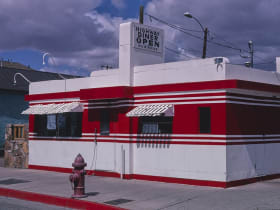
Historic Route 66, Flagstaff to Winslow
46 miles away
The Route 66 alignment east of Flagstaff passes through Winona (you need to know it) and ends at the famous Standin' on the Corner park in Winslow.