

Cathedral Rock
Cathedral Rock Trail, Sedona, AZ
Sedona, AZ
A cluster of red sandstone spires reflected in Oak Creek, perhaps the most photographed rock in Arizona and one of Sedona's celebrated vortex sites.
Cathedral Rock is the image most people carry away from Sedona, a soaring cluster of red sandstone spires and buttresses rising above the green line of Oak Creek. Its towers, worn into the shape that gave it its name, glow deep red against the blue Arizona sky and are reflected in the creek at a nearby crossing, making one of the most photographed scenes in the entire American Southwest. If you have seen a picture of Sedona, chances are you have seen Cathedral Rock.
The formation is more than a photograph, though. A short trail climbs steeply up its slickrock flank to a saddle high among the spires, a scramble that rewards the effort with a thrilling perch and sweeping views. And like other great Sedona landmarks, Cathedral Rock is counted among the area's energy vortexes, drawing seekers as well as hikers and photographers. It is a place that gathers together everything that makes Sedona famous.
What Travelers Love
- Iconic red rock spires that are among the most photographed in the Southwest
- A short but exhilarating climb to a saddle high among the towers
- The classic reflection of the rock in Oak Creek at Red Rock Crossing
- Its fame as one of Sedona's most powerful vortex sites
Worth Knowing
- The summit trail is short but steep, with real rock scrambling that is not for everyone
- There is little shade, so bring water and sun protection, especially in warm months
- The trailhead lot is small and fills very early, so arrive at dawn or use the shuttle when running
- Stay on the established route to protect the fragile slickrock and desert soil
Learn about Cathedral Rock
The most photographed rock in Sedona
Cathedral Rock's fame rests largely on a single, perfect view. Not far from the formation, at a spot along Oak Creek known as Red Rock Crossing, the spires rise directly behind the creek and are mirrored in its still water, framed by green cottonwoods. That composition, red towers, blue sky, green trees, and shining water, has been photographed and painted countless times and is one of the defining images of Arizona.
The rock itself, seen from many angles around Sedona, is instantly recognizable, its cluster of tall spires and the deep clefts between them forming a distinctive silhouette on the skyline. Photographers chase it at sunrise and sunset, when the low light sets the sandstone glowing, and it appears on postcards, calendars, and gallery walls throughout the region. Few natural landmarks are so closely tied to a single place's identity.
The climb to the saddle
For those who want more than a photograph, a trail climbs Cathedral Rock itself. It is short, but it is steep, ascending the bare slickrock of the formation's flank in a series of scrambles that require using your hands to pull up and over ledges. It is not a casual stroll, and it demands care and reasonable fitness, but it is well within reach of many hikers and endlessly popular.
The trail's goal is a saddle high between the great spires, a natural gap where you can stand hemmed in by towers of red rock with the country falling away on both sides. From there the views open across the red rock country and down to Oak Creek and the Verde Valley beyond. Reaching the saddle, breathless from the scramble and surrounded by the towering spires, is one of the great short hikes in Sedona.
A Sedona vortex
Cathedral Rock is one of the most celebrated of Sedona's energy vortexes, sites where many people believe the earth's energy is especially concentrated. Since the vortex idea took hold in the later twentieth century, Sedona has become a destination for those drawn to the metaphysical, and Cathedral Rock, along with Bell Rock and Boynton Canyon, is among the sites they most often seek out.
Visitors come to the rock and the creek below to meditate, reflect, and feel what they describe as the vortex energy, and the area around Red Rock Crossing in particular is a favored spot for quiet contemplation. Whatever one makes of the vortex idea, there is no denying the powerful presence of the place, and that blend of natural grandeur and spiritual reputation is central to Cathedral Rock's fame.
Red rock and running water
Cathedral Rock is carved from the brilliant red sandstone that defines Sedona, rock laid down as ancient dunes and floodplains, stained deep red by iron, and sculpted by water and weather into spires and buttes. Its worn towers are a textbook example of how the region's soft-and-hard layering erodes into dramatic vertical forms.
At its foot runs Oak Creek, a clear, cottonwood-lined stream that flows year round through the red rock country, one of the rare permanent creeks in this dry land. The meeting of red rock and green water is the heart of Sedona's beauty, and nowhere is it more perfectly expressed than at Cathedral Rock and the crossing below it, where stone and stream compose the region's signature scene.
Closest Boutels
The closest Boutel™ stays, so you can turn this stop into an overnight. Each is a place we chose through independent editorial review, never a paid placement.
The Iron Horse Inn
Boutel1034 N Main St, Cottonwood, AZ 86326, Cottonwood, AZ
14 miles away|Learn More ›
Details
Sedona, AZ
Frequently asked questions
What is Cathedral Rock?
Cathedral Rock is one of the most iconic and photographed red-rock formations in Sedona, Arizona, its towering sandstone spires rising dramatically against the blue desert sky. A symbol of Sedona's stunning landscape, it is famous both for its beauty and as a spiritual vortex site believed by many to hold special energy. Whether admired from a distance at sunset, reflected in nearby Oak Creek, or reached by a short but steep climb, Cathedral Rock is a must-see centerpiece of the Sedona experience.
How hard is the hike up Cathedral Rock?
The Cathedral Rock Trail is short, only about a mile and a half round trip, but it is steep and strenuous, involving a real scramble up sloping sandstone and through a rocky chute using your hands in places, so it is more challenging than the distance suggests. The reward is spectacular views from the saddle between the spires. Wear sturdy shoes with good grip, take your time, and know your limits, as the steep, exposed rock can be difficult for some hikers.
What safety precautions should I take at Cathedral Rock?
Because the trail climbs steep, slick sandstone with some exposure, wear shoes with good traction, use your hands for balance on the scramble sections, and avoid the climb in wet, icy, or windy conditions when the rock becomes dangerously slippery. The Arizona sun is intense, so carry plenty of water, wear sun protection, and hike in cooler hours to avoid heat exhaustion. Keep children close on the steep sections, watch your footing near drop-offs, and turn back if conditions feel unsafe.
When is the best time to hike Cathedral Rock?
Spring and fall offer the most comfortable temperatures for the strenuous climb, while summer is very hot, so early morning or late afternoon is essential to avoid dangerous midday heat. Sunset is a magical time when the red rock glows, though you should allow enough time to descend safely before dark. The trailhead parking is small and fills fast, so arriving early helps. Cooler months are ideal, but always carry water and avoid the exposed rock in bad weather.
What is near Cathedral Rock?
Cathedral Rock is in Sedona, surrounded by other famous red-rock landmarks like Bell Rock, the Chapel of the Holy Cross, and Oak Creek Canyon, with scenic drives, art galleries, and vortex sites throughout the area. The Red Rock State Park and Oak Creek offer more nature nearby. That makes Cathedral Rock a highlight of a Sedona visit, easily combined with the town's other stunning rock formations, hiking trails, and the beautiful drive through Oak Creek Canyon.
Nearby
Red Rock Scenic Byway
0.7 miles away
Red Rock Scenic Byway follows AZ-179 for about seven miles between the Village of Oak Creek and Sedona, threading past some of the most photographed red rock in the Southwest.
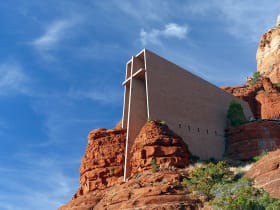
Chapel of the Holy Cross
1.5 miles away
A modernist chapel built straight into the red rock buttes just south of Sedona, with a ninety-foot cross for a spine and a glass wall framing the Verde Valley.

Bell Rock
1.6 miles away
Bell Rock is one of Sedona's most iconic butte formations, and one of the few where scrambling on the rock itself is allowed and common.

Red Rock State Park
2.4 miles away
Red Rock State Park is a quieter alternative to Slide Rock, with guided creek hikes, ranger programs, and a riparian cottonwood corridor along Oak Creek.
Boynton Canyon
7.6 miles away
Boynton Canyon is one of Sedona's premier day hikes - 6 miles round-trip through a lush canyon that ends in a box with high red walls. The Enchantment Resort sits midway through the canyon.
Slide Rock State Park
8.5 miles away
The main feature at Slide Rock State Park is a natural water slide worn smooth by Oak Creek flowing over sandstone slabs for centuries.
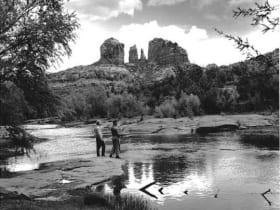
Oak Creek Canyon
10 miles away
Oak Creek Canyon runs from Sedona north to the Mogollon Rim, dropping 3,400 feet in 16 miles.
Oak Creek Canyon Overlook
11 miles away
The first overlook on US-89A heading south from Flagstaff into Oak Creek Canyon appears after the switchbacks at 6,400 feet and gives a full view into the canyon before the road descends.

Montezuma Well
12 miles away
Montezuma Well is a detached unit of Montezuma Castle NM - a 350-foot-diameter limestone sinkhole fed by a subsurface spring at 1.5 million gallons per day.

Tuzigoot National Monument
14 miles away
Tuzigoot is a hilltop pueblo of 110 rooms occupied by the Sinagua people for nearly 300 years.
Dead Horse Ranch State Park
14 miles away
A cool, green riverside state park on the Verde River just outside Cottonwood, with three fishing lagoons, shady cottonwood trails, and some of the best birding in Arizona.

Montezuma Castle National Monument
15 miles away
Montezuma Castle is one of the best-preserved cliff dwellings in North America.
Verde Canyon Railroad
17 miles away
Verde Canyon Railroad runs a 4-hour, 40-mile excursion through the Verde Canyon, which has no road access - train is the only way in.

Fort Verde State Historic Park
18 miles away
Fort Verde preserves several original 1870s adobe buildings from an Apache Wars era army post, arranged around a parade ground you can cross in a few minutes.

Sycamore Canyon Wilderness
18 miles away
Sycamore Canyon is a 21-mile wilderness canyon with a perennial creek, sycamore-cottonwood gallery forest, and red rock walls.
Palatki Heritage Site, Sedona area
19 miles away
Palatki has two adjacent sites: a Sinagua cliff dwelling occupied 1150-1350 CE, and a shelter with 6,000 years of painted pictographs in overlapping layers.

Jerome
19 miles away
A former copper boomtown stacked up the side of a mountain, once branded the wickedest town in the West and now an artists' colony full of galleries and ghost stories.

Jerome Grand Hotel
19 miles away
The Jerome Grand Hotel occupies the 1926 United Verde Hospital, built by the Phelps Dodge Corporation on the most prominent point in Jerome at 5,200 feet.
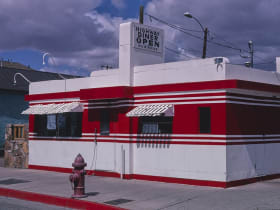
Historic Route 66, Flagstaff to Winslow
44 miles away
The Route 66 alignment east of Flagstaff passes through Winona (you need to know it) and ends at the famous Standin' on the Corner park in Winslow.