


Montezuma Castle National Monument
Montezuma Castle Rd, Camp Verde, AZ
Camp Verde, AZ
A many-roomed stone dwelling tucked into a high alcove in a limestone cliff, built by the Sinagua people and among the best-preserved cliff dwellings in the country.
Montezuma Castle is one of the best-preserved cliff dwellings in North America, a five-story stone structure of many rooms set into a natural alcove high in a limestone cliff above Beaver Creek. It was built and lived in some seven or eight centuries ago by the Sinagua, a farming people of the Verde Valley, who raised it in the sheltered recess where it has survived remarkably well ever since.
The name is a misunderstanding. Early American settlers, awed by the ruin, wrongly imagined it had something to do with the Aztec emperor Montezuma, though he never came anywhere near this place and the dwelling predates him. The name stuck, but the true story belongs to the Sinagua and to the Native peoples of Arizona today who count them among their ancestors.
What Travelers Love
- A remarkably intact cliff dwelling perched high in a sheer limestone wall
- The shaded creekside path beneath towering sycamore trees
- The sense of how a people built and lived in the cliff face centuries ago
- An easy, short visit that pairs well with the nearby Montezuma Well
Worth Knowing
- You view the dwelling from the trail below, as visitors no longer climb into the fragile ruins
- This is a sacred ancestral place, so treat the site and its trails with respect
- The paved loop trail is short and mostly shaded, easy for most visitors
- Summer days in the valley are hot, so early or late visits are more comfortable
Learn about Montezuma Castle National Monument
The people who built it
The Sinagua were a farming culture who lived across the Verde Valley and the surrounding high country for centuries, growing corn, beans, and squash along the streams and trading with peoples far beyond their homeland. In this stretch of the valley they built their dwelling into a high alcove in the cliff, a location that offered shelter from weather, protection, and a commanding view of the fertile creek bottom below.
Building high in the cliff was a feat. The Sinagua carried stone, mud mortar, and timber up the sheer face and fitted rooms into the natural recess, stacking them several stories high and reaching them by ladders that could be pulled up. They farmed the well-watered land along Beaver Creek and thrived here for generations before leaving the valley, for reasons still not fully understood, some six hundred years ago. Their descendants live on among the Hopi and other tribes of the region, who regard this as an ancestral place.
A dwelling that endured
What sets Montezuma Castle apart is how well it has lasted. Sheltered from rain and sun in its deep alcove, the dwelling has kept its walls, its rooms, and even some of its original timbers largely intact across all the centuries since it was abandoned. It looks today much as it must have looked when its builders walked away, a rare thing among such ancient structures.
For a long time visitors could climb ladders up into the rooms, but the traffic wore on the fragile old building, and to preserve it people now view it from the trail below. Even from the ground the sight is striking: the honey-colored stone rooms fitted into the pale cliff, high above the shaded creek, a piece of daily life from eight hundred years ago frozen in the rock.
The creek and the sycamores
Beneath the cliff runs Beaver Creek, a year-round stream that made this a good place to live and makes the visit a pleasure today. A short paved loop trail winds along the creek bottom under a canopy of tall Arizona sycamores, their pale trunks and broad leaves throwing welcome shade, a green and cool ribbon through the surrounding dry country.
This riparian corridor draws wildlife and birds to the water, and it shows exactly why the Sinagua chose this spot. The reliable creek let them farm the bottomlands in a land where water is precious, and the same stream now shelters herons, songbirds, and the trees that make the walk beneath the dwelling so lovely. It is a reminder that in the desert, life gathers wherever water flows.
The wider Verde Valley
Montezuma Castle is one of several ancient sites in the Verde Valley, and it pairs naturally with nearby Montezuma Well, a separate part of the same monument where a spring-fed sinkhole and more cliff dwellings tell another chapter of the Sinagua story. Together they paint a picture of a landscape that supported people for a very long time.
The green valley around the monument, watered by the Verde River and its creeks, sits between the low desert and the high plateau, and it has long been a crossroads. Today it holds the towns of Camp Verde and Cottonwood, the old mining town of Jerome on the mountain, and the red-rock country near Sedona just up the road, making the monument an easy and rewarding stop on a tour of central Arizona.
Closest Boutels
The closest Boutel™ stays, so you can turn this stop into an overnight. Each is a place we chose through independent editorial review, never a paid placement.
The Iron Horse Inn
Boutel1034 N Main St, Cottonwood, AZ 86326, Cottonwood, AZ
15 miles away|Learn More ›
Lantern Light Inn & Wedding Gardens
Boutel+3085 W State Rte 89A, Sedona, AZ
17 miles away|Learn More ›
Details
Camp Verde, AZ
Frequently asked questions
What is Montezuma Castle National Monument?
Montezuma Castle National Monument, near Camp Verde in central Arizona, protects one of the best-preserved cliff dwellings in North America, a striking five-story ancestral Sinagua structure tucked into a limestone alcove high above Beaver Creek. Built around eight hundred years ago, its remarkably intact rooms perched in the cliff face have awed visitors for generations. Despite the name, it had no connection to the Aztec ruler Montezuma, a misnomer from early settlers. An easy paved trail leads to viewpoints of the dwelling, making it an accessible and memorable glimpse into the ancient past.
Can you go inside Montezuma Castle?
No, visitors cannot enter or climb up to the cliff dwelling itself, as access was closed decades ago to protect the fragile structure, so the experience is enjoyed by viewing the dwelling from the paved trail below. The well-placed viewpoints and interpretive signs offer excellent looks at the remarkable cliff home and explain its history and the Sinagua people who built it. While you cannot go inside, the view of the dwelling nestled in its alcove is impressive and clearly visible from the accessible loop path.
Why is it called Montezuma Castle if it is not connected to Montezuma?
The name is a historical mistake. Early American settlers who came upon the impressive cliff dwelling wrongly assumed it was connected to the famous Aztec emperor Montezuma, and called it a castle, though neither association is accurate, since it was built by the ancestral Sinagua people long before and had nothing to do with the Aztecs. The romantic but incorrect name stuck. The site is actually one of many Sinagua dwellings in the region, and the visitor center explains its true origins and heritage.
When is the best time to visit Montezuma Castle National Monument?
Spring and fall offer the most comfortable weather for the easy paved trail, while summer in the Verde Valley is hot, so early morning visits are best then, and winter is mild and pleasant. The short, accessible loop takes under an hour, making it easy to fit in any time of day. Morning light is lovely on the cliff dwelling. Because it is a quick, easy stop, it combines well with other Verde Valley sites regardless of season, with the milder months most comfortable.
What is near Montezuma Castle National Monument?
Montezuma Castle is near Camp Verde in central Arizona, close to the related Montezuma Well unit with its natural limestone sinkhole, the Verde Valley towns of Cottonwood and Clarkdale with Tuzigoot National Monument and the Verde Canyon Railroad, the historic town of Jerome, and Sedona's red rocks to the north. That makes Montezuma Castle an easy and rewarding stop along Interstate 17 to combine with the Verde Valley's many ancient sites, scenic attractions, and the wonders of nearby Sedona.
Nearby

Fort Verde State Historic Park
3.4 miles away
Fort Verde preserves several original 1870s adobe buildings from an Apache Wars era army post, arranged around a parade ground you can cross in a few minutes.

Montezuma Well
4.8 miles away
Montezuma Well is a detached unit of Montezuma Castle NM - a 350-foot-diameter limestone sinkhole fed by a subsurface spring at 1.5 million gallons per day.
Red Rock Scenic Byway
7.3 miles away
Red Rock Scenic Byway follows AZ-179 for about seven miles between the Village of Oak Creek and Sedona, threading past some of the most photographed red rock in the Southwest.

Red Rock State Park
14 miles away
Red Rock State Park is a quieter alternative to Slide Rock, with guided creek hikes, ranger programs, and a riparian cottonwood corridor along Oak Creek.

Bell Rock
14 miles away
Bell Rock is one of Sedona's most iconic butte formations, and one of the few where scrambling on the rock itself is allowed and common.
Dead Horse Ranch State Park
14 miles away
A cool, green riverside state park on the Verde River just outside Cottonwood, with three fishing lagoons, shady cottonwood trails, and some of the best birding in Arizona.

Cathedral Rock
15 miles away
Cathedral Rock is the most-photographed rock formation in Arizona. The classic shot is from the Red Rock Crossing area of Oak Creek, with the twin spires reflected in the water.

Tuzigoot National Monument
16 miles away
Tuzigoot is a hilltop pueblo of 110 rooms occupied by the Sinagua people for nearly 300 years.
Chapel of the Holy Cross
16 miles away
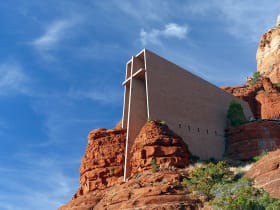
A modernist chapel built straight into the red rock buttes just south of Sedona, with a ninety-foot cross for a spine and a glass wall framing the Verde Valley.
Verde Canyon Railroad
16 miles away
Verde Canyon Railroad runs a 4-hour, 40-mile excursion through the Verde Canyon, which has no road access - train is the only way in.
Mingus Mountain Viewpoint
17 miles away
Mingus Mountain rises on the north flank of the Black Hills above the Verde Valley and has a series of viewpoints accessible from US-89A on the switchbacking road between Prescott and Jerome.

Jerome
19 miles away
A former copper boomtown stacked up the side of a mountain, once branded the wickedest town in the West and now an artists' colony full of galleries and ghost stories.

Jerome Grand Hotel
19 miles away
The Jerome Grand Hotel occupies the 1926 United Verde Hospital, built by the Phelps Dodge Corporation on the most prominent point in Jerome at 5,200 feet.