

Fort Verde State Historic Park
125 E Hollamon St, Camp Verde, AZ
Camp Verde, AZ
One of the best-preserved army posts of the Indian Wars in the Southwest, its original officers' quarters still lining a quiet parade ground in the Verde Valley.
Fort Verde State Historic Park preserves the core of a frontier army post established in the Verde Valley of central Arizona in the 1870s. Several of its original adobe buildings still stand around the old parade ground, including officers' quarters furnished to look as they did when soldiers lived here, making Fort Verde one of the best-preserved and most complete examples of an Indian Wars military post in the Southwest.
The fort was built as a base for the army's campaigns against the Yavapai and Apache peoples of the region, and its history is bound up with a painful chapter, the forced removal of those peoples from their homeland. Today the park tells that story with care while giving visitors a vivid, tangible sense of daily army life on the frontier, from the officers' parlors to the soldiers' gear.
What Travelers Love
- Original adobe officers' quarters furnished as they were in the 1880s
- Walking the old parade ground of a genuine frontier fort
- A clear, human window into army life on the frontier
- Its central spot for exploring the wider Verde Valley
Worth Knowing
- The park is compact, an easy hour or two, and pairs well with nearby sites
- Summer afternoons are hot, so morning visits are more comfortable
- It tells a hard history of conflict with the Yavapai and Apache, told with care
- Camp Verde makes a handy base between Phoenix and Sedona
Learn about Fort Verde State Historic Park
The fort and the Verde campaigns
Fort Verde grew out of a series of camps established in the Verde Valley beginning in the mid-1860s, built to protect settlers moving into the valley and to serve as a base for army operations against the Yavapai and Tonto Apache peoples who lived across this country. The permanent post took shape in the early 1870s and became a hub for General George Crook's campaigns in the region.
The Yavapai and Apache were forced from the Verde Valley in the 1870s and marched to a distant reservation in a hard removal that the park does not shy from telling. Many later returned to the valley, and their descendants live here today as the Yavapai-Apache Nation. Fort Verde was decommissioned in the early 1890s once the conflicts had ended, and its surviving buildings were later preserved as a state historic park.
Life on the parade ground
What makes Fort Verde special is how much of it survives. Several original adobe buildings still line the parade ground, including a row of officers' quarters, and inside they are furnished with period pieces that recreate the domestic life of the officers and their families, from parlors and bedrooms to a surgeon's quarters.
The former administration building serves as a museum, displaying uniforms, weapons, medical instruments, and the everyday gear of frontier soldiering, along with exhibits on the scouts, many of them Native, who served with the army. Walking the quiet parade ground and stepping into the restored rooms gives an unusually intimate sense of what daily life was like at a remote frontier post.
The Verde Valley setting
Fort Verde sits in the heart of the Verde Valley, a green pocket in the Arizona uplands watered by the Verde River, one of the state's few year-round rivers. The valley has drawn people for thousands of years, and the ancient Sinagua pueblos and cliff dwellings at nearby Montezuma Castle and Tuzigoot show how long this well-watered ground has sustained life.
The valley's river and its cottonwood groves make it a haven for wildlife, especially birds, and the surrounding country ranges from desert grassland up into the pine forests of the Mogollon Rim. Camp Verde's central position, within reach of Sedona's red rocks, the mining town of Jerome, and the ancient monuments, makes the fort an easy stop on a wider exploration of the region.
Season by season
Spring is mild and green, with wildflowers in the valley and comfortable days for exploring the fort and the region. Summer is hot in the afternoons, so morning visits to the mostly outdoor park are best, and the late-summer monsoon brings dramatic rain and cooler evenings.
Fall is one of the finest seasons, with warm days, cool nights, and golden cottonwoods along the nearby river. Winter is cool and often sunny, with cold nights and bright days good for a walk around the parade ground, and wintering bald eagles along the Verde River nearby.
Closest Boutels
The closest Boutel™ stays, so you can turn this stop into an overnight. Each is a place we chose through independent editorial review, never a paid placement.
The Iron Horse Inn
Boutel1034 N Main St, Cottonwood, AZ 86326, Cottonwood, AZ
16 miles away|Learn More ›
Lantern Light Inn & Wedding Gardens
Boutel+3085 W State Rte 89A, Sedona, AZ
21 miles away|Learn More ›
Details
Camp Verde, AZ
Frequently asked questions
What is Fort Verde State Historic Park?
Fort Verde State Historic Park, in Camp Verde in central Arizona, preserves one of the best-kept examples of an Indian Wars-era U.S. Army fort in the state. Established in the 1870s, the fort served as a base for soldiers and scouts during the conflicts of that period in the Verde Valley. Today several original adobe buildings survive, furnished to reflect the era, and a museum tells the fort's story. Offering a vivid, well-preserved glimpse of frontier military life, it is a valuable historical destination in the region.
What can you see at Fort Verde State Historic Park?
You can tour several original fort buildings, including officers' quarters furnished with period pieces, walk the historic parade ground, and explore a museum with exhibits on the soldiers, scouts, and daily life of the frontier army during the Indian Wars era. Interpretive displays and, at times, living-history events bring the period to life. The combination of authentic historic buildings, period furnishings, and informative exhibits offers an engaging and educational look at a significant chapter of central Arizona's frontier past.
Why is Fort Verde historically significant?
Fort Verde is significant as one of Arizona's best-preserved forts from the Indian Wars period, offering a rare, authentic look at frontier military life during the campaigns of the 1870s and 1880s in the Verde Valley. Its surviving original buildings and furnishings, unusual for forts of its kind, make it especially valuable for understanding the era. The site also reflects the complex and often painful history of conflict between the U.S. Army and Native peoples, providing important historical context and reflection for visitors.
When is the best time to visit Fort Verde State Historic Park?
Spring and fall offer the most comfortable weather for exploring the buildings and grounds, while summer in the Verde Valley is hot, so morning visits are best then, and winter is mild and pleasant. Checking the schedule for any living-history events or reenactments before you go can add to the experience, as these bring the fort's history vividly to life. A visit takes about an hour or two, making it easy to combine with other Verde Valley attractions.
What is near Fort Verde State Historic Park?
The park is in Camp Verde, near Montezuma Castle and Montezuma Well, with the Verde Valley towns of Cottonwood and Clarkdale, Tuzigoot National Monument, the Verde Canyon Railroad, Dead Horse Ranch State Park, and historic Jerome all nearby, and Sedona's red rocks a short drive away. That makes Fort Verde an easy and enriching historical stop to combine with the Verde Valley's ancient dwellings, scenic railroad, and the surrounding attractions of central and northern Arizona.
Outside the Park

Montezuma Castle National Monument
3.4 miles away
Montezuma Castle is one of the best-preserved cliff dwellings in North America.

Montezuma Well
7.8 miles away
Montezuma Well is a detached unit of Montezuma Castle NM - a 350-foot-diameter limestone sinkhole fed by a subsurface spring at 1.5 million gallons per day.
Red Rock Scenic Byway
10 miles away
Red Rock Scenic Byway follows AZ-179 for about seven miles between the Village of Oak Creek and Sedona, threading past some of the most photographed red rock in the Southwest.
Dead Horse Ranch State Park
16 miles away
A cool, green riverside state park on the Verde River just outside Cottonwood, with three fishing lagoons, shady cottonwood trails, and some of the best birding in Arizona.
Verde Canyon Railroad
17 miles away
Verde Canyon Railroad runs a 4-hour, 40-mile excursion through the Verde Canyon, which has no road access - train is the only way in.
Mingus Mountain Viewpoint
17 miles away
Mingus Mountain rises on the north flank of the Black Hills above the Verde Valley and has a series of viewpoints accessible from US-89A on the switchbacking road between Prescott and Jerome.

Tuzigoot National Monument
17 miles away
Tuzigoot is a hilltop pueblo of 110 rooms occupied by the Sinagua people for nearly 300 years.

Red Rock State Park
18 miles away
Red Rock State Park is a quieter alternative to Slide Rock, with guided creek hikes, ranger programs, and a riparian cottonwood corridor along Oak Creek.

Bell Rock
18 miles away
Bell Rock is one of Sedona's most iconic butte formations, and one of the few where scrambling on the rock itself is allowed and common.

Cathedral Rock
18 miles away
Cathedral Rock is the most-photographed rock formation in Arizona. The classic shot is from the Red Rock Crossing area of Oak Creek, with the twin spires reflected in the water.
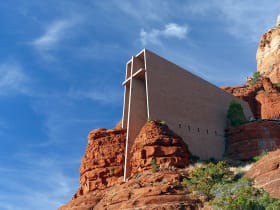
Chapel of the Holy Cross
19 miles away
A modernist chapel built straight into the red rock buttes just south of Sedona, with a ninety-foot cross for a spine and a glass wall framing the Verde Valley.

Fossil Springs
20 miles away
One of Arizona's largest springs pours tens of millions of gallons a day of clear, seventy-degree water from the base of the Mogollon Rim, building turquoise travertine pools and waterfalls in a deser...

Jerome
20 miles away
A former copper boomtown stacked up the side of a mountain, once branded the wickedest town in the West and now an artists' colony full of galleries and ghost stories.

Jerome Grand Hotel
20 miles away
The Jerome Grand Hotel occupies the 1926 United Verde Hospital, built by the Phelps Dodge Corporation on the most prominent point in Jerome at 5,200 feet.