

Fossil Springs
Fossil Springs Trailhead, Forest Rd 708
Pine, AZ
Millions of gallons a day of clear, seventy-degree water pour from the base of the Mogollon Rim, building turquoise travertine pools and waterfalls in a desert wilderness.
Fossil Springs is one of the largest springs in Arizona, and one of the most improbable sights in the state. From the base of the Mogollon Rim, tens of millions of gallons of water pour out of the ground every single day, at a steady seventy degrees, year round. The water is so heavy with dissolved minerals that it builds its own dams and terraces of pale stone called travertine, ponding into pools of an almost unreal turquoise blue in the middle of dry desert country.
It looks like it has always been this way. In fact this creek was nearly dead for almost a hundred years, and its return to life is one of the great restoration stories of the American Southwest. Getting there takes a permit, a long dirt road, and a hard hike, but the reward is a genuine desert oasis, clear water and waterfalls in a canyon that most people never imagine exists in Arizona.
What Travelers Love
- Turquoise, travertine-lined pools and waterfalls in the middle of the desert
- Constant seventy-degree spring-fed water, refreshing in the Arizona heat
- The remarkable comeback story of a creek restored to full natural flow after a century of diversion
- The quiet wilderness feel, with side reaches where you can find your own pool away from the crowd
Worth Knowing
- A permit is required to visit and park during the warm season, reserved in advance online, so no permit means no entry in those months
- It is a strenuous hike, descending to the water and climbing roughly 1,500 feet back out with little shade, so carry plenty of water and start early
- Access is by a long, rough dirt forest road that can close in bad weather, so check road and weather conditions first and a high-clearance vehicle helps
- It is a Wild and Scenic river and wilderness, so pack out everything and protect the fragile travertine and the native fish
Learn about Fossil Springs
A spring that builds its own pools
Fossil Creek is fed by springs that discharge on the order of tens of thousands of gallons a minute, an enormous, unwavering flow of about seventy-degree water rising from deep beneath the Mogollon Rim. What makes it extraordinary is what the water carries. It is loaded with dissolved calcium carbonate, and as it flows and the mineral settles out, it coats everything in a pale stone crust and builds low dams and terraces across the creek.
Those natural dams pond the water into a chain of pools and small waterfalls, and the mineral gives the water its famous milky turquoise color. The mineral crust is what gave the place its name: everything the water touches slowly turns to stone, as if fossilized. Below the falls the pools run deep and cool, and in the heat of an Arizona summer they are a genuine oasis.
The century the creek ran dry, and how it came back
This is the story most visitors never hear. Beginning in 1909, nearly the entire flow of Fossil Creek was captured and diverted through flumes to run the Childs and Irving hydroelectric plants, among the earliest power stations in Arizona. For almost a hundred years the creek bed below the diversion was left largely dry, its famous water sent off to spin turbines instead.
Then in 2005 the utility decommissioned the old plants and returned the full natural flow to the creek. It was the first time a desert stream in the Southwest had been restored to its natural flow, and only the second dam in the entire country taken out for environmental reasons alone. Part of the old diversion dam was removed a few years later, with a piece left in place on purpose to block invasive fish from moving upstream.
The recovery was fast and remarkable. Within a few years the travertine was rebuilding, greenery returned along the banks, and native Arizona fish, once nearly gone, reclaimed the spring-fed reach as a stronghold. In 2009 Congress protected roughly sixteen miles of it as a Wild and Scenic River, one of only two in Arizona. What looks like untouched wilderness is really a landscape brought back from the edge.
The hike down, and the cautions
The classic way in is the Fossil Springs Trail, also called the Bob Bear Trail, and it is not an easy walk. It runs about four miles each way, and the trick is that you hike downhill to the water first and then have to climb roughly 1,500 feet back out at the end, mostly over rocky ground with little shade. In summer heat, that return climb is the real challenge, and it catches unprepared hikers out every year.
So come ready. Carry far more water than you think you need, start early, and know your limits. The water hides hazards too: sudden drop-offs, deep pools, slick travertine, and swirling currents near the falls, with no signs to warn you. It is a wild place, not a maintained swimming park.
And it takes planning to even reach the trailhead. During the warm season a permit is required to park and visit, reserved ahead of time online, and the access is a long, unpaved forest road that can close in bad weather. Do the homework first, and Fossil Springs pays it all back with a turquoise creek few people ever see.
Visiting Fossil Springs
The trailhead sits off a long forest road near the mountain towns of Pine and Strawberry, up at around six thousand feet where the air is cooler than the desert below. Those little towns, along with Payson to the south, are the closest places to fuel up, grab a meal, and sleep, and they make a fine cool-weather base for the whole Mogollon Rim.
Plan a full day, treat the permit and the road conditions as non-negotiable, and respect both the heat and the water. Fossil Springs rewards the effort like few places in Arizona: a clear, blue, spring-fed creek in a protected wilderness, quietly thriving again after nearly a century of running dry.
Closest Boutels
The closest Boutel™ stays, so you can turn this stop into an overnight. Each is a place we chose through independent editorial review, never a paid placement.
Details
Pine, AZ
Frequently asked questions
What is Fossil Springs?
Fossil Springs is a stunning oasis in the Fossil Springs Wilderness of central Arizona, where powerful springs pour out huge volumes of clear, mineral-rich water to form a lush, turquoise-tinged creek amid the desert and forest. Famous for its vivid blue-green pools, waterfalls, and dense greenery, it is a beautiful and popular spot for swimming and soaking in a wild setting. However, reaching it requires a long, strenuous hike, and access is limited by a permit system, so visiting Fossil Springs demands real preparation and planning.
How hard is the hike to Fossil Springs, and do you need a permit?
The hike to Fossil Springs is long and strenuous, typically several miles each way with significant elevation change, and crucially, the climb back out is steep, hot, and exhausting, catching many hikers off guard. Access is limited by a required permit during much of the year to protect the fragile area, so you must obtain a permit in advance for the busy season. Never underestimate this hike: it demands fitness, an early start, and careful planning, and it is far tougher than the beautiful destination suggests.
What safety precautions should I take at Fossil Springs?
This is critical: the strenuous, exposed hike out in intense heat causes frequent rescues and has led to deaths, so carry far more water than you think you need, start very early, avoid hiking in the heat of the day, and turn back if you are struggling. Do not attempt it in the extreme heat of summer midday. Wear sturdy shoes and sun protection, know your limits, and never jump into pools without knowing the depth. Respecting the difficulty and heat, and securing a permit, are essential for a safe visit.
When is the best time to visit Fossil Springs?
Spring and fall offer the safest and most comfortable temperatures for the demanding hike, while summer brings dangerous heat that makes the strenuous climb out hazardous, so summer visits require a very early start and extreme caution, or are best avoided. The water is refreshing year-round, but the difficulty of the hike, not the water, drives the timing. Because permits are required in the busy season, plan and reserve ahead. For a safer, more comfortable trip, choose the cooler shoulder seasons and start at dawn.
What is near Fossil Springs?
Fossil Springs is in the Fossil Springs Wilderness near the central Arizona Rim Country communities of Pine and Strawberry, close to Tonto Natural Bridge State Park, the town of Payson, and the Mogollon Rim with its overlooks and lakes. That makes Fossil Springs a spectacular but demanding natural destination to combine, with proper preparation, with the gentler attractions of the Rim Country, such as Tonto Natural Bridge and the Mogollon Rim's scenic drives, in the cool high country of central Arizona.
Nearby

Arizona Trail at Pine Trailhead
7.6 miles away
Just south of Pine, this trailhead opens onto the 800-mile Arizona National Scenic Trail and the historic 1870s Highline Trail, in cool ponderosa-pine forest beneath the towering Mogollon Rim.
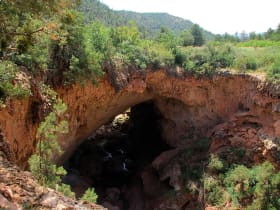
Tonto Natural Bridge State Park
8.7 miles away
Tonto Natural Bridge is a natural arch formed by travertine deposits building up over centuries from a spring.
Mogollon Rim
9.2 miles away
A thousand-foot escarpment marking the southern edge of the Colorado Plateau, running for two hundred miles with cool Ponderosa pine forest on top and the desert falling away below.

Fort Verde State Historic Park
20 miles away
Fort Verde preserves several original 1870s adobe buildings from an Apache Wars era army post, arranged around a parade ground you can cross in a few minutes.
Red Rock Scenic Byway
22 miles away
Red Rock Scenic Byway follows AZ-179 for about seven miles between the Village of Oak Creek and Sedona, threading past some of the most photographed red rock in the Southwest.