
Natural History Museum of Utah
301 Wakara Way, Salt Lake City, UT
Salt Lake City, UT
A copper-clad museum built into the Wasatch foothills, holding one of the great collections of Utah dinosaurs and telling the deep story of a state built on ancient life and rock.
The Natural History Museum of Utah is one of the finest natural history museums in the West, a dramatic copper-clad building set into the Wasatch foothills above Salt Lake City. Its galleries tell the deep story of Utah, from the dinosaurs that once roamed its ancient landscapes to the Native peoples who have lived here for thousands of years and the geology that built the whole region.
Utah is one of the richest places on earth for dinosaur fossils, and the museum's dinosaur hall reflects that, filled with skeletons and skulls unearthed from the state's own rock. But the museum reaches far beyond bones, into minerals, the Great Salt Lake, human history, and the living land, all in a building whose form deliberately echoes the layered rock of the mountains behind it.
What Travelers Love
- A world-class hall of Utah dinosaurs, many found in the state's own fossil-rich rock
- The building itself, a copper-clad structure set into the hillside with sweeping valley views
- Thoughtful galleries on Utah's Native peoples, developed with the tribes themselves
- Rich exhibits on minerals, the Great Salt Lake, and the geology that shaped the region
Worth Knowing
- It sits up in the foothills on the university campus, so plan for the drive and the parking
- The galleries are large and detailed, so allow a good part of a day to see them well
- It can be busy on weekends and school holidays, and quieter on weekday afternoons
- The site connects to trails and Red Butte Garden nearby, easy to combine into one outing
Learn about Natural History Museum of Utah
A building shaped like the land
The museum's home, opened in the early 2010s, was designed to belong to its hillside site. Its exterior is wrapped in panels of copper, a metal mined in Utah, that will weather and change color over the years, and its form steps up the slope in layers meant to echo the bands of sedimentary rock exposed across the state. From its windows and terraces the whole Salt Lake Valley spreads out below.
Inside, the galleries are arranged to lead visitors upward and back through time, so that moving through the building becomes a kind of journey through Utah's past. The design won wide praise for weaving architecture, landscape, and exhibit together, making the building itself part of the story it tells about rock, time, and place.
Utah's dinosaurs
The museum's dinosaur hall is its showpiece, one of the great displays of its kind. Utah's badlands and quarries have yielded an extraordinary trove of fossils, and many of the skeletons and skulls here were dug from the state's own rock, including horned dinosaurs and other species first described from Utah finds. The hall arranges them to show how life changed across the ages of the dinosaurs.
The museum is also a working research institution. Its paleontologists lead field expeditions into Utah's fossil country each season, and the collections behind the scenes hold specimens studied by scientists worldwide. Exhibits pull back the curtain on that work, showing how a jumble of bones in the desert becomes a mounted skeleton and a piece of the scientific record.
The people of Utah
Beyond deep time, the museum tells the human story of Utah. Its galleries on the state's Native peoples were developed in partnership with the tribes themselves, and they present the living cultures of the Ute, Paiute, Goshute, Navajo, and Shoshone nations, as well as the earlier Fremont and Ancestral Puebloan peoples known from the state's archaeology.
Rather than treating Native history as something finished, the exhibits emphasize that these are contemporary peoples with continuing traditions, communities, and ties to the land. Objects, voices, and stories are presented with the involvement and consent of the nations they belong to, making this one of the more thoughtfully collaborative human-history galleries in the region.
Rock, water, and the living land
Other galleries range across the natural world of Utah. A minerals hall glitters with crystals and ores drawn from a state famous for its mining, and exhibits on the Great Salt Lake explore the strange, saline ecosystem that dominates the valley to the west, along with the ancient Lake Bonneville whose shorelines still ring the mountains.
The museum also connects to the outdoors around it. Trails run from its doors into the Wasatch foothills, and Red Butte Garden and Red Butte Canyon lie just beyond, so a visit can move naturally from the exhibits inside to the living landscape they describe. It is a place designed to send visitors back out to look at Utah with new eyes.
Closest Boutels
The closest Boutel™ stays, so you can turn this stop into an overnight. Each is a place we chose through independent editorial review, never a paid placement.
Details
Salt Lake City, UT
Frequently asked questions
What is the Natural History Museum of Utah?
It is a world-class museum housed in the striking Rio Tinto Center, set in the Wasatch foothills on the University of Utah campus in Salt Lake City, with sweeping views over the valley. Renowned especially for its extraordinary dinosaurs, the museum explores Utah's natural history, geology, and native cultures through immersive, hands-on exhibits. The dramatic building itself, tucked into the hillside, is part of the experience, making a visit as much about architecture and views as about the collections.
What are the dinosaur exhibits like at the Natural History Museum of Utah?
The Past Worlds hall is the star, displaying dozens of reconstructed dinosaur skeletons, many discovered in Utah, one of the world's great dinosaur states. Highlights include the fearsome Utahraptor found near Moab, an Allosaurus, Utah's state fossil, a huge Stegosaurus, a remarkable lineup of horned-dinosaur skulls, and an ancestor of the T. rex unearthed in Grand Staircase-Escalante. A visible fossil-prep lab lets you watch real paleontology in action, delighting dinosaur fans of all ages.
How much time do you need, and is it good for families?
Plan on around two to three hours to enjoy the dinosaurs and the museum's other exhibits at a comfortable pace, with families easily filling that or more thanks to the many interactive, hands-on displays. It is an outstanding destination for kids, especially dinosaur lovers, while the depth of the exhibits and the stunning building appeal to adults too. It makes a rewarding outing for a wide range of ages and interests.
When is the best time to visit the Natural History Museum of Utah?
As a fully indoor museum it is a great year-round and rainy-day or cold-weather choice, and weekdays tend to be quieter, with fewer school groups than busy times. Checking current hours and any special exhibitions before you go helps you plan. A nice bonus: the Bonneville Shoreline Trail runs right past the museum, so on a fair day you can add a scenic walk with valley views after your visit.
What is near the Natural History Museum of Utah?
The museum sits on the University of Utah campus in the eastern foothills of Salt Lake City, near Red Butte Garden and the scenic Bonneville Shoreline Trail, and within easy reach of downtown and the mouths of the Cottonwood canyons. That location makes it easy to combine a museum visit with a garden stroll, a foothill hike, or downtown sightseeing for a well-rounded day in Salt Lake City.
Nearby
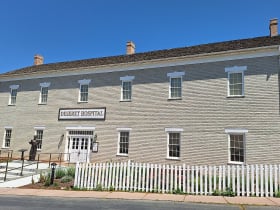
This Is The Place Heritage Park
0.8 miles away
This Is the Place is where Brigham Young reportedly said "This is the right place" upon first seeing the Salt Lake Valley in 1847 after leading 2,000 pioneers west.

Liberty Park
2.8 miles away
Liberty Park covers 80 acres in central Salt Lake City and is the largest urban park in the city. The children's play area is large and well-maintained. A splash pad operates in summer at no charge.

Temple Square
3.5 miles away
Temple Square is the administrative and spiritual center of the Church of Jesus Christ of Latter-day Saints.
Wheeler Historic Farm
9.1 miles away
Wheeler Historic Farm operates as a living history site and working farm on the edge of Salt Lake Valley.
Big Cottonwood Canyon
11 miles away
Big Cottonwood Canyon (UT-190) is the most accessible canyon in the Wasatch Range for Salt Lake residents.

Great Salt Lake State Park
14 miles away
The Great Salt Lake is 7-10x saltier than the ocean, making it impossible to sink. The Saltair area (16 miles west of Salt Lake City) is the nearest accessible swimming beach.
Little Cottonwood Canyon, Alta and Snowbird
15 miles away
Little Cottonwood Canyon narrows to a slot at its base and climbs to 11,000 feet at Alta and Snowbird ski resorts.

Utah Olympic Park
16 miles away
Utah Olympic Park hosted the bobsled, luge, skeleton, ski jumping, and Nordic combined events of the 2002 Salt Lake City Olympics.

Point of the Mountain Viewpoint
16 miles away
Point of the Mountain is the topographic ridge that separates the Salt Lake Valley from Utah Valley to the south.
Great Salt Lake Shoreline Park
16 miles away
The northeast shore of the Great Salt Lake accessible from Salt Lake City. The lake's north arm has an extremely high salinity that turns the water pink from halophilic bacteria.

Park City Historic Main Street
19 miles away
Park City's Main Street is one of the best-preserved Western mining town streetscapes in the West - a continuous line of brick commercial buildings from the 1880s silver boom, now housing independent...