

Harvard Museum of Natural History Glass Flowers
26 Oxford Street
Cambridge, MA
Roughly 4,300 flowers, leaves, and rotting fruit that look freshly picked, every one of them made entirely of glass by a father and son over half a century.
The Glass Flowers are one of those things people struggle to believe until they are standing in front of them. Formally the Ware Collection of Blaschka Glass Models of Plants, the display holds roughly 4,300 models representing more than 780 plant species, and every single one is made of glass. Petals, veined leaves, root hairs, pollen, even fruit spotted with decay: all of it was shaped from glass, and much of it looks so alive that visitors routinely assume they are looking at pressed and painted specimens.
The collection exists because a Harvard botany professor wanted a way to teach plants in three dimensions, in the middle of a New England winter when nothing was in bloom. Pressed flowers flattened and faded, and wax and papier-mache models looked crude. The answer turned out to be two glassworkers in Germany, a father and son, who spent five decades turning that teaching problem into one of the strangest and most beautiful scientific collections in the world.
What Travelers Love
- Leaning in close and realizing that a blossom, stem, and even a bruised petal are all glass
- The sheer patience of a collection built by two people over fifty years
- Enlarged models that open up the hidden parts of a flower for you
- A quiet, jewel-box gallery tucked inside a full natural history museum
Worth Knowing
- The Glass Flowers gallery is one part of the larger Harvard Museum of Natural History, and admission also covers the connected Peabody Museum
- The models are fragile and lit low to protect them, so give your eyes a moment to adjust
- Photography without flash is generally allowed, but tripods and flash are not
- Weekday mornings are the calmest time to have the cases nearly to yourself
Learn about Harvard Museum of Natural History Glass Flowers
The story of the Glass Flowers
The models are the work of Leopold Blaschka and his son Rudolf, glass artisans who worked in Hosterwitz, near Dresden, Germany. The Blaschkas came from a long line of glassworkers and had already earned a reputation making detailed glass models of jellyfish, sea anemones, and other soft-bodied marine invertebrates that were nearly impossible to preserve any other way.
In 1886 George Lincoln Goodale, the first director of Harvard's Botanical Museum, sought them out. He wanted lifelike plant models for teaching, and he convinced the Blaschkas to try. The commission was funded by Elizabeth C. Ware and her daughter Mary Lee Ware in memory of Dr. Charles Eliot Ware, and the collection carries the Ware name to this day.
What began as a trial order grew into a life's work. From 1887 until Rudolf finished in 1936, the Blaschkas made models almost exclusively for Harvard. Leopold died in 1895, and Rudolf carried the work on alone for another four decades. They guarded their methods closely, and after Rudolf's death the exact techniques were not fully documented, which is part of why the collection has never been truly duplicated.
The models were shaped from clear and colored glass, sometimes worked hot at the lamp and sometimes cold, with wire supports inside the stems and, in many cases, careful painting and enamel to capture color. Over the years some of the surface color and glue grew unstable, and Harvard has undertaken long conservation campaigns to clean and stabilize the pieces so they keep looking as fresh as the day they arrived.
What you are actually looking at
The collection is not only whole plants. Alongside the full flowering specimens are greatly enlarged models of flower parts, cross-sections, and the tiny structures of pollination, made big enough to read across a room. That was the teaching point all along: a student could see how a plant is built without waiting for spring.
One of the most talked-about groups is a set of models showing fruit attacked by fungal and other diseases, rot, spots, and shriveled skins rendered in glass. They were made to teach plant pathology, and they are oddly moving, proof that the Blaschkas were interested in the whole truth of a plant and not just its prettiest moment.
Because the models are lit softly and displayed in old wooden cases, the gallery has the hush of a library. The reward comes from getting close. Details that read as ordinary from a step back, a curling tendril, the fuzz on a stem, the translucence of a petal, are what give the game away once you understand they are glass.
Inside the museum around them
The Glass Flowers are the signature draw, but they sit within the Harvard Museum of Natural History, which draws on the university's vast research collections. Nearby galleries hold minerals and sparkling gemstones, meteorites, and one of the great historic collections of taxidermy in the Great Mammal Hall, where whale skeletons hang overhead.
The museum also displays the Blaschkas' earlier subject, glass sea creatures, so you can trace the family's path from marine invertebrates to plants. Fossils include a mounted Kronosaurus, a massive marine reptile from the age of dinosaurs.
One admission connects through to the Peabody Museum of Archaeology and Ethnology next door, which means a single visit can move from glass flowers to gems to human cultures without stepping back outside.
Why it still matters
The Glass Flowers were built as teaching tools, but they have become something larger: a record of craft that no one has been able to repeat, and a bridge between art and science that people find genuinely emotional to stand in front of.
They are also a lesson in patience in a hurried age. Two people, working by hand across fifty years, made an object of study that generations of students, botanists, and ordinary curious visitors have relied on. In a museum full of the products of deep time, the Glass Flowers are a reminder of what deep human attention can make.
Closest Boutels
The closest Boutel™ stays, so you can turn this stop into an overnight. Each is a place we chose through independent editorial review, never a paid placement.
Details
Cambridge, MA
Frequently asked questions
What are the Glass Flowers at Harvard?
The Glass Flowers, formally the Ware Collection of Blaschka Glass Models of Plants, are one of Harvard's most famous treasures, on display at the Harvard Museum of Natural History in Cambridge. This astonishing collection of roughly 4,300 glass models representing hundreds of plant species was handcrafted over five decades by a father-and-son team of Czech glass artists. So lifelike they look freshly picked, and never fading, they are a breathtaking fusion of art and science found nowhere else in the world.
How were the Glass Flowers made?
The Blaschkas created each model entirely from glass, often reinforced internally with wire, shaping the softened glass by hand and sometimes blowing it, then adding color with tinted glass or fine washes fused on by heat. Working from real field specimens, drawings, and detailed notes, they achieved extraordinary botanical accuracy. The result is a collection of flowers, leaves, and even magnified plant parts so precise and vivid that visitors can scarcely believe they are made of glass.
What else can you see at the Harvard Museum of Natural History?
Beyond the Glass Flowers, general admission gives you the whole natural history museum, with its famous collections of dinosaur and other fossils, sparkling minerals and gems, and mounted wildlife from around the globe. It is connected to Harvard's broader museum complex as well. The variety means you can pair the delicate wonder of the Glass Flowers with dinosaurs, meteorites, and animals for a rich, wide-ranging visit.
How much time do you need, and when should I go?
Plan on around one and a half to two hours to enjoy the Glass Flowers and the rest of the natural history galleries at a comfortable pace. As a fully indoor museum it is a great choice in any weather and an ideal rainy-day stop, and weekday mornings tend to be quietest. Checking current hours and admission before you go helps, especially if you are timing a visit around a Cambridge or Harvard Square day.
Who will enjoy the Glass Flowers?
Nature and science lovers, art and craft enthusiasts, gardeners, and families all find the Glass Flowers captivating, since they appeal on so many levels at once, as botanical marvels, as masterful artworks, and as a testament to decades of painstaking skill. Children are wowed that something so realistic is glass, and adults marvel at the artistry. Combined with the museum's dinosaurs and gems, it makes a memorable outing for nearly everyone.
Nearby
Isabella Stewart Gardner Museum
2.9 miles away
Most Boston visitors make it to the Museum of Fine Arts and never walk the extra block to this one, which is a mistake.
Museum of Fine Arts, Boston
2.9 miles away
One of the world's great encyclopedic art museums, with the largest Monet collection outside France, a legendary ancient Egyptian hall, and top American art.

USS Constitution
3.0 miles away
Kids get to climb aboard a real fighting ship more than two centuries old.
Boston Common and Public Garden
3.0 miles away
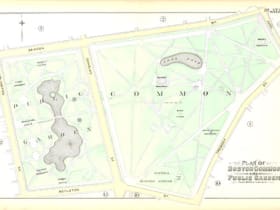
America's oldest public park beside the country's first public botanical garden, with pedal-powered swan boats, seasonal flower beds, and monuments at the heart of Boston.

Minute Man National Historical Park
9.5 miles away
This is where kids can actually stand on the spot the Revolution started.

Adams National Historical Park
10 miles away
Two modest saltbox birthplaces and the graceful Old House at Peace field make up this Quincy site, home to four generations of the Adams family.

Walden Pond
12 miles away
The water is the surprise: Walden is a glacial kettle pond, over a hundred feet deep and startlingly clear, formed when a buried block of ice melted after the last ice age.

World's End
14 miles away
Frederick Law Olmsted laid out the winding, tree-lined carriage roads on this Hingham peninsula in the 1890s for a neighborhood that was never built, leaving a rolling green headland that juts into Bo...

Fuller Craft Museum
19 miles away
Almost nobody outside the field knows Brockton holds New Englands only contemporary craft museum, on a pond in a leafy park.