
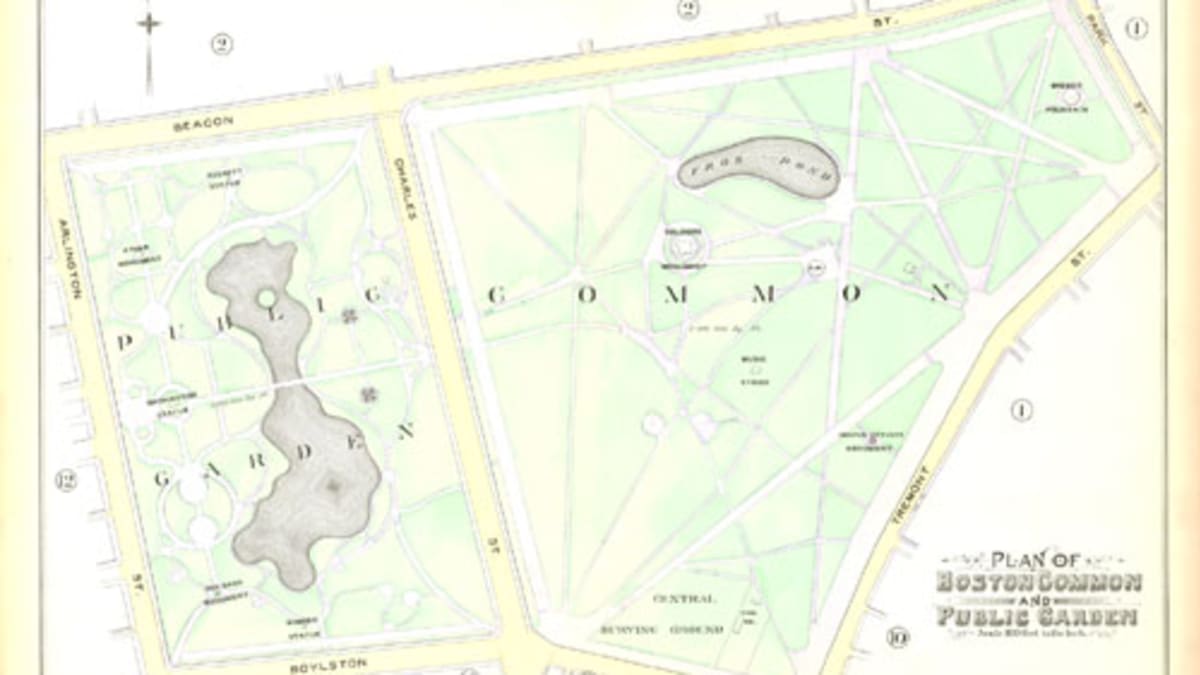
Boston Common and Public Garden
139 Tremont St
Boston, MA
The oldest public park in America right beside the country's first public botanical garden, with swan boats, monuments, and four centuries of history in the middle of Boston.
In the middle of one of America's oldest cities lie two of its most historic green spaces, side by side. Boston Common, founded in 1634, is the oldest public park in the entire country, a rolling stretch of lawns, paths, and monuments that Bostonians have shared for nearly four centuries. Just across Charles Street is the Public Garden, established in 1837 as the first public botanical garden in the United States, all formal flower beds, winding paths, and the famous lagoon.
Together they make a single green heart for the city, and a single walk through American history. The Common began as common land for grazing cattle and drilling militia and went on to see British redcoats camp on it, abolitionists and suffragists rally on it, and generations of Bostonians gather on it. The Garden answered it a couple of centuries later with beauty rather than utility, giving the same city a place of tulips, roses, and swan boats. Standing here, you are standing at the origin point of the whole historic city.
What Travelers Love
- Walking the oldest public park in America, in continuous use since 1634
- The famous pedal-powered Swan Boats gliding on the Public Garden lagoon in warm months
- The bright seasonal flower beds and grand old shade trees of the country's first botanical garden
- Standing where the Freedom Trail begins, surrounded by monuments and centuries of Boston history
Worth Knowing
- The two parks are separated by Charles Street but connect easily, so plan to stroll both together
- The Swan Boats and the flower displays are seasonal, at their best from spring into early fall
- It is right on the subway at Park Street, so it is far easier to reach by transit than to park nearby
- These are busy, beloved city parks, so expect crowds on fine days and keep an eye on belongings
Learn about Boston Common and Public Garden
The oldest park in America
Boston Common dates to 1634, when the young Puritan town set aside this ground as shared common land, and it was formally designated public in 1640, purchased by the townspeople for a modest sum. From the start it was practical space: a place to graze cattle and to muster and drill the local militia, a commons in the old English sense that gives it its name.
Over the centuries the Common became the stage for Boston's public life. British troops camped here before the Revolution, and later it hosted everything from public celebrations and protests to speeches by figures at the center of the abolition and civil rights movements. Today it is a working city park, fifty acres of lawns and trees threaded with paths, monuments, and a frog pond that becomes a skating rink in winter, and it is where the redbrick Freedom Trail begins its route through historic Boston.
The Public Garden and the Swan Boats
The Public Garden, laid out beginning in 1837 on former tidal marshland, was something new: America's first public botanical garden, meant purely for beauty and public enjoyment. In place of the Common's open lawns it offers formal design, with meandering paths, a small lagoon crossed by a graceful suspension footbridge, and lavish seasonal plantings of tulips, roses, and beds of color that change through the year beneath a dense canopy of trees.
Its most beloved feature glides across the lagoon: the Swan Boats, pedal-powered pleasure boats shaped like great white swans that have carried passengers since 1877 and been run by the same family for well over a century. Nearby, a much-loved bronze sculpture of a mother duck and her ducklings delights children, a nod to a classic Boston picture book. Between the flowers, the water, and the swans, the Garden is one of the most photographed spots in the city.
Visiting the Common and the Garden
The two parks sit right at the center of Boston and are separated only by Charles Street, so the natural way to see them is to wander both together, crossing from the Common's open lawns into the Garden's flower beds and back. The Park Street subway station opens right onto the Common, which makes public transit by far the easiest way to arrive, since parking downtown is scarce and costly.
Come in the warmer months if you can, when the flower beds are in full color and the Swan Boats are running, though the parks are lovely in every season and the frog pond draws skaters in winter. These are much-loved, well-used city spaces, so expect company on a sunny day and keep an eye on your belongings in the crowds. With the Freedom Trail starting here, they make the perfect first stop for a day of exploring historic Boston on foot.
Closest Boutels
The closest Boutel™ stays, so you can turn this stop into an overnight. Each is a place we chose through independent editorial review, never a paid placement.
AWOL Provincetown
Honorable Mention59 Province Lands Road, Provincetown, MA
49 miles away|Learn More ›
Details
Boston, MA
Frequently asked questions
What are Boston Common and the Public Garden?
Boston Common, established in 1634, is the oldest public park in the United States, and the adjoining Public Garden is America's first public botanical garden. Together they form the beloved green heart of downtown Boston, blending open lawns and historic monuments on the Common with the formal flower beds, lagoon, and winding paths of the Garden. Free and central, they are a lovely place to stroll, relax, and connect with the city's history, and they mark the start of the Freedom Trail.
Can you ride the Swan Boats in the Public Garden?
Yes, the iconic Swan Boats are a cherished Boston tradition, gliding gently around the Public Garden's lagoon on a leisurely ride that has delighted visitors for generations. They operate seasonally, generally from spring into early fall, so check current dates if a ride is a must. Nearby, the adorable Make Way for Ducklings bronze statues, inspired by the classic children's book, are a favorite photo stop for families with young children.
What is there to do at Boston Common and the Public Garden?
You can stroll the Public Garden's beautiful seasonal flower displays and paths, ride the Swan Boats, visit the duckling statues and the equestrian statue of George Washington, and picnic or people-watch on the Common's lawns. The Common's Frog Pond offers ice skating in winter and a splash area in summer. As the starting point of the Freedom Trail, the Common is also the launch pad for exploring Boston's Revolutionary history.
When is the best time to visit Boston Common and the Public Garden?
Spring through fall is loveliest, when the Public Garden's flowers are in bloom and the Swan Boats are running, with spring tulips and summer greenery especially beautiful. Winter has its own charm, with skating on the Frog Pond and holiday lights. The parks are free and open year-round, so they are easy to enjoy in any season as part of a day exploring downtown Boston.
What is near Boston Common and the Public Garden?
The parks sit at the center of historic Boston, bordered by the charming brick streets of Beacon Hill, the gold-domed Massachusetts State House, and the shops of Newbury Street and Back Bay. The Freedom Trail begins right on the Common, linking to landmarks like the Old State House and Faneuil Hall. That central location makes the Common and Public Garden a perfect starting point for exploring the city on foot.
Nearby

USS Constitution
1.4 miles away
Kids get to climb aboard a real fighting ship more than two centuries old.
Museum of Fine Arts, Boston
1.8 miles away
One of the world's great encyclopedic art museums, with the largest Monet collection outside France, a legendary ancient Egyptian hall, and top American art.
Isabella Stewart Gardner Museum
2.0 miles away
Most Boston visitors make it to the Museum of Fine Arts and never walk the extra block to this one, which is a mistake.
Harvard Museum of Natural History Glass Flowers
3.0 miles away
People walk right past this in Cambridge, but it is one of a kind on earth.

Adams National Historical Park
7.4 miles away
Two modest saltbox birthplaces and the graceful Old House at Peace field make up this Quincy site, home to four generations of the Adams family.

World's End
12 miles away
Frederick Law Olmsted laid out the winding, tree-lined carriage roads on this Hingham peninsula in the 1890s for a neighborhood that was never built, leaving a rolling green headland that juts into Bo...

Minute Man National Historical Park
13 miles away
This is where kids can actually stand on the spot the Revolution started.

Walden Pond
15 miles away
The water is the surprise: Walden is a glacial kettle pond, over a hundred feet deep and startlingly clear, formed when a buried block of ice melted after the last ice age.

Fuller Craft Museum
17 miles away
Almost nobody outside the field knows Brockton holds New Englands only contemporary craft museum, on a pond in a leafy park.