
World Kite Museum
303 Sid Snyder Dr SW
Long Beach, WA
A whole museum devoted to kites, from silk fighting kites to giant Japanese banners, steps from the hard-packed sand of the country's unofficial kite capital.
The World Kite Museum is one of those small, single-minded places that turns out to be a delight. It is devoted entirely to kites, holding a collection of more than a thousand from dozens of countries: military and scientific kites, whirling fighter kites from India, enormous painted banners from Japan, delicate paper kites from China, and modern sport kites that carve the sky in teams. It bills itself as the only museum of its kind in the country.
It could not sit in a more fitting place. Long Beach, with its miles of hard, flat sand and steady ocean wind, is one of the great kite-flying spots in North America, and the museum grew directly out of that culture. Step outside its doors and you are a short walk from the beach where those kites take to the air.
What Travelers Love
- Galleries of more than a thousand kites from dozens of countries
- Delicate hand-painted silk and paper kites from Japan, China, and across Asia
- The Kite Hall of Fame honoring the sport's great makers and fliers
- Being able to walk straight out to one of the best kite-flying beaches anywhere
Worth Knowing
- It is a compact, focused museum, so it pairs well with a walk on the beach rather than filling a whole day
- The Washington State International Kite Festival each August is the peninsula's biggest event, and the town fills up
- Long Beach weather is often breezy, foggy, and cool, which is exactly why the kites fly so well; dress warm
- Exhibits rotate, so the kites on display change from visit to visit
Learn about World Kite Museum
How the museum began
The story starts with a festival. The Washington State International Kite Festival began in 1982, a small weekend gathering that grew year after year into one of the largest events on the Washington coast, drawing kite makers and fliers from around the world to the peninsula's endless beach. As the festival grew, so did the idea of a permanent home for kite history and art.
The museum's first exhibit, a display on the history of kites in Washington, appeared during the 1989 festival, crammed into the Long Beach city council chambers, and it was a hit. The following year, in 1990, the World Kite Museum opened as a permanent institution in a converted beach cottage, with a founding collection of hundreds of kites. In 2005 it moved into its current, larger home near the beach approach.
Kites from around the world
Inside, the collection spans centuries and continents. There are the fierce, nimble fighter kites of South Asia, flown on abrasive line in contests to cut a rival from the sky, and the towering rokkaku battle kites of Japan. There are exquisitely painted silk and paper kites, some genuine works of folk art, alongside kites that once carried scientific instruments or served in war.
The museum also keeps a Kite Hall of Fame, honoring the designers, artists, and fliers who shaped the craft, and it rotates its exhibits so that regular visitors keep finding something new. For children, the appeal is immediate; for adults, the surprise is how much history and artistry hangs in the air of a single gallery.
The kite capital by the sea
Long Beach earns its reputation as a kite town honestly. The peninsula offers a long, wide, firm beach and the reliable onshore wind that kite fliers dream of, conditions so good that the beach becomes a canvas of color whenever the weather cooperates. During the August festival, the sky over the sand fills with everything from tiny handheld kites to inflatable creatures the size of a house.
The setting is classic southwest Washington coast: often gray, breezy, and cool, with the surf rolling in and the wind never quite still. That weather can feel raw, but it is the whole point here, the engine that lifts the kites, and the reason a museum devoted to them makes perfect sense in this particular town.
The art and science of the kite
Part of what the museum quietly makes clear is that a kite is far more than a toy. Its collection traces kites used to carry scientific instruments aloft, to lift observers and cameras, and even to serve in wartime, alongside the fighting kites and festival banners that are pure spectacle. The result is a small course in how a simple idea, a wing on a string, has been bent to a hundred purposes across cultures and centuries.
There is real artistry on display, too. Many of the Asian kites in particular are hand-painted works, their silk and paper surfaces carrying dragons, warriors, and birds rendered with the care of a scroll painting. Between the engineering and the artistry, visitors of every age tend to leave with a new respect for the humble kite, and often an itch to go fly one on the beach outside.
Closest Boutels
The closest Boutel™ stays, so you can turn this stop into an overnight. Each is a place we chose through independent editorial review, never a paid placement.
Details
Long Beach, WA
Frequently asked questions
What is the World Kite Museum?
The World Kite Museum, in the town of Long Beach on the Long Beach Peninsula in southwestern Washington, is a delightful and unique museum dedicated to the history, art, and culture of kites from around the world. Fittingly located in Long Beach, famous for its kite-flying beach and its major kite festival, the museum displays a colorful collection of kites, including historic, artistic, and international examples, along with exhibits on kite history, science, and the role of kites in various cultures. Fun and family-friendly, the World Kite Museum celebrates the joy and heritage of kites, offering a charming and educational stop on the kite-loving Long Beach Peninsula in Washington.
What can you see at the World Kite Museum?
You can see a colorful and diverse collection of kites from around the world, including historic kites, beautiful artistic and decorative kites, giant and unusual kites, and examples reflecting kite traditions from various cultures, along with exhibits on the history, science, and cultural significance of kites, from ancient origins to their use in war, science, and recreation. The vibrant displays are engaging and fun. It celebrates the area's strong kite-flying tradition. With its worldwide kite collection and exhibits on kite history and culture, the World Kite Museum offers a charming, colorful, and educational outing for families on the Long Beach Peninsula, Washington.
Is the World Kite Museum good for families?
Yes, the World Kite Museum is a wonderful family destination, with colorful, engaging displays of kites that delight children and adults alike, exhibits that make learning about kite history and science fun, and a natural connection to the joy of flying kites on the nearby Long Beach shoreline, one of the best kite-flying beaches around. The manageable size makes it easy to enjoy with kids, and it inspires families to fly kites afterward. With its colorful, kid-friendly displays and celebration of kites, the World Kite Museum offers a delightful and educational family stop in Long Beach, Washington.
When is the best time to visit the World Kite Museum?
As an indoor museum, the World Kite Museum is enjoyable year-round and a great option in any weather, including a perfect choice on a rainy or windy coastal day. Visiting during the famous Washington State International Kite Festival, typically held in Long Beach in summer, adds extra fun, letting you see the museum and watch spectacular kite flying on the beach. Checking current hours before you go is wise. For the fullest kite experience, time a visit to the summer kite festival, while the museum makes an enjoyable stop any time of year in Long Beach.
What is near the World Kite Museum?
The World Kite Museum is in the town of Long Beach on the Long Beach Peninsula in southwestern Washington, near the famous Long Beach shoreline, the boardwalk, the historic village of Oysterville, Willapa Bay, and within reach of Cape Disappointment State Park and Astoria, Oregon. That makes the World Kite Museum a fun family stop to combine with the Long Beach shoreline, Oysterville, Cape Disappointment, and the other attractions of the Long Beach Peninsula on a visit to Washington.
Nearby

Long Beach Pacific Shoreline
1.0 miles away
A wide, hard-packed strand billed as the longest continuous beach on a peninsula anywhere, running some 28 miles up Washington's southwest coast.

Cape Disappointment State Park
5.3 miles away
Cape Disappointment is where the Columbia River collides with the Pacific at the foot of the Long Beach Peninsula, a place of fog, wind, and enormous history.
South Jetty of the Columbia River
7.9 miles away
Drive to the end of Clatsop Spit in Fort Stevens State Park, near Hammond west of Astoria, to reach the South Jetty, where the mighty Columbia River pours into the Pacific across the Graveyard of the...
Fort Stevens State Park
11 miles away
At the wild northwest tip of Oregon where the Columbia River meets the Pacific, Fort Stevens stacks a Civil War through World War II coastal fort, the rusted beach wreck of the Peter Iredale, and warm...

Willapa National Wildlife Refuge
13 miles away
Willapa National Wildlife Refuge protects the tidal mudflats, salt marshes, and upland forests of Willapa Bay, one of the cleanest estuaries in the Pacific Northwest.
Oysterville
13 miles away
Oysterville was established in 1854 when Robert Espy and I.A. Clark discovered vast beds of native Olympia oysters in Willapa Bay.
The Goonies House
17 miles away
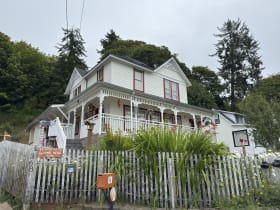
The hillside Victorian in Astoria that played Mikey's house in the 1985 movie The Goonies still stands above the Columbia River, at the top of its long gravel drive in the oldest town in the Pacific N...

Willapa Bay
20 miles away
Willapa Bay is the estuary between Long Beach Peninsula and the Washington coast and is one of the least developed large estuaries on the Pacific Coast.