
Willapa Bay
US-101 along Willapa Bay
South Bend, WA
A vast, tide-swept estuary sheltered behind the Long Beach Peninsula, so clean and productive that it grows a large share of the nation's oysters and draws birds by the tens of thousands.
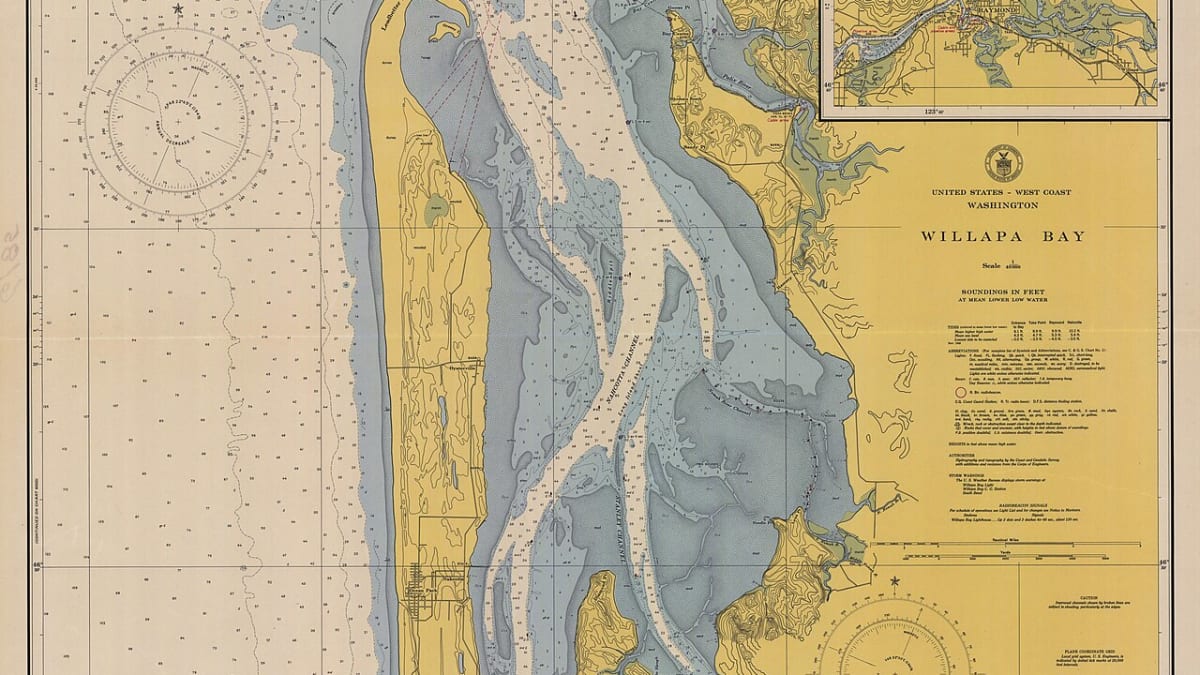
Willapa Bay is one of the quiet giants of the Washington coast. Sheltered behind the long sandbar of the Long Beach Peninsula, it is the second largest estuary on the Pacific coast of the United States, spreading across more than 260 square miles of water, mudflat, marsh, and eelgrass meadow. It is also, by wide agreement, one of the cleanest and least developed estuaries of its size left in the country, fed by clear rivers off a lightly settled watershed.
That cleanliness is not just scenery. It is the reason Willapa Bay is one of the great oyster grounds of North America, and the reason it teems with life. Twice a day the tide floods in from the ocean and drains back out, and each turn of the water sets a huge, patient engine of mud, shellfish, salmon, and birds back into motion.
What Travelers Love
- Watching the enormous tides pour in and out across miles of mudflat and eelgrass
- Fresh oysters, raised in the bay and served just up the road from where they grow
- Huge flocks of shorebirds and waterfowl stopping over on the Pacific Flyway
- The quiet, unhurried feel of the working oyster towns around the bay
Worth Knowing
- The bay's mood changes completely with the tide; check a tide table, because low tide reveals vast flats and high tide fills them
- Much of the productive tideland is privately farmed for oysters, so look for public access points and refuge trails rather than wandering the flats
- This is a wet, misty corner of the coast most of the year, so come dressed for it
- The mudflats are soft and the channels deep and fast; do not wade out onto the flats without local knowledge
Learn about Willapa Bay
An oyster capital
People and oysters have been bound together on this bay for a very long time. The native Olympia oyster grew here in beds so rich that they drew settlers early, and the little town of Oysterville, on the peninsula side of the bay, was founded in 1852 as the center of a booming trade that shipped shellfish as far as San Francisco. Overharvesting eventually exhausted the native beds.
In the 1920s growers introduced the larger Pacific oyster, which took to Willapa Bay so well that it now spawns and settles naturally on its own. Today the bay produces a large share of the oysters grown in the United States, farmed on tideland leases and sorted in weathered plants along the shore. To eat an oyster in one of the bay towns is to taste the water itself.
A crossroads for birds
Willapa Bay sits squarely on the Pacific Flyway, the great north-south highway of migrating birds, and its miles of exposed mudflat are one of the richest feeding stops along it. In spring and fall the flats fill with shorebirds, dunlin, sandpipers, plovers, and dowitchers probing the mud, sometimes rising all at once in shimmering clouds.
Through the colder months the bay hosts huge numbers of ducks, geese, and swans, and its edges shelter herons, eagles, and the occasional peregrine falcon hunting the flocks. For anyone who loves birds, a rising or falling tide here is a spectacle, the whole bay alive with wings.
Reading the tides
More than almost any other place on the coast, Willapa Bay rewards paying attention to the tide. At low water the bay pulls back to reveal a glistening world of mudflats and channels, oyster ground and eelgrass, stranded and shining. A few hours later the same view is a broad sheet of water lapping at the grass, with only the channel markers to hint at what lies beneath.
The safest and most rewarding way to experience it is from the edges, at public accesses, boat launches, and the trails of the nearby national wildlife refuge, with a tide table in hand. The flats themselves are soft and cut by deep, fast channels, and they are best admired rather than walked.
A working shore
For all its wildness, Willapa Bay is a working place, and its human life is as much a part of the draw as its birds. The towns around the bay, South Bend and Bay Center and the peninsula villages, run on oysters and fishing, and their weathered plants, tide-stranded boats, and shell-paved lots give the shore an honest, unpolished character.
That working culture reaches back generations, to the native Olympia oyster beds that first drew settlers and the schooners that once carried shellfish south to San Francisco. To buy oysters at a shop beside the water, or eat them at a bayside table, is to take part in a trade that has shaped this quiet corner of Washington for well over a century.
Closest Boutels
The closest Boutel™ stays, so you can turn this stop into an overnight. Each is a place we chose through independent editorial review, never a paid placement.
Details
South Bend, WA
Frequently asked questions
What is Willapa Bay?
Willapa Bay, on the southwestern Washington coast, is a large, pristine estuary renowned as one of the cleanest estuaries in the country and a major producer of oysters, with its rich tidal waters supporting extensive oyster farming. The bay is also a haven for wildlife, especially birds, with vast mudflats and marshes drawing huge numbers of migratory shorebirds and waterfowl, protected in part by the Willapa National Wildlife Refuge. Sheltered behind the Long Beach Peninsula, Willapa Bay offers beautiful, tranquil scenery, excellent birdwatching, fresh oysters, and a glimpse of a healthy coastal ecosystem. With its estuary, oysters, and wildlife, Willapa Bay is a scenic and ecologically rich destination in southwestern Washington.
What can you do at Willapa Bay?
You can watch for abundant birds, especially the huge flocks of migratory shorebirds and waterfowl that the estuary attracts, explore the Willapa National Wildlife Refuge with its trails and wildlife, savor the fresh local oysters for which the bay is famous, kayak or boat on the tranquil waters, enjoy the beautiful estuary scenery, and combine a visit with the nearby Long Beach Peninsula. Birdwatching and oysters are highlights. With its exceptional birdwatching, fresh oysters, wildlife refuge, and peaceful estuary scenery, Willapa Bay offers a scenic and ecologically rich outdoor experience on the southwestern Washington coast.
Why is Willapa Bay known for oysters?
Willapa Bay is famous for oysters because its exceptionally clean, nutrient-rich tidal waters and extensive intertidal areas create ideal conditions for growing them, making the bay one of the largest and most productive oyster-farming regions in the country. Oysters have been harvested here for well over a century, and the bay produces a significant portion of the oysters grown in the United States. Visitors can enjoy the fresh local oysters at area establishments and see the oyster farms in the bay. This thriving, long-standing oyster industry, supported by the pristine estuary, is a defining feature of Willapa Bay.
When is the best time to visit Willapa Bay?
Fall through spring is excellent for birdwatching, when huge numbers of migratory shorebirds and wintering waterfowl gather in the estuary, with the spring and fall migrations especially spectacular, while spring and fall also offer pleasant weather, and summer is mild and pleasant for exploring and enjoying oysters. Low tide reveals the mudflats where shorebirds feed. Fresh oysters are enjoyed year-round. For the most abundant birdlife, aim for the migration seasons of fall through spring, while the oysters and scenery make Willapa Bay rewarding year-round on the southwestern Washington coast.
What is near Willapa Bay?
Willapa Bay is on the southwestern Washington coast, sheltered behind the Long Beach Peninsula with its long ocean beaches and towns like Long Beach and Oysterville, near the Willapa National Wildlife Refuge, and within reach of the Columbia River mouth, Cape Disappointment, and the Astoria area in Oregon. That makes Willapa Bay a scenic and ecologically rich stop to combine with the Long Beach Peninsula, the Willapa refuge, and the other attractions of the southwestern Washington coast on a visit to the state.
Nearby
Oysterville
7.3 miles away
Oysterville was established in 1854 when Robert Espy and I.A. Clark discovered vast beds of native Olympia oysters in Willapa Bay.

Willapa National Wildlife Refuge
9.5 miles away
Willapa National Wildlife Refuge protects the tidal mudflats, salt marshes, and upland forests of Willapa Bay, one of the cleanest estuaries in the Pacific Northwest.
Twin Harbors State Park
17 miles away
A wide, wind-scoured Pacific beach reached through tunnels of planted shore pine and grass-topped dunes, a few miles south of Westport on State Route 105.
Twin Harbors Beach State Park
17 miles away
Washington's first ocean state park, on the spit just south of Westport off State Route 105.

Long Beach Pacific Shoreline
19 miles away
A wide, hard-packed strand billed as the longest continuous beach on a peninsula anywhere, running some 28 miles up Washington's southwest coast.
Grays Harbor Lighthouse
19 miles away
Washington's tallest lighthouse, a graceful 107-foot octagonal tower first lit in 1898 and still holding its original French Fresnel lens.
Westhaven State Park
19 miles away
Washington's best-known surf beach sits at the ocean end of the Westport peninsula, tucked against the great stone jetty where the open Pacific curls into sheltered Half Moon Bay.

Westport Light State Park
20 miles away
Westport Light State Park is at the west edge of Westport, a short drive from the harbor and marina.
World Kite Museum
20 miles away
The World Kite Museum in Long Beach has a collection of more than 1,500 kites from 33 countries, displayed in changing exhibits covering military kites, fighter kites, Japanese rokkaku competition kit...