
Whale Watching Center
119 SW Hwy 101
Depoe Bay, OR
Big windows, free binoculars, and a volunteer who will point you right at a whale, on the seawall in the whale-watching capital of the Oregon coast.
The Whale Watching Center is one of the friendliest introductions to the ocean anywhere on the Oregon coast, and it costs nothing to walk in. Run by Oregon State Parks, it sits right on the seawall in the heart of Depoe Bay, a two-story building with tall windows facing straight out to sea. Inside you will find exhibits about gray whales and, most days in season, a trained volunteer with a pair of binoculars who will help you spot a spout and explain what the whale is up to.
What makes this stretch of coast special is that you do not always have to catch a passing migration. A group of about two hundred gray whales has given up the long trip to Alaska and instead spends much of the year feeding on the reefs just offshore, close enough to watch from the seawall. The center is the hub of Oregon's long-running volunteer whale-watching program, and it turns a lucky glimpse into something you can reliably come and find.
What Travelers Love
- It is completely free, run by Oregon State Parks, with no ticket and no tour to book
- Trained volunteers stand ready with binoculars and will help you find a whale and read what it is doing
- Tall picture windows look straight out over the water, so you can watch in comfort out of the wind and rain
- A resident group of gray whales feeds just offshore for much of the year, so your odds are good outside of deep winter
Worth Knowing
- The center sits right on the seawall along US 101 in the middle of town, with public parking nearby that fills up on sunny weekends
- The best whale-watching happens during the two migration weeks each winter and spring, and again through the summer and early fall when the resident whales are feeding
- Bring a jacket even on a clear day, since the wind coming off the water on the exposed seawall can be sharp
- Whales are wild animals, so some visits bring many spouts and some bring few, and a calm morning with flat water makes them far easier to see
Learn about Whale Watching Center
From roadside restroom to whale-watching hub
The spot has drawn people to the edge of the sea for a long time. A wayside pullout was set aside along the young Oregon Coast Highway back in 1930, when travelers first began stopping here to look at the water, and the little building on the site was originally built in the 1950s as a restroom for the popular overlook. For decades it was simply the place you stopped to stretch your legs and watch the waves crash against the seawall.
In the mid-2000s the building was reborn as the Whale Watching Center, and Oregon State Parks later took it over from the city so it could be run as a permanent public facility. Today it anchors the state's whale-watching program and is staffed by volunteers, so a stop that was once just a roadside restroom has become one of the best free nature experiences on the whole coast.
The whales that never left
Most gray whales spend their lives on an epic commute, wintering in the warm lagoons of Baja Mexico and summering in the cold, rich waters off Alaska, passing Oregon twice a year. But a smaller group, roughly two hundred animals, has broken the pattern. Instead of pushing all the way north, they stop and feed along the Oregon coast from spring through fall, working the shallow reefs and kelp beds for tiny shrimp-like creatures.
Depoe Bay sits right in the middle of that feeding zone, which is why the town calls itself the whale-watching capital of the Oregon coast. From the seawall you may see a whale surface again and again in the same cove, blowing a misty spout, rolling, or lifting its tail before a dive. Because these resident whales linger rather than hurrying past, a visitor has a real chance of watching the same whale for many minutes, something that is hard to do almost anywhere else.
When to come and what you will see
There are three good windows for a visit. In late December the whales stream south toward Mexico, and in late March they head back north, and during both of those weeks Oregon runs its Whale Watching Spoken Here program, when trained volunteers set up at overlooks up and down the coast, including here. Then, from about late spring into early fall, the resident whales settle in to feed just offshore, which many visitors find is the most reliable time of all.
Inside the center, look for the exhibits that explain what different surfacing behaviors mean, from a simple breath to a full tail-up dive, so you can read the water like the volunteers do. Then step to the windows or out to the seawall, take a turn with the binoculars, and scan for the tell-tale puff of a spout hanging over the swell. The volunteers do this all day and love nothing more than getting a first-timer onto their first whale.
Visiting the Whale Watching Center
The center stands right on US 101 in the middle of Depoe Bay, built into the seawall above the harbor, so it is impossible to miss as you drive through town. Public parking sits close by, though it fills quickly on sunny weekends, and the seawall walkway runs the length of the waterfront for a longer stroll along the sea. Entry is free.
Give yourself time to do it right. Read a few of the exhibits, ask a volunteer where the whales have been showing that morning, then settle in at the windows or along the wall and simply watch. Pair it with the short walk out to see the tiny harbor channel and the boats squeezing through the gap in the rock, and you have one of the most rewarding no-cost stops on the entire Oregon coast, whales willing.
Closest Boutels
The closest Boutel™ stays, so you can turn this stop into an overnight. Each is a place we chose through independent editorial review, never a paid placement.
Details
Depoe Bay, OR
Frequently asked questions
What is the Whale Watching Center in Depoe Bay?
It is a state-run center perched on the seawall in Depoe Bay, often called the whale watching capital of the Oregon coast, with a viewing deck, big ocean-facing windows, exhibits about whales, and binoculars for visitors. Friendly staff and volunteers help you spot whales and read their behavior, and a board tracks recent sightings. It is a free, welcoming place to learn about and look for whales right from shore.
When is the best time to see whales at Depoe Bay?
You have a good chance much of the year. A group of resident gray whales feeds close to shore through summer and fall, roughly July into mid-November with peak viewing from late summer into October, when the whales are nearest and easiest to watch. Big migrations also pass by in winter, around December and January, and again in spring, so Depoe Bay offers whale watching across most of the calendar.
What kinds of whales might I see?
Gray whales are by far the most common, and thousands stream past during the migrations while the resident group lingers to feed in summer and fall. On lucky days people also spot humpback whales, orcas, dolphins, and porpoises offshore. Watch for the telltale spout of mist, then the dark back or tail, and check the center's sightings board to see what has been passing recently.
What tips help for whale watching at the center?
Pick a calmer, clearer day when the sea is less choppy and spouts are easier to see, and give yourself time, since patience pays off. Bring binoculars, though some are available to borrow, and scan slowly across the water for blows. Staff can point you to what to look for. You can also watch from the seawall or take a boat tour from the harbor for a closer view.
What should I know before visiting the Whale Watching Center?
It is a small state facility, and its open days and hours can vary by season, with occasional closures for maintenance or improvements, so it is worth checking its current status before making a special trip. The seawall and outdoor viewing areas around Depoe Bay are accessible anytime for whale watching regardless. Dress warmly, since the exposed coast is often cool and windy.
Nearby
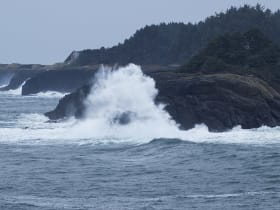
Rocky Creek State Scenic Viewpoint
1.9 miles away
A quiet forested clifftop above Whale Cove on the central Oregon Coast, one of the best low-key spots to watch gray whales pass, including a group that feeds here through summer.

Devil's Punchbowl State Natural Area
4.3 miles away
A collapsed sea cave at Otter Rock, off the Otter Crest Loop about five miles south of Depoe Bay, where the surf rushes in and churns a giant bowl of rock to foam at high tide.
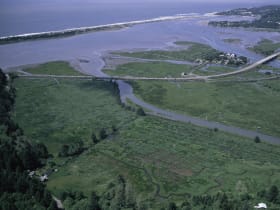
Siletz Bay National Wildlife Refuge
6.9 miles away
A restored coastal salt marsh and estuary at the south end of Lincoln City, where a diked dairy pasture was let back to the tide.
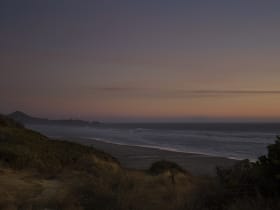
Moolack Beach
7.4 miles away
A long, wild, uncrowded beach north of Newport famous for agates, fossils, and ancient petrified wood exposed in dark low-tide bedrock, with the Yaquina Head lighthouse to the south.

Yaquina Head Outstanding Natural Area, Newport
9.2 miles away
The tide pools here are the payoff. On most of the Oregon coast you hunt for a decent pool; at Cobble Beach they are laid out in tiers right below the lighthouse, close enough that a family can be cro...
Agate Beach State Recreation Site
9.8 miles away
A broad, open sweep of sand at the north edge of Newport, running up to the dark basalt of Yaquina Head and its lighthouse.
Devil's Lake State Recreation Area
12 miles away
A large, sheltered freshwater lake right in the middle of Lincoln City, just off US 101 and a short walk from the beach, calm for paddling when the ocean is rough.
Mo's Original, Newport
12 miles away
Mo's is the Oregon coast's most famous chowder house: a 1946 original on Newport's working Bayfront with the same recipe for 80 years.

Hatfield Marine Science Center, Newport
13 miles away
Hatfield's touch tanks let kids handle sea stars, urchins, and small invertebrates under staff supervision - great for a rainy Oregon coast day.
Road's End State Recreation Area, Lincoln City
13 miles away
Road's End is the locals' beach in Lincoln City: no amenities, no services, just a rocky headland and a wide sand beach that's usually half-empty even in summer.

Oregon Coast Aquarium
13 miles away
One of the nation's top-ranked aquariums, on Yaquina Bay in Newport and once the home of Keiko from Free Willy.
Cascade Head: Coastal Prairie and Salmon Estuary
19 miles away
Cascade Head's coastal prairie hosts the rare Oregon silverspot butterfly, which depends on early blue violet plants found only in this type of native grassland.