

Yaquina Head
Newport
Yaquina Head is a mile-long finger of black basalt reaching into the Pacific just north of Newport, and it is one of the great wildlife-watching perches on the whole Oregon Coast. At its tip stands the tallest lighthouse in the state, a 93-foot white tower first lit in 1873, and just offshore rise the rocks where tens of thousands of seabirds nest each summer.
Come for the lighthouse and stay for everything around it: a black cobble beach that clatters in the surf, tidepools full of sea stars and anemones, harbor seals hauled out on the rocks, and gray whales passing close to shore. It is the kind of place where you can stand in one spot and watch the whole coast at work.
Learn about Yaquina Head
The story of Yaquina Head
The headland is named for the Yaquina people, a tribe of the Yakonan family who lived along Yaquina Bay just to the south before the reservation era. Their name endures all across this stretch of coast, on the bay, the head, and the lighthouse.
The Yaquina Head Lighthouse was first lit on the evening of August 20, 1873, when keeper Fayette Crosby climbed the 114 steps and set flame to a wick fed by lard oil. At 93 feet it is the tallest lighthouse in Oregon. Its beam shines through a first-order Fresnel lens made in Paris in 1868 and shipped halfway around the world, and the tower itself was raised from something like 370,000 bricks, its base walls more than five feet thick. Keepers tended the light by hand until it was automated in 1966.
There is a long-told story that the lighthouse was meant for Cape Foulweather, a few miles up the coast, and that the building materials were landed at the wrong headland by mistake. The tidier truth is that the light was originally designated the Cape Foulweather light before it took the name of the head it actually stands on. Either way, it remains a favorite piece of local lore.
For decades a basalt quarry chewed into the headland here. When it closed, the pit was reclaimed and reshaped in the early 1990s into Quarry Cove, an accessible tidepool area, so an old industrial scar became one of the easiest places on the coast to come face to face with a sea star.
The rock and the black cobble beach
Yaquina Head is built of basalt, the same dark volcanic rock that armors much of the Oregon Coast, poured out in ancient lava flows and left standing as the softer ground around it eroded away into bays. The offshore islands and sea stacks are the hard remnants of that headland, slowly being cut off by the waves.
Below the lighthouse, a staircase drops to Cobble Beach, where sand gives way to countless rounded black basalt stones. As each wave pulls back it drags the cobbles over one another, and the whole beach clacks and rattles, one of the strangest and most wonderful sounds on the coast.
The seabird city and the whales
The rocks just offshore hold one of the largest seabird colonies in Oregon. In spring and summer, tens of thousands of common murres, black-and-white seabirds that stand about like little penguins, pack shoulder to shoulder onto Colony Rock to lay their eggs and raise their chicks.
Among them, a patient watcher can pick out tufted puffins with their bright orange bills wheeling past, pigeon guillemots tucked into the cliffs of Smuggler’s Cove, and pelagic cormorants low on their nests. Bring binoculars, because the show is constant.
Below the birds, harbor seals haul out on the rocks to rest, and offshore the gray whales pass by, sometimes close enough to spot from the headland, with some lingering to feed near shore through the summer. At low tide the pools at Cobble Beach and Quarry Cove fill with orange and purple sea stars, green anemones, urchins, and hermit crabs.
Season by season
Spring is one of the best times to come, as the murres return by the tens of thousands and the northbound gray whales stream past, with the migration peaking around late March.
Summer keeps the colony busy with chicks and brings the calmest water for tidepooling at the lowest daytime tides, though it is also the busiest season on the headland.
Fall quiets down as the birds disperse back out to sea, leaving crisp, clear days and long views up and down the coast.
Winter is storm-watching weather, when big swells explode against the rocks and the southbound gray whales pass through, thickest around late December and early January. Dress for wind and rain.
Closest Boutels
The closest Boutel™ stays, so you can turn this stop into an overnight. Each is a place we chose through independent editorial review, never a paid placement.
Frequently asked questions
When is the best time to visit Yaquina Head?
Aim for low tide, which is when the tide pools are exposed and at their best, so check a tide table before you go. Late spring and summer add nesting seabirds on the offshore rocks and harbor seals hauled out below, while winter and spring bring migrating gray whales offshore. Mornings are often calmer, and the paved paths are lovely in almost any weather, though the headland catches the wind.
What are the tide pools at Yaquina Head like?
They are among the finest and most accessible on the Oregon coast. At low tide, the rocky shelves below the headland fill with sea stars, anemones, urchins, crabs, and more, reached from the distinctive Cobble Beach. Step carefully on the wet, uneven rocks, look but leave the creatures where they are, and keep an eye on the incoming tide so you are not caught out on the rocks.
What is Cobble Beach?
Cobble Beach is a beach made not of sand but of millions of smooth, round black basalt stones, and its signature feature is the sound: as each wave rolls back over the cobbles, they clatter together in a noise like distant applause. It is also the gateway to the headland's excellent tide pools, reached by a stairway down from the bluff.
Can you tour the Yaquina Head Lighthouse?
Sometimes. The 93-foot lighthouse is the tallest in Oregon, and when staffing and conditions allow, volunteers offer tours, though availability varies and is not always guaranteed, so it is worth asking at the interpretive center when you arrive. Even without a tour, the lighthouse is beautiful to walk around and photograph from the paved path that circles it.
Is Yaquina Head good for families and easy to get around?
Yes. A network of flat, paved paths links the interpretive center, the lighthouse, and the overlooks, making much of the site easy for all ages and abilities, and the interpretive center has exhibits and a short film to set the scene. The tide pools and Cobble Beach involve stairs and slippery rocks, so keep children close there, but overall it is a friendly, rewarding stop.
Nearby
Agate Beach State Recreation Site
1.0 miles away
A broad, open sweep of sand at the north edge of Newport, running up to the dark basalt of Yaquina Head and its lighthouse.
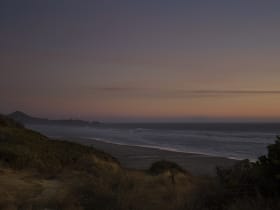
Moolack Beach
1.9 miles away
A long, wild, uncrowded beach north of Newport famous for agates, fossils, and ancient petrified wood exposed in dark low-tide bedrock, with the Yaquina Head lighthouse to the south.
Mo's Original, Newport
3.3 miles away
Mo's is the Oregon coast's most famous chowder house: a 1946 original on Newport's working Bayfront with the same recipe for 80 years.

Hatfield Marine Science Center, Newport
3.6 miles away
Hatfield's touch tanks let kids handle sea stars, urchins, and small invertebrates under staff supervision - great for a rainy Oregon coast day.

Oregon Coast Aquarium
4.2 miles away
One of the nation's top-ranked aquariums, on Yaquina Bay in Newport and once the home of Keiko from Free Willy.

Devil's Punchbowl State Natural Area
5.0 miles away
A collapsed sea cave at Otter Rock, off the Otter Crest Loop about five miles south of Depoe Bay, where the surf rushes in and churns a giant bowl of rock to foam at high tide.
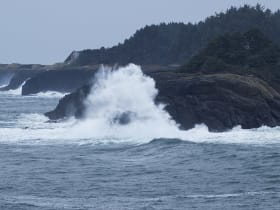
Rocky Creek State Scenic Viewpoint
7.3 miles away
A quiet forested clifftop above Whale Cove on the central Oregon Coast, one of the best low-key spots to watch gray whales pass, including a group that feeds here through summer.
Whale Watching Center
9.2 miles away
A free Oregon State Parks overlook built into the seawall in the middle of Depoe Bay, right on US 101, where tall picture windows and trained volunteers with binoculars help you spot the resident gray...
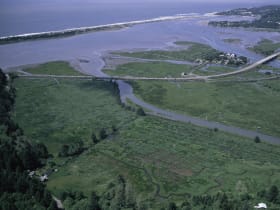
Siletz Bay National Wildlife Refuge
16 miles away
A restored coastal salt marsh and estuary at the south end of Lincoln City, where a diked dairy pasture was let back to the tide.