
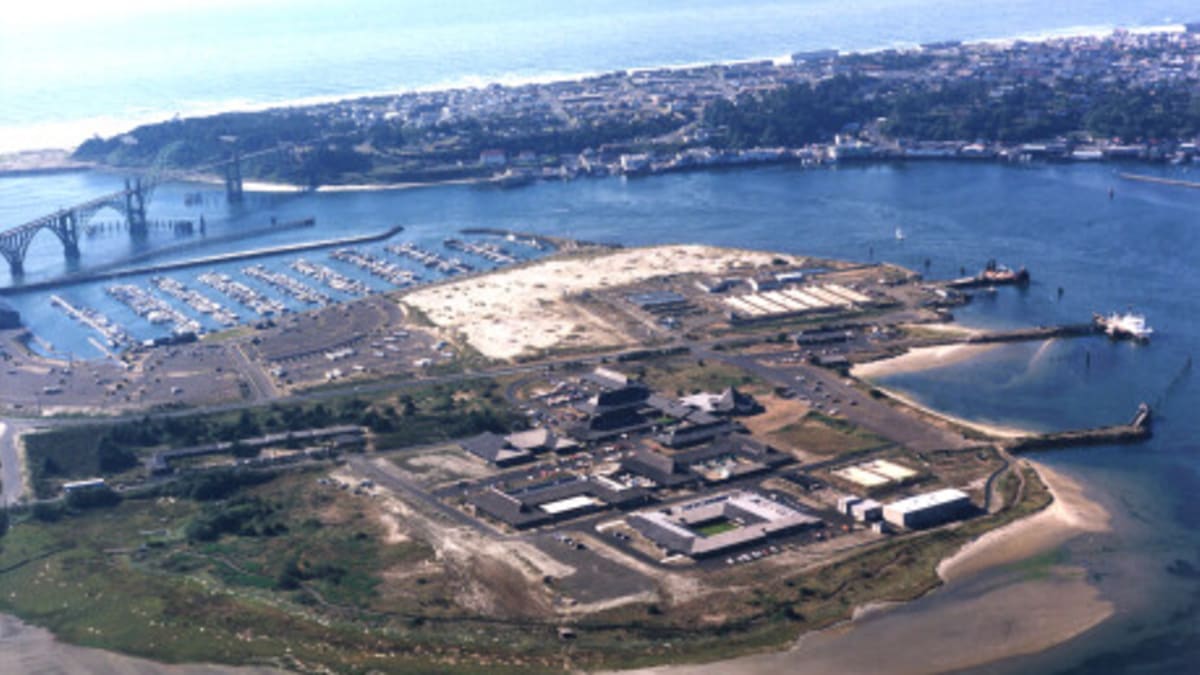
Hatfield Marine Science Center
2030 SE Marine Science Dr, Newport, OR
Newport, OR
A working ocean-research campus on Yaquina Bay where the public visitor center lets you touch tide-pool creatures, meet a giant Pacific octopus, and stand inside the science of the sea.
The Hatfield Marine Science Center is Oregon State University's coastal campus on Yaquina Bay, a place where marine scientists actually do their work, and where a public visitor center invites everyone else in to see it. It is not a slick tourist aquarium. It is a real laboratory that happens to keep its doors open, which is exactly what makes it special: the exhibits grow straight out of the research happening in the buildings around you.
For visitors, the heart of it is the hands-on floor. You can dip your fingers into touch tanks full of tide-pool life, watch a giant Pacific octopus study you back through the glass, and move among displays on fisheries, tsunamis, ocean currents, and the creatures of the deep. It is the kind of stop that turns a rainy coastal afternoon into the moment a kid decides to become a marine biologist.
What Travelers Love
- The touch tanks, where you can gently handle sea stars, anemones, and other tide-pool animals
- Meeting the resident giant Pacific octopus, the visitor center's famous eight-armed greeter
- Real science on display: this is an active research campus, not a staged aquarium
- A donation-based admission that makes it an easy, low-pressure stop for families
Worth Knowing
- It is a research and teaching center first, so it is smaller and more hands-on than a big commercial aquarium
- Days, exhibits, and animals on view can change with the work of the lab; check current details before you go
- The center sits in a tsunami inundation zone, and evacuation route signs point uphill for good reason
- Parking and paths are near the water and can be breezy and cool even on a sunny day, so bring a layer
Learn about Hatfield Marine Science Center
From a fisheries shack to a coastal campus
The story starts across the bay. In 1939, Roland Dimick, who led Oregon State's fisheries and wildlife department, set up the small Yaquina Bay Fisheries Laboratory over at Sally's Bend, a modest outpost for studying the coast's fish and shellfish. It ran for more than two decades.
In 1965, the pieces came together for something bigger. The Port of Newport leased Oregon State a stretch of the old Yaquina Bay ferry dock on the south shore, the university agreed to build and run a proper marine lab, and the plan included a public aquarium to draw visitors. The new Marine Science Center opened that June to considerable fanfare, and the campus has been growing ever since.
It carries the name of Mark O. Hatfield, who represented Oregon in the U.S. Senate for three decades and was a steady champion of science, education, and the Oregon coast. The public-facing Visitor Center was expanded and rededicated in the late 1990s, and later additions, including federal partner buildings and, in 2020, the Gladys Valley Marine Studies Building, turned the site into a full research and teaching campus.
A living laboratory you can walk into
Today the center is home to hundreds of researchers, students, and staff drawn from across Oregon State and from federal and state agencies that share the campus. Their work spans fisheries science, aquaculture, ocean ecology, the physics and chemistry of seawater, and even marine renewable energy, the study of drawing power from waves and tides.
The center also keeps a fleet of research vessels working out of Newport, ships that carry scientists offshore to sample the water, track fish, and monitor a changing ocean. When you visit the exhibits, you are seeing the shoreline end of that far larger effort.
That connection is the whole point. The animals in the tanks, the data on the screens, and the questions the displays pose are the same ones the people down the hall are chasing. It is a rare chance to see science not as a finished story but as a work in progress.
The touch tanks and the octopus
For most families the visitor center is a hands-on hour. The touch tanks let you carefully handle the hardy animals of the rocky intertidal, sea stars, anemones, urchins, and hermit crabs, the same creatures you might meet in a tide pool at low water, with a volunteer nearby to explain who is who.
The undisputed star is the giant Pacific octopus, the largest octopus species in the world and famously clever. Watching one uncurl an arm, change color, or fix you with a considering eye is the sort of encounter people remember for years. Individual animals come and go over time, as they are eventually returned to the wild, so the octopus you meet is one in a long line.
Around the tanks, exhibits dig into the wider ocean: how commercial fishing works and how it is managed, how weather and currents shape the coast, and what lives out in the deep water off Oregon. The tone is curious and plainspoken, meant to send you back outside looking at the sea a little differently.
Life on Yaquina Bay, and the wave that could come
The center sits right at the edge of Yaquina Bay, a rich estuary where the river meets the sea and salt and fresh water mix. That makes the setting itself a lesson: harbor seals haul out on the flats, ospreys and bald eagles hunt overhead, herons stalk the shallows, and shorebirds work the mud at low tide. A short estuary trail lets you walk out into that world.
It also sits squarely in a tsunami inundation zone, and the center does not hide it. This coast lies along the Cascadia Subduction Zone, an offshore fault capable of a great earthquake and a tsunami, and one of the center's own exhibits explains that danger. Evacuation route signs point the way uphill to high ground, a quiet reminder that the ocean you are learning about is a powerful and unpredictable neighbor.
The wildlife shifts with the seasons. Gray whales pass offshore on their long migrations in winter and spring, seabirds crowd the nearby cliffs and islands in the nesting months, and the bay stays busy year-round with the coming and going of the fishing fleet just across the water.
Season by season
Summer is the busiest and sunniest stretch on the central coast, ideal for pairing a visit with the beaches, lighthouses, and tide pools nearby. Expect more company on the hands-on floor, especially midday.
Winter turns the center into a perfect refuge from the coast's famous storms, warm, dry, and full of things to touch while the rain and wind hammer outside. It also lines up with the gray-whale migration offshore.
Spring and fall bring thinner crowds and changeable weather, a good time for a quieter visit and a walk on the estuary trail between the showers, with a jacket always close at hand.
Closest Boutels
The closest Boutel™ stays, so you can turn this stop into an overnight. Each is a place we chose through independent editorial review, never a paid placement.
Details
Newport, OR
Frequently asked questions
What can you see at the Hatfield Marine Science Center?
It is a hands-on marine science visitor center run by Oregon State University, with live exhibits rather than a big commercial aquarium. Highlights include a giant Pacific octopus, indoor touch pools where you can gently feel anemones and sea stars, a huge blue whale skeleton, and exhibits on tsunamis, ocean research, and coastal wildlife. It is smaller and more science-focused than the big aquarium nearby, and that is part of its charm.
Is Hatfield Marine Science Center good for kids?
Very much so. The touch pools are the star attraction for children, letting them gently handle tide-pool creatures, and the octopus and whale skeleton hold attention too. It is compact enough not to overwhelm, and the staff and student volunteers are enthusiastic about answering questions, so plan a little extra time if you are visiting with young ones eager to linger at the tanks.
Is the Hatfield Marine Science Center the same as the Oregon Coast Aquarium?
No, they are two different places in Newport, and it is a common mix-up. The Oregon Coast Aquarium is the large public aquarium with big outdoor exhibits, while the Hatfield Marine Science Center is Oregon State University's research station and visitor center, smaller, more hands-on, and focused on the science of the sea. Many visitors enjoy both on a longer stay.
How long does a visit take, and what should I know before going?
Most visitors spend an hour or two, more if children are captivated by the touch pools. It is largely indoors, which makes it a great rainy-day stop, and it is affordable. Hours and open days can shift with the season, and admission is required, so it is worth checking current details before you go and planning around the touch-pool time if you have kids.
What else is nearby to pair with a visit?
Plenty, since it sits near Newport's working bayfront. The Yaquina Head Outstanding Natural Area, with its tide pools and historic lighthouse, is a classic add-on, and the larger Oregon Coast Aquarium is close by as well. Together they make an easy, full day of ocean-themed exploring on the central Oregon coast.
Nearby
Mo's Original, Newport
0.8 miles away
Mo's is the Oregon coast's most famous chowder house: a 1946 original on Newport's working Bayfront with the same recipe for 80 years.

Oregon Coast Aquarium
0.8 miles away
One of the nation's top-ranked aquariums, on Yaquina Bay in Newport and once the home of Keiko from Free Willy.
Agate Beach State Recreation Site
2.9 miles away
A broad, open sweep of sand at the north edge of Newport, running up to the dark basalt of Yaquina Head and its lighthouse.

Yaquina Head Outstanding Natural Area, Newport
3.6 miles away
The tide pools here are the payoff. On most of the Oregon coast you hunt for a decent pool; at Cobble Beach they are laid out in tiers right below the lighthouse, close enough that a family can be cro...
Moolack Beach
5.3 miles away
A long, wild, uncrowded beach north of Newport famous for agates, fossils, and ancient petrified wood exposed in dark low-tide bedrock, with the Yaquina Head lighthouse to the south.

Devil's Punchbowl State Natural Area
8.5 miles away
A collapsed sea cave at Otter Rock, off the Otter Crest Loop about five miles south of Depoe Bay, where the surf rushes in and churns a giant bowl of rock to foam at high tide.
Rocky Creek State Scenic Viewpoint
11 miles away
A quiet forested clifftop above Whale Cove on the central Oregon Coast, one of the best low-key spots to watch gray whales pass, including a group that feeds here through summer.
Whale Watching Center
13 miles away
A free Oregon State Parks overlook built into the seawall in the middle of Depoe Bay, right on US 101, where tall picture windows and trained volunteers with binoculars help you spot the resident gray...
Siletz Bay National Wildlife Refuge
19 miles away
A restored coastal salt marsh and estuary at the south end of Lincoln City, where a diked dairy pasture was let back to the tide.