

Devil's Punchbowl State Natural Area
1st St
Otter Rock, OR
A giant hollow bowl carved into the headland where the ocean rushes in and churns itself to foam, with some of the coast's best tide pools right next door.
Devil's Punchbowl is one of the most dramatic pieces of shoreline on the whole Oregon coast, and one of the easiest to reach. From a clifftop viewpoint in the little community of Otter Rock, you look down into an enormous hollow bowl carved into the sandstone headland, partly open to the sea. When the tide comes in, the ocean rushes through the openings and slams against the curved walls, so the whole bowl churns and boils with white water, a genuine spectacle in a heavy swell.
It is a place that changes completely with the tide. Come at high water for the churning show. Come at low tide instead and a different park appears, one where you can walk down onto the beach, step into the quiet bowl itself, and explore some of the richest tide pools on the central coast. Add whales offshore and it is a lot of coast packed into one short stop.
What Travelers Love
- Watching the ocean pour into the hollow bowl and churn violently at high tide, especially during winter storms
- Walking down onto the beach to explore the rich tide pools at low tide, part of a protected marine reserve
- The chance to see gray whales spouting offshore from the clifftop viewpoint
- A dramatic, deeply photographed piece of coast that costs nothing to visit
Worth Knowing
- The show is completely different depending on the tide, so a high tide brings the churning bowl and a low tide opens the tide pools and lets you walk inside the bowl
- Never enter the bowl or the beach on a rising or high tide, since sneaker waves can surge in fast and the sea here is powerful and cold
- The tide pools sit inside a protected marine reserve, so look and photograph but leave every creature and shell exactly where it is
- Parking is limited at the clifftop lot and fills on sunny weekends, and reaching the beach means a set of stairs and a short walk
Learn about Devil's Punchbowl State Natural Area
How the punchbowl was made
The bowl is the ghost of two sea caves. Waves worked at the soft sandstone headland for ages, hollowing out caverns, until the roof over the caves finally collapsed and left a great open pit in the rock roughly eighty-five feet across and fifty feet deep. The ocean still reaches in through the old cave mouths, and it has kept shaping and smoothing the bowl ever since.
There is a deeper reason the bowl formed right here. Long ago, hot lava was forced into wet seafloor sediment and shattered into a jumbled rock called volcanic breccia, which you can still spot as dark, broken patches on the floor of the bowl. That shattered rock was a weak spot, and the sea found it first, which is why the caves, and then the bowl, opened here rather than a few hundred yards up the coast.
Two parks in one, set by the tide
At high tide, and especially during the big storms of winter, the punchbowl earns its name. Water forces its way through the openings, hits the curving walls, and spins into a violent, foaming churn that echoes up to the viewpoint. It is loud, it is powerful, and it is the reason so many photographers make the trip out along the Otter Crest Loop to catch it in a strong swell.
At low tide the mood flips entirely. The water drains out, and you can take the stairs down to Otter Crest Beach and even walk into the bottom of the bowl. Just north of it, the rocks hold some of the finest tide pools on the central coast, alive with ochre and purple sea stars, green anemones, hermit crabs, mussels, and barnacles. The whole area is a protected marine reserve, so everything you find stays exactly where it is.
Whales, surfers, and safe timing
The clifftop viewpoint is also a fine place to watch for gray whales, which feed and pass just offshore for much of the year, so keep an eye on the horizon for a misty spout while you wait for the tide to do its thing. Below the headland, Otter Rock's protected cove is a well-loved spot for beginning surfers, and you will often see them out on the small, gentle waves.
Timing is everything, and so is respect for the sea. Plan your visit around the tide, high for the churning bowl, low for the tide pools and the beach, and check a tide chart before you go. Never walk into the bowl or out onto the beach on a rising or high tide, because sneaker waves can rush in without warning and the cold Pacific here is not forgiving. Watched from the safe clifftop railing, though, it is pure drama.
Visiting Devil's Punchbowl
The park sits in Otter Rock, off US 101 along the scenic Otter Crest Loop, about five miles south of Depoe Bay and eight miles north of Newport. A small parking lot serves the clifftop viewpoint, and it fills quickly on clear weekends, so an early or late visit is easier. From the lot it is just a few steps to the railing above the bowl.
To reach the beach and the tide pools, look for the stairway and short trail that lead down to Otter Crest Beach. Give yourself an hour or more if you want to catch the tide right, poke through the tide pools, and scan for whales, and pair it with a stop in Depoe Bay just up the road. It is one of those Oregon coast places that rewards you for checking the tide chart and coming at the right moment.
Closest Boutels
The closest Boutel™ stays, so you can turn this stop into an overnight. Each is a place we chose through independent editorial review, never a paid placement.
Details
Otter Rock, OR
Frequently asked questions
What is the Devil's Punchbowl?
It is a striking bowl-shaped hollow in the coastal rock at Otter Rock, formed when the roof of a sea cave collapsed, leaving an open amphitheater of layered sandstone that the ocean surges into and out of. At high tide, waves crash and churn inside it in a dramatic, foaming spectacle best watched from the overlook above. It is one of the most distinctive natural features on the central Oregon coast.
Can you go inside the Devil's Punchbowl?
Yes, but only at low tide, and timing is everything for safety. Around a low, and especially a negative, tide the water drains out and you can walk in through an arch on the north side to stand inside the bowl among tide pools. There is only a short window of a couple of hours when this is safe, so check a tide table carefully and get out well before the tide turns, since a rising tide fills the bowl fast and can trap people against the walls.
When is the best time to visit the Devil's Punchbowl?
It depends on what you want to see. For the dramatic churning-waves show, come near high tide and watch from the clifftop viewpoint. To explore inside the bowl and the tide pools, come at a low, ideally negative, tide. Either way, check a tide table first. Winter and spring add migrating gray whales offshore and bigger, more powerful surf, while summer brings the calmest, clearest weather.
What else is there to do around the Devil's Punchbowl?
Quite a lot for a small park. The nearby Marine Gardens shelter excellent protected tide pools full of sea stars and anemones, best explored at low tide and strictly look-but-do-not-take, since it is a protected reserve. The beach at Otter Rock is a gentle, popular spot for beginning surfers, and the whole area, close to Depoe Bay, is prime for watching whales offshore in season.
Where do I park at the Devil's Punchbowl?
Use only the designated parking areas near the viewpoint and beach access, and be aware a day-use parking permit is required. Parking on the surrounding neighborhood streets is not allowed and can earn you a ticket, so if the lots are full it is best to come back at a quieter time. Weekday and off-peak visits make parking much easier and the overlook less crowded.
Outside the Park
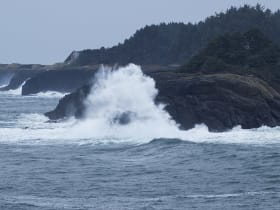
Rocky Creek State Scenic Viewpoint
2.4 miles away
A quiet forested clifftop above Whale Cove on the central Oregon Coast, one of the best low-key spots to watch gray whales pass, including a group that feeds here through summer.
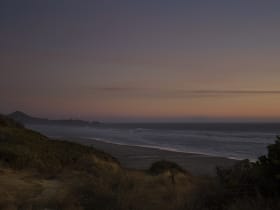
Moolack Beach
3.2 miles away
A long, wild, uncrowded beach north of Newport famous for agates, fossils, and ancient petrified wood exposed in dark low-tide bedrock, with the Yaquina Head lighthouse to the south.
Whale Watching Center
4.3 miles away
A free Oregon State Parks overlook built into the seawall in the middle of Depoe Bay, right on US 101, where tall picture windows and trained volunteers with binoculars help you spot the resident gray...

Yaquina Head Outstanding Natural Area, Newport
5.0 miles away
The tide pools here are the payoff. On most of the Oregon coast you hunt for a decent pool; at Cobble Beach they are laid out in tiers right below the lighthouse, close enough that a family can be cro...
Agate Beach State Recreation Site
5.6 miles away
A broad, open sweep of sand at the north edge of Newport, running up to the dark basalt of Yaquina Head and its lighthouse.
Mo's Original, Newport
8.0 miles away
Mo's is the Oregon coast's most famous chowder house: a 1946 original on Newport's working Bayfront with the same recipe for 80 years.

Hatfield Marine Science Center, Newport
8.5 miles away
Hatfield's touch tanks let kids handle sea stars, urchins, and small invertebrates under staff supervision - great for a rainy Oregon coast day.

Oregon Coast Aquarium
9.0 miles away
One of the nation's top-ranked aquariums, on Yaquina Bay in Newport and once the home of Keiko from Free Willy.
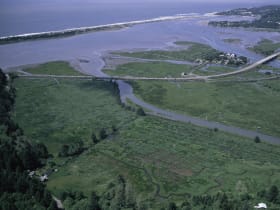
Siletz Bay National Wildlife Refuge
11 miles away
A restored coastal salt marsh and estuary at the south end of Lincoln City, where a diked dairy pasture was let back to the tide.
Devil's Lake State Recreation Area
16 miles away
A large, sheltered freshwater lake right in the middle of Lincoln City, just off US 101 and a short walk from the beach, calm for paddling when the ocean is rough.
Road's End State Recreation Area, Lincoln City
18 miles away
Road's End is the locals' beach in Lincoln City: no amenities, no services, just a rocky headland and a wide sand beach that's usually half-empty even in summer.