
Cascade Head
Cascade Head, Three Rocks Rd
Otis, OR
A grassy headland that climbs straight out of the sea into open, wildflower-strewn prairie, protecting a rare butterfly and a river estuary reborn.
Cascade Head is one of the strangest and most beautiful places on the Oregon coast, a two-mile basalt headland whose top is not forest but open, grassy prairie, tilting out over the Pacific. Walk up through the spruce and you suddenly step into meadow, with the ocean far below and the Salmon River curling into the sea at your feet.
That open grassland is rare and precious. It shelters plants and animals found almost nowhere else, and the whole area, from the headland down to the estuary and out into the water, has been recognized as a UNESCO biosphere reserve. It is protected by a patchwork of caretakers, including the Nature Conservancy, which has looked after the preserve here since 1966.
What Travelers Love
- Open, ocean-facing prairie that feels more like a Scottish headland than an Oregon forest
- Long views down to the Salmon River meeting the sea
- Summer wildflowers and the chance of spotting the rare Oregon silverspot butterfly
- Big wildlife: elk in the meadows, whales offshore, hawks and eagles overhead
Worth Knowing
- The upper trail through the preserve is closed part of the year, roughly January into mid-July, to protect the fragile prairie and nesting wildlife
- It is a steep climb up an exposed headland, often windy and wet, so wear grippy shoes and a layer
- Stay on the trail: the prairie and its butterfly are protected, and the cliff edges are dangerous
- Dogs are not allowed on the Nature Conservancy preserve, to protect the wildlife
Learn about Cascade Head
A prairie on top of a volcano
Cascade Head is an ancient, extinct volcano, uplifted from beneath the Pacific so that its dark basalt now forms the headland's spine. What makes it remarkable is the coastal prairie on top, a community of native grasses and wildflowers, red fescue, wild rye, Pacific reedgrass, coastal paintbrush, goldenrod, and blue violet, kept open by wind, thin soil, and salt spray rather than fire.
Because prairie like this has become so rare along the forested Oregon coast, the whole headland has been layered with protections. There is a Nature Conservancy preserve, a Forest Service experimental forest that has studied these coastal spruce and hemlock woods since 1934, a scenic research area, and a marine reserve offshore, all folded together into a biosphere reserve first designated in 1976 and expanded decades later.
The butterfly and the rare plants
The prairie's most famous resident is the Oregon silverspot butterfly, a small orange and silver-spotted butterfly that is federally threatened and survives in only a handful of places on earth. Its caterpillars can eat just one thing, the early blue violet, which grows in this coastal grassland, so the fate of the butterfly is tied directly to the fate of the meadow.
The headland is a stronghold for other rarities too. Nearly all of the world's Cascade Head catchfly, a delicate flowering plant, grows on this one prairie. Caretakers use careful prescribed burns and hand-pull invasive plants to keep the grassland open, which is why staying on the trail matters so much here: a single boot off the path can crush what took the meadow years to grow.
The Salmon River estuary, brought back to life
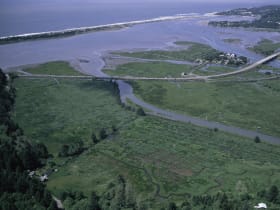
From the headland you look straight down on the Salmon River as it braids into the sea through one of the most intact estuaries on the coast. It was not always so healthy. The salt marshes had been diked off for pasture, cutting the tides off from the land, until restoration began in 1979 with the first breaching of a dike.
Since then, scientists have watched the salt marsh knit itself back together and the young salmon return to feed and grow in the recovering channels. It has become a living classroom for how a damaged estuary can heal, and part of why this whole landscape is studied and protected so closely.
Wildlife and the trails
Roosevelt elk graze the meadows and forest edges, and it is not unusual to come over a rise and find a herd bedded in the grass. Overhead you may see osprey, bald eagles, red-tailed hawks, northern harriers coursing low over the prairie, and the occasional peregrine falcon. In the wet forest below, the Pacific giant salamander hides in the streams, and gray whales pass offshore on migration.
Two main routes lead onto the headland. A lower trail climbs from near the mouth of the Salmon River up through forest into the open prairie, with the big views, while a separate trail leads to Hart's Cove, a hidden inlet where a waterfall drops toward the sea. The lower prairie trail closes for part of the year to protect the ground, so check before you set out.
When to go
Summer and early fall are the reliable season here, when the upper trail reopens, the wildflowers bloom, and the prairie is at its most golden. Even then the headland makes its own weather: clear one minute, socked in fog and wind the next, so come prepared for both.
Spring can be spectacular but the sensitive trails may still be closed, and winter turns the climb slick and stormy. Whenever you come, the headland rewards patience: stand still a while and the fog may lift to reveal the whole coast unspooling south.
Closest Boutels
The closest Boutel™ stays, so you can turn this stop into an overnight. Each is a place we chose through independent editorial review, never a paid placement.
Details
Otis, OR
Frequently asked questions
Can I bring my dog to Cascade Head?
No. Cascade Head is a protected nature preserve, and dogs are not allowed at all, even on a leash, in order to safeguard its rare plants, wildflowers, and wildlife. Bicycles, camping, and campfires are also not permitted. If you are traveling with a dog, plan to leave it elsewhere for this hike.
Is Cascade Head open all year?
Partly. The lower trail, reached from near the bottom of the headland, is open year-round. The upper trailheads on Forest Service land are open only in the second half of the year, roughly mid-July through December, and closed the rest of the time to protect nesting wildlife and the rare butterflies that live here. If you want the upper route, plan for that open window and check current conditions, since landslides can also close access.
How hard is the hike at Cascade Head?
It is a moderately challenging climb, especially on the lower trail, which gains real elevation through forest before opening onto the grassy headland, with steep pitches, stairs, and tree roots along the way. It can be muddy and slick after rain, so wear sturdy, grippy shoes and take your time. The reward at the top is a sweeping view over the Salmon River estuary and the Pacific.
What makes Cascade Head special?
It is one of the last intact coastal prairies on the Oregon coast, a grassy headland protected as a nature preserve and home to rare species including the threatened Oregon silverspot butterfly. In summer the meadows bloom with wildflowers, and the views from the open slopes are among the finest on the coast. Because it is so fragile, visitors are asked to stay on the trail and leave every plant and flower where it is.
When is the best time to visit Cascade Head?
Summer and early fall are ideal, when the wildflowers peak, the weather is driest, and the upper trails are open; volunteer naturalists are often on the trail on summer weekends to answer questions. Mornings can be foggy on the coast, sometimes burning off to clear views by midday. Dress in layers and expect wind and cool air on the exposed headland any time of year.
Nearby
Road's End State Recreation Area, Lincoln City
5.8 miles away
Road's End is the locals' beach in Lincoln City: no amenities, no services, just a rocky headland and a wide sand beach that's usually half-empty even in summer.
Devil's Lake State Recreation Area
6.8 miles away
A large, sheltered freshwater lake right in the middle of Lincoln City, just off US 101 and a short walk from the beach, calm for paddling when the ocean is rough.

Bob Straub State Park
8.4 miles away
A wild three-mile sand spit with the open Pacific on one side and the quiet Nestucca River on the other, saved from becoming a highway.

Cape Kiwanda State Natural Area
9.9 miles away
A soft, honey-gold sandstone headland the ocean has carved into arches and sea caves, backed by a giant sand dune you can climb for a wide Pacific view.
Siletz Bay National Wildlife Refuge
12 miles away
A restored coastal salt marsh and estuary at the south end of Lincoln City, where a diked dairy pasture was let back to the tide.
Whale Watching Center
19 miles away
A free Oregon State Parks overlook built into the seawall in the middle of Depoe Bay, right on US 101, where tall picture windows and trained volunteers with binoculars help you spot the resident gray...