

Vista House at Crown Point
40700 Historic Columbia River Hwy
Corbett, OR
A domed stone rotunda perched on a basalt point some seven hundred feet above the Columbia, built in 1918 as a rest stop for the first scenic highway in the country and a memorial to Oregon's pioneers.
Vista House is a domed stone observatory perched on Crown Point, a basalt promontory that rises some seven hundred feet straight up from the Columbia River. Opened in 1918, it was conceived as part of the Historic Columbia River Highway, the first paved scenic highway in the United States, and it served three purposes at once: an observatory taking in the Gorge, a comfort station where early motorists could stop and rest, and a memorial to the hardships of Oregon's pioneers. Its octagonal shape, green-tiled dome, and marble-and-glass interior make it one of the most distinctive buildings in the state.
The view is the reason to come. From the observation deck the Columbia River Gorge opens up and down the river in both directions, a landscape of basalt cliffs, forested slopes, and moving water that has drawn travelers for more than a century. It is also famously, ferociously windy up here, which is part of the drama and, on the roughest days, the reason the doors stay shut.
What Travelers Love
- The sweeping view up and down the Columbia River Gorge from the observation deck
- A jewel-box interior of marble and opalescent glass under a domed rotunda
- The way it caps a drive along the historic highway's graceful curves and viewpoints
- Sunrise and sunset light on the Gorge, long a favorite of photographers
Worth Knowing
- Crown Point is famously windy, and the building closes when winds get strong enough to make the doors hard to open
- The interior keeps seasonal hours, so it can be open or closed depending on the day and time of year
- Parking is limited and fills on fair-weather weekends, so an early or off-peak visit is calmer
- The site is high and exposed, so dress for wind and shifting weather even on a mild day
Learn about Vista House at Crown Point
The story of Vista House
The Columbia River Gorge is the homeland of Chinookan peoples, who lived in villages along the river from its mouth eastward, with salmon central to their lives and the river itself a great trade corridor linking many Native nations. Today the Gorge tribes are represented by federally recognized nations including the Confederated Tribes of the Warm Springs Reservation, the Confederated Tribes and Bands of the Yakama Nation, the Confederated Tribes of the Umatilla Indian Reservation, and the Confederated Tribes of the Grand Ronde. The Chinook Indian Nation, whose westernmost tribes have deep ties to the lower river, continues to seek federal recognition.
The idea for Vista House took shape in 1913, as the Historic Columbia River Highway was being built. Samuel Lancaster, the engineer behind the highway, proposed an observatory where the view up and down the Columbia could be taken in, and Samuel Hill championed the road itself. The architect Edgar M. Lazarus designed the building and described it as a temple to the natural beauty of the Gorge. Construction began in late 1916, and the finished building was dedicated in May 1918.
It cost far more than planned. Budgeted at around twelve thousand dollars, the design and scope grew until the final bill approached a hundred thousand, which earned it the mocking construction-era nickname of the hundred-thousand-dollar outhouse. It has since become one of the Gorge's beloved landmarks, named a National Natural Landmark and listed on the National Register of Historic Places. After decades of weather took their toll, a major restoration in the early 2000s repaired the stonework and interior and brought it back, and a devoted group of volunteers, the Friends of Vista House, help keep it running today.
How the point formed and what to see
Crown Point is a piece of the Columbia River Basalt Group, floods of lava that poured across this region roughly fifteen million years ago and hardened into the dark, cliff-forming rock that defines the Gorge. During the last Ice Age, the Missoula floods, a series of catastrophic outpourings when glacial ice dams failed far upstream, tore through the Gorge and scoured out its steep walls, exposing the layered basalt you see today.
The result is one of the great overlooks in the Pacific Northwest. From the deck the river stretches away in both directions, framed by forested cliffs and, on a clear day, distant peaks. Below the point, the historic highway loops down through a set of graceful curves that were themselves an engineering showpiece, designed to carry early cars gently down off the promontory.
Wind is a defining part of the experience. The Gorge narrows here, funneling and accelerating the air, and Crown Point is one of the windiest spots along the river. Gusts can be strong enough to make the building's doors hard to pull open, and on the fiercest days the interior closes for safety.
Wildlife and the Gorge
The cliffs and updrafts of the Gorge are raptor country. Peregrine falcons, once nearly lost and now recovered, nest on the rock walls, and red-tailed hawks, turkey vultures, and kestrels ride the wind that streams through the gap. Watching a bird hang almost motionless on a gorge updraft is one of the quiet pleasures of a visit.
The Columbia Gorge is one of the richest wildflower landscapes in Oregon, its slopes coloring up through spring as the temperate forest and open bluffs come alive. The mild, wet maritime climate feeds mossy forests and a long procession of waterfalls just east along the historic highway.
That combination of river, cliff, forest, and falling water is what makes the drive around Vista House feel less like a single stop than the doorway to a whole landscape.
Season by season
Spring brings wildflowers to the Gorge slopes and swollen, thundering waterfalls along the highway below, with the air washed and green after the winter rains.
Summer offers the longest days and the most reliable weather, though a warm afternoon can bring haze into the Gorge. It is the busiest season, so an early arrival beats both the crowds and the midday wind.
Fall is many visitors' favorite, when the bigleaf maples and other deciduous trees turn gold and red and the light goes soft. Winter is mild but wet and can bring fog and ice to the exposed point, and the building keeps shorter seasonal hours, so it is worth checking conditions before making the drive. In every season, the wind is part of the deal.
Closest Boutels
The closest Boutel™ stays, so you can turn this stop into an overnight. Each is a place we chose through independent editorial review, never a paid placement.
Details
Corbett, OR
Frequently asked questions
What is Vista House at Crown Point?
It is a beautiful octagonal stone building perched on a cliff more than seven hundred feet above the Columbia River, built between 1916 and 1918 as an elegant rest stop, or comfort station, for travelers on the new Historic Columbia River Highway, and as a memorial to Oregon Trail pioneers. With its marble floors, stained glass, and dome, it is as much a work of art as a viewpoint, and it is one of the signature landmarks of the Columbia River Gorge.
What can you see and do at Vista House?
The main draw is the sweeping view up and down the Columbia River Gorge from its cliff-top perch, one of the grandest panoramas in the region. Inside, the restored building houses interpretive displays on the Gorge's history and geology, a gift shop, and a small espresso and snack counter downstairs. Walking the outside gallery lets you take in the full circle of the view.
Why is Vista House sometimes closed for wind?
Crown Point is one of the windiest spots in the Gorge, funneling powerful gusts off the river, and for safety the building is closed when winds reach around fifty miles per hour. That means on a very blustery day you may find the doors shut, though the exterior viewpoints are still dramatic. It is worth checking conditions before a special trip, and always hold onto hats, doors, and small children in the wind.
When is the best time to visit Vista House?
Clear days reward you with the fullest Gorge views, and the low light of sunrise and sunset is magical on the stone building and the river below. Summer is busiest and generally calmest, while the windy shoulder seasons can be dramatic but sometimes close the building. Mornings are quieter, and a clear, calm day is the ideal.
Is Vista House free, and how do I get there?
Yes, it is free to visit. It sits at Crown Point along the Historic Columbia River Highway east of Portland, an easy and scenic drive up onto the bluff, and it makes a natural first or last stop on a loop of the Gorge's famous waterfalls just beyond. Note the building keeps limited open days and hours, so if you want to go inside, it is worth checking current times.
Nearby
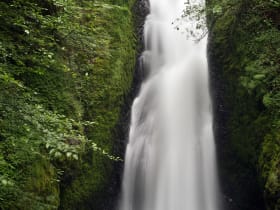
Bridal Veil Falls
3.3 miles away
Most drivers on the Historic Columbia River Highway stop at Multnomah and skip Bridal Veil three miles back, even though the walk is the same length and the falls are easily as dramatic.

Multnomah Falls
6.7 miles away
Multnomah Falls drops 620 feet in two tiers, the tallest waterfall in Oregon, with the arched Benson Bridge spanning the gap between them.

Oneonta Gorge
9.1 miles away
The cliffs of Oneonta Gorge are close enough together that a full-grown Douglas fir could not fall across the gap in the narrowest section.
Beacon Rock
12 miles away
Beacon Rock is right off SR-14 in Beacon Rock State Park, about 35 miles east of Vancouver.
Rocky Butte Natural Area
16 miles away
Five Cascade volcanoes visible from one overlook inside a major city is not common.

Bonneville Dam Fish Ladder
16 miles away
The underwater viewing windows are the draw: floor-to-ceiling glass with salmon and steelhead swimming past at eye level. During fall Chinook season, the volume of fish can be extraordinary.

Eagle Creek Trail
17 miles away
A legendary Columbia Gorge waterfall hike blasted into sheer basalt cliffs in 1915, stringing together fall after fall, including the emerald pool of Punch Bowl Falls and Tunnel Falls, where the trail...

Bridge of the Gods and Cascade Locks
19 miles away
A slender steel toll bridge across the Columbia River in the heart of the Gorge, named for a Native American legend of a natural stone land bridge, at the historic town of Cascade Locks where steamboa...