

The Breakers
44 Ochre Point Avenue
Newport, RI
The Vanderbilts' seventy-room summer palace above the Atlantic, the grandest of Newport's Gilded Age cottages and a monument to the wealth of an entire era.
The Breakers is the grandest of Newport's Gilded Age mansions, a seventy-room Italian Renaissance palace built in the 1890s as a summer home for Cornelius Vanderbilt II, then head of the family whose railroad fortune was among the largest in America. Set on a bluff called Ochre Point, it faces the open Atlantic, and its name comes from the surf that breaks on the rocks below.
It was designed to overwhelm, and it still does. Behind its stone walls lie a two-story great hall, a grand staircase, a dining room dripping with gilt and crystal, and rooms finished in imported marble, alabaster, and mosaic, all built at staggering cost as a warm-weather retreat used only a few weeks a year. The Breakers is at once a masterpiece of design and a monument to the extremes of wealth that gave the Gilded Age its name.
What Travelers Love
- The sheer scale and opulence of a seventy-room mansion built as a summer home
- A dramatic clifftop setting with the Atlantic crashing below
- The great hall, the grand staircase, and rooms finished in marble, gilt, and mosaic
- Its place at the head of the Cliff Walk, so a tour pairs with a shoreline stroll
Worth Knowing
- The Breakers is a museum run by the Preservation Society of Newport County; admission and timed entry apply
- It is the most visited of the Newport mansions, so book ahead and expect crowds in summer
- An audio tour is included and worth the time to grasp the history
- Combine it with the Cliff Walk, which passes directly behind the grounds
Learn about The Breakers
The Vanderbilts and the Gilded Age
The Vanderbilt fortune began with Cornelius Vanderbilt, the shipping and railroad magnate known as the Commodore, who became one of the richest men in American history. By the late nineteenth century his descendants were among the leading families of the American elite, and they built to match.
The Gilded Age, the decades after the Civil War when industrial fortunes exploded, saw the newly rich compete in conspicuous display, and Newport became their summer capital. Along its shore the wealthiest families raised enormous mansions they modestly called cottages, staffed by armies of servants and used for a brief, intense social season of balls, dinners, and yachting.
Cornelius Vanderbilt II commissioned the architect Richard Morris Hunt to build The Breakers as the largest and most magnificent of them all, completed in 1895. It was meant to announce the family's standing at the very top of American society, and in scale and expense it succeeded.
The architecture
Richard Morris Hunt modeled The Breakers on the grand palaces of Renaissance Italy, and the house was built of stone and steel to be as fireproof as possible after an earlier Vanderbilt house on the site had burned. Its heating plant was placed well away from the mansion, underground, for the same reason.
Inside, no expense was spared. Craftsmen and materials were brought from Europe, and the interiors combine marble, alabaster, gilded bronze, mosaic, and carved stone. The centerpiece is the great hall, rising two full stories to a painted ceiling of sky, meant to feel like an open-air Italian courtyard brought indoors.
For all its grandeur, the house also reflects its moment technologically, wired for electricity and fitted with the modern conveniences the era's wealth could command, a blend of old-world splendor and new industrial power.
Upstairs and downstairs
The Breakers is not only a story of the family who owned it but of the many people who ran it. Behind the opulent public rooms lay an extensive world of kitchens, service corridors, and servants' quarters, where a large staff worked to sustain the household during its short, demanding summer season.
Modern tours increasingly tell both sides, the glittering life of the Vanderbilts above and the labor of the cooks, maids, footmen, and grounds staff below, giving a fuller and more honest picture of how such a place actually functioned.
That contrast, extraordinary luxury sustained by an unseen workforce, is part of what makes The Breakers such a vivid window into the Gilded Age, an era of both dazzling wealth and deep inequality.
The setting and the Cliff Walk
The Breakers sits at the edge of the sea on Ochre Point, and its grounds run to the top of the bluff where the famous Cliff Walk passes. From the lawn and the loggia, the view is straight out over the Atlantic.
That location makes it easy to combine a mansion tour with a walk along the shore. The Cliff Walk threads the boundary between the manicured estates and the wild rocky coast, giving a rare public view of both the mansions and the sea they were built to command.
Newport itself, with its colonial harbor town, its other mansions, and its sailing history, spreads out just beyond, so The Breakers works well as the centerpiece of a broader day in one of America's great historic resorts.
Closest Boutels
The closest Boutel™ stays, so you can turn this stop into an overnight. Each is a place we chose through independent editorial review, never a paid placement.
Details
Newport, RI
Frequently asked questions
What is The Breakers?
The Breakers, in Newport, Rhode Island, is the grandest and most famous of Newport's Gilded Age mansions, a breathtaking seaside palace built as a summer home for one of America's wealthiest families. This magnificent mansion, perched above the ocean, is a masterpiece of opulent architecture, with soaring ceilings, marble and gilt, exquisite craftsmanship, and dozens of lavish rooms, all reflecting the extraordinary wealth of the Gilded Age. Its grand rooms and ocean-facing grounds astonish visitors and evoke a vanished era of American opulence. A spectacular monument to a bygone age of wealth, it dazzles visitors. With its palatial grandeur, The Breakers offers a stunning destination in Rhode Island.
What can you see at The Breakers?
You can tour the opulent rooms of the mansion, including the grand great hall, the ornate dining room, the music room, and the family quarters, all richly decorated with marble, gilt, and fine craftsmanship, and stroll the grounds overlooking the ocean. The palatial interiors, the exquisite craftsmanship, the ocean-facing setting, and the story of the Gilded Age family are the draws, offering a dazzling glimpse of extraordinary wealth. The scale and richness of the rooms are astonishing. With its grandeur, The Breakers offers a rewarding visit in Newport, Rhode Island.
Why is The Breakers significant?
The Breakers is significant as the grandest of Newport's Gilded Age summer cottages and one of the most opulent houses ever built in America, a symbol of the immense wealth and lavish lifestyle of the industrial elite of that era. Built for one of the richest families of the age, its scale, artistry, and ocean setting made it the crown jewel of Newport society. It stands as a preserved monument to a defining chapter of American history. Understanding this history enriches a visit to The Breakers in Rhode Island.
When is the best time to visit The Breakers?
The Breakers welcomes visitors year-round, with the warmer months especially lovely for enjoying the ocean-facing grounds along with the mansion, though the house is popular, so weekdays and earlier or later in the day are generally less crowded. Because hours and tours can vary by season and it draws many visitors, checking current information and considering tickets ahead are wise. For a fuller experience with the grounds, aim for the warmer months, and visit off-peak to avoid crowds, at The Breakers in Rhode Island.
What is near The Breakers?
The Breakers is in Newport, Rhode Island, within reach of the Cliff Walk, which passes near it, the other Newport mansions, Fort Adams State Park, and downtown Newport with its harbor and colonial streets. That makes The Breakers a spectacular stop to combine with the Cliff Walk and the other attractions of Newport on a visit to Rhode Island.
Nearby

Rosecliff Mansion
0.8 miles away
One of the loveliest of Newport's Gilded Age summer mansions, a gleaming white palace modeled on the Grand Trianon at Versailles and designed by Stanford White for the silver heiress and society hoste...

The Cliff Walk
1.0 miles away
The Cliff Walk gives kids the best of Newport in one walk: crashing surf on one side, jaw-dropping mansions on the other, and the sense of an adventure along the edge of the sea.
Touro Synagogue
1.5 miles away
Tucked on a side street off Newports colonial core is a building most visitors walk past without knowing its weight.

Fort Adams State Park
2.1 miles away
A real fortress to explore turns a history stop into an adventure.
Beavertail State Park
5.4 miles away
Beavertail is where Conanicut Island runs out of land and drops onto open granite ledges at the very mouth of Narragansett Bay.
Narragansett Town Beach
8.2 miles away
This is the easy family beach in Narragansett, a broad crescent of sand right in the middle of town.
Gilbert Stuart Birthplace and Museum
8.3 miles away
Hardly anyone realizes the face on the dollar bill was painted by a Rhode Islander born in this quiet mill hamlet.
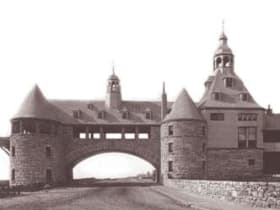
The Towers
8.6 miles away
This granite arch spanning Ocean Road is the last piece of an 1880s seaside casino designed by McKim, Mead & White, all that survived a fire in 1900.
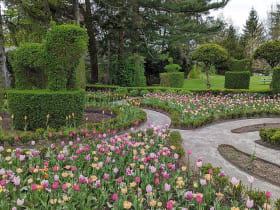
Green Animals Topiary Garden
9.1 miles away
Off the usual Newport circuit, up in Portsmouth on the bay, sits a garden that delights people who did not expect to be delighted.

Historic Wickford Village
11 miles away
Wickford is the kind of place people stumble into and cannot believe is not more famous.
Smiths Castle
11 miles away
People drive right past this on Post Road without realizing they are passing one of the oldest houses in America.
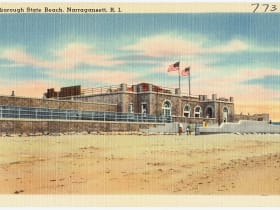
Scarborough State Beach
12 miles away
Rhode Island's most beloved ocean beach, a wide crescent of Atlantic surf on Ocean Road in Narragansett with a long boardwalk, an observation tower, and the stone ruins of a lost Gilded Age mansion ab...

Point Judith Lighthouse
12 miles away
This brown-and-white 1857 lighthouse guards one of New England's most treacherous points, where Narragansett Bay meets the open Atlantic.

Blithewold Mansion, Gardens and Arboretum
13 miles away
Garden people travel for this one; casual visitors are stunned to find giant sequoias on the Rhode Island shore.
Rocky Point State Park
14 miles away
Rocky Point is a shoreline haunted, in the fondest way, by a lost amusement park.

Herreshoff Marine Museum
14 miles away
Sailors know it, but plenty of visitors miss that a tiny Bristol yard once ruled world yacht racing.
Linden Place
14 miles away
It looks like a simple grand house on the parade route, but Linden Place at 500 Hope St carries a heavier story.
Colt State Park
15 miles away
This former gentlemans farm gives Bristol a broad, open front on Narragansett Bay.

Battleship Cove
18 miles away
People drive over the Braga Bridge and spot the gray battleship without realizing they can walk right through it.
East Bay Bike Path
19 miles away
This is the family bike ride in the East Bay. The East Bay Bike Path is a flat, paved rail-trail running 14 miles from Providence to Bristol, mostly away from cars, so young riders can pedal without t...