

Lowell Observatory
1400 W Mars Hill Rd, Flagstaff, AZ
Flagstaff, AZ
A pinewood hilltop observatory above Flagstaff where Pluto was discovered and the first clues to an expanding universe were read from the night sky.
Lowell Observatory sits atop Mars Hill above Flagstaff, one of the oldest observatories in the country and the site of some of the most important discoveries in the history of astronomy. It was founded in 1894 by the wealthy Bostonian Percival Lowell, who chose this high, clear-aired mountain for its dark skies and steady seeing, and it has been peering at the heavens ever since.
This is where the dwarf planet Pluto was discovered in 1930, and where earlier astronomers gathered some of the first evidence that the universe is expanding. Today the observatory blends its historic domes with modern research and a lively public program, letting visitors tour the old telescopes, look through eyepieces at the night sky, and stand in the very places where the map of the solar system was redrawn.
What Travelers Love
- Standing in the dome where Pluto was discovered in 1930
- Looking through historic and modern telescopes at guided evening programs
- The dark, clear skies of the country's first International Dark Sky City
- A cool pine setting high above the desert, a world away from the heat below
Worth Knowing
- Evening sky-viewing programs depend on clear weather, so check conditions before you go
- Flagstaff is high and cool, and nights get cold even in summer, so dress warmly for stargazing
- The observatory is popular, so busy nights fill up and planning ahead helps
- This is a working research campus, so follow staff guidance and keep lights low
Learn about Lowell Observatory
Percival Lowell and the search for life on Mars
Percival Lowell founded the observatory partly out of a fascination with Mars. He was captivated by the idea that the red planet was crossed by canals built by an intelligent civilization, and he chose Flagstaff's high, dry air and dark skies as an ideal place to study it. Though his canals turned out to be an illusion of the eye and the atmosphere, his choice of site was inspired, and it drew serious astronomy to northern Arizona.
Lowell used his fortune to build a first-rate research station on the mountain, equipping it with a great refracting telescope housed under a wooden dome. His enthusiasm and money gave the observatory its start, and his belief that something waited to be found beyond the known planets would, years after his death, bear remarkable fruit.
The discovery of Pluto
Lowell had predicted an undiscovered planet tugging at the orbits of Neptune and Uranus, which he called Planet X, and he searched for it without success. The hunt continued after he died, and in 1930 a young Kansas farm-raised astronomer named Clyde Tombaugh, comparing photographic plates of the sky taken nights apart, spotted a tiny point of light that had moved. It was a new world, and it was named Pluto.
The discovery made headlines around the globe and put Lowell Observatory in the history books. Visitors today can see the telescope and the plate-comparing machine that made it possible, and stand in the dome where a patient search across the winter sky added a ninth body to the solar system, a place of pilgrimage for anyone who has ever looked up and wondered what lies out there.
Reading an expanding universe
Lowell Observatory played a part in an even larger discovery. In the early twentieth century the astronomer Vesto Slipher, working here, measured the light of distant spiral nebulae and found that most of them were rushing away from us at enormous speed. His measurements were among the first hard clues that the universe is not static but expanding, a finding that reshaped our whole understanding of the cosmos.
That work, less famous than Pluto but arguably more profound, cemented the observatory's place at the frontier of astronomy. From this pine-topped hill came evidence that would help lead others to the idea of a universe born in a single beginning and growing ever since, a reminder that great discoveries can come from a modest mountaintop far from any city.
Dark skies over Flagstaff
The observatory endures in part because Flagstaff has protected the very thing that drew Lowell here: darkness. The city was the first in the world to be named an International Dark Sky City, passing laws to limit light pollution so the stars stay bright overhead, a rare civic commitment that keeps its skies among the finest near any American town.
That heritage makes an evening at Lowell special. On clear nights, staff open the domes and set up telescopes for the public, guiding visitors to the moon, the planets, star clusters, and distant galaxies. Set high in the cool pines above the desert, with the Milky Way arching overhead, it is a place that connects the great discoveries of the past to the simple wonder of looking up at a truly dark sky.
Closest Boutels
The closest Boutel™ stays, so you can turn this stop into an overnight. Each is a place we chose through independent editorial review, never a paid placement.
Lantern Light Inn & Wedding Gardens
Boutel+3085 W State Rte 89A, Sedona, AZ
25 miles away|Learn More ›
The Iron Horse Inn
Boutel1034 N Main St, Cottonwood, AZ 86326, Cottonwood, AZ
37 miles away|Learn More ›
Details
Flagstaff, AZ
Frequently asked questions
What is Lowell Observatory?
Lowell Observatory, perched on a hill above Flagstaff, Arizona, is one of the oldest and most historic observatories in the United States, founded in 1894 by astronomer Percival Lowell. It is famous as the place where Pluto was discovered in 1930, and it remains an active research and public-education center. Flagstaff's status as the world's first International Dark Sky City makes it an ideal spot for stargazing. With historic telescopes, exhibits, tours, and public night-sky viewing, Lowell offers an inspiring journey through astronomy for all ages.
Where was Pluto discovered at Lowell Observatory?
Pluto was discovered at Lowell Observatory in 1930 by a young astronomer named Clyde Tombaugh, working from photographic plates in a systematic search for a distant planet that Percival Lowell had predicted. The telescope and dome used in the discovery are preserved at the observatory, and visitors can see them and learn the story of how the tiny, distant world was found. This landmark achievement is a highlight of a visit and a proud chapter in the history of American astronomy.
Can you look through telescopes at Lowell Observatory?
Yes, one of the joys of visiting Lowell is the chance to look through telescopes during evening programs, when weather permits, viewing the moon, planets, star clusters, and other celestial objects under Flagstaff's famously dark skies, alongside daytime solar viewing. The observatory offers guided programs, exhibits, and access to historic instruments like the Clark Telescope. Because night-sky viewing depends on clear weather and program schedules, checking the current calendar and hours before you go helps ensure you catch the telescope experiences.
When is the best time to visit Lowell Observatory?
Evening visits are ideal for the signature telescope viewing and stargazing programs, so plan around a clear night if possible, while daytime visits offer tours, exhibits, and solar viewing. Clear, dark nights are best for seeing celestial objects, and the high-elevation Flagstaff climate means chilly evenings even in summer, so bring layers. Checking the program schedule and weather before you go is wise, since night-sky viewing depends on clear skies. Any season can be rewarding with the right conditions.
What is near Lowell Observatory?
Lowell Observatory is in Flagstaff, a lively mountain town with historic downtown, Northern Arizona University, and the Riordan Mansion, and a gateway to the volcanic monuments of Sunset Crater and Wupatki, Walnut Canyon's cliff dwellings, and the San Francisco Peaks. The Grand Canyon and Sedona are within reach. That makes Lowell Observatory a highlight of a Flagstaff visit, easily combined with the town's culture, the surrounding national monuments, and the dark-sky stargazing the region is famous for.
Nearby

Riordan Mansion State Historic Park
1.1 miles away
Riordan Mansion is a 40-room Arts and Crafts home built in 1904 for two Riordan brothers who ran Flagstaff's lumber empire, connected as a single duplex by a central common room.
The Arboretum at Flagstaff
3.6 miles away
The Arboretum at Flagstaff is a 200-acre botanical garden at 7,150 feet with a focus on plants native to the Colorado Plateau.

Walnut Canyon National Monument
9.0 miles away
Walnut Canyon contains over 25 cliff dwelling "rooms" built by the Sinagua people around 1100-1250 CE under natural overhanging ledges in the canyon walls.
Sunset Crater Volcano National Monument
14 miles away
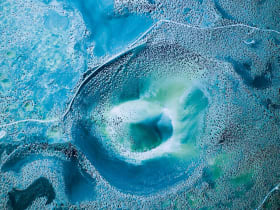
Sunset Crater erupted around 1085 CE, blanketing the surrounding ponderosa forest in volcanic ash.
Oak Creek Canyon Overlook
16 miles away
The first overlook on US-89A heading south from Flagstaff into Oak Creek Canyon appears after the switchbacks at 6,400 feet and gives a full view into the canyon before the road descends.
Oak Creek Canyon
17 miles away
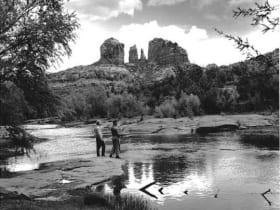
Oak Creek Canyon runs from Sedona north to the Mogollon Rim, dropping 3,400 feet in 16 miles.
Slide Rock State Park
19 miles away
The main feature at Slide Rock State Park is a natural water slide worn smooth by Oak Creek flowing over sandstone slabs for centuries.
Red Rock Scenic Byway
27 miles away
Red Rock Scenic Byway follows AZ-179 for about seven miles between the Village of Oak Creek and Sedona, threading past some of the most photographed red rock in the Southwest.
Historic Route 66, Flagstaff to Winslow
33 miles away
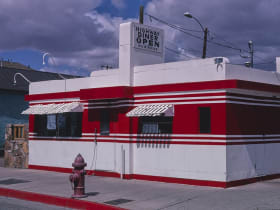
The Route 66 alignment east of Flagstaff passes through Winona (you need to know it) and ends at the famous Standin' on the Corner park in Winslow.

Grand Canyon National Park
64 miles away
A mile deep and up to 18 miles wide, revealing nearly two billion years of Earth's history in its walls.