
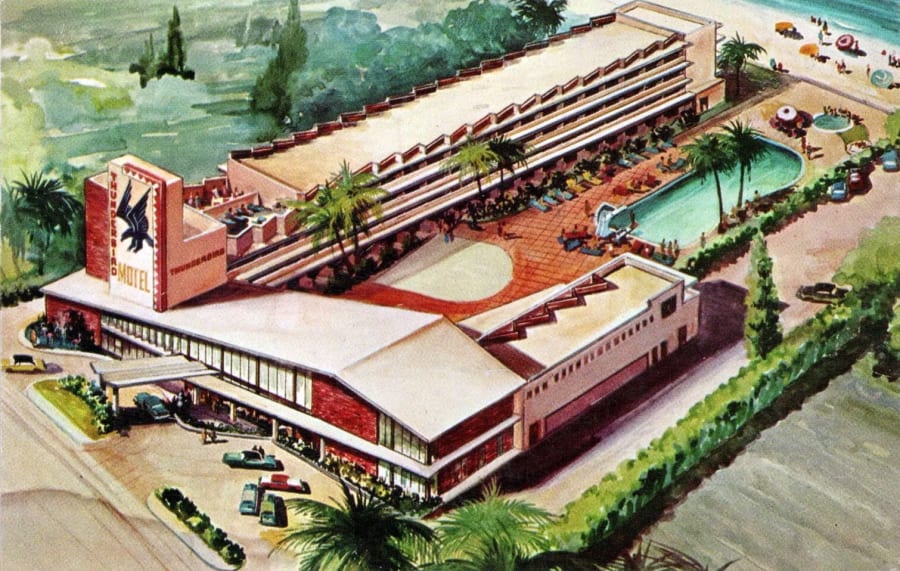
By the middle of the 1950s the American highway had become the country's brightest stage, and the motel was its glowing marquee. A family loading suitcases into a two-tone sedan on a summer Saturday was joining a ritual that felt almost patriotic. Gas was cheap, wages were rising, and the open road promised something the crowded prewar years never had, which was room to roam and the money to do it. Along every arterial highway, from the Mojave to the Ozarks, the signs began to bloom after dark: bright arrows, leaping fish, cactus wearing sombreros, and that single word every tired driver strained to read, Vacancy.
This was the golden age of the roadside motel, and it arrived on the crest of a country remade by victory and prosperity. The soldiers had come home, the babies had come by the millions, and the young families they made needed somewhere to sleep that was not a hotel lobby with a bellhop and a necktie. The motel answered perfectly. You parked your car outside your own door, carried your own bags, let the kids splash in a pool shaped like a kidney bean, and paid a fair price for a clean room with a bed and, if you were lucky, that thrilling modern luxury, refrigerated air. For roughly a decade, the humble motor court became one of the defining images of American life.
The golden age arrives
The postwar boom was the engine under all of it. Between 1945 and 1964 the country added tens of millions of new citizens in the great wave known as the baby boom, and those growing families settled into a landscape of brand-new suburbs stitched together by automobiles. The car stopped being a luxury and became the way a household lived, shopped, worked, and, crucially, vacationed. When Disneyland opened its gates in Anaheim on July 17, 1955, and nearly half the nation watched the live television broadcast, it confirmed a new national appetite. Leisure was no longer for the idle rich. It belonged to the middle class, and the middle class reached it by car.
Motels had existed since the 1920s and 1930s, but the 1950s were when they truly multiplied. By the early part of the decade something on the order of 50,000 motels lined the roads of the United States, and the number kept climbing toward a peak of roughly 61,000 by 1964. Most were mom-and-pop operations, a dozen or two rooms run by a couple who lived on site and swept the walk each morning. They competed for the same headlights, and competition in that era meant spectacle. A motel had only a few seconds to catch a driver going fifty miles an hour, so it learned to shout in light and color.
A motel had only a few seconds to catch a driver going fifty miles an hour, so it learned to shout in light and color.
That impulse gave birth to some of the most exuberant architecture America has ever produced. The style that came to be called Googie, born in Southern California and blazing through the fifties, threw out restraint entirely. Rooflines swooped like boomerangs, canopies angled toward the sky, and steel, glass, and plastic promised a Space Age future you could rent for the night. Alongside it ran the cheerful consumer optimism sometimes called Populuxe, all bright palettes and starbursts and atomic motifs. The buildings were not shy, and they were never meant to be.
The open road and the interstate
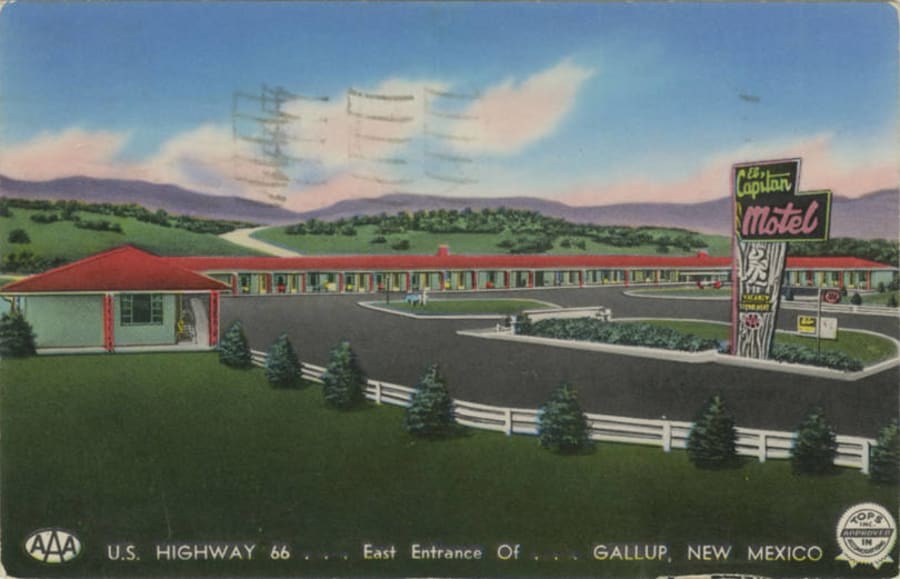
The family road trip became a genuine national ritual in these years, as fixed on the calendar as the Fourth of July. Parents pointed the car at a distant relative, a national park, or a shimmering new attraction, and the children in the back seat learned the country by watching it scroll past the window. The great mother road of that migration was U.S. Route 66, running from Chicago to Santa Monica, and in the 1950s it was booming, lined end to end with diners, filling stations, trading posts, and motels lit up like carnivals in the desert dark.
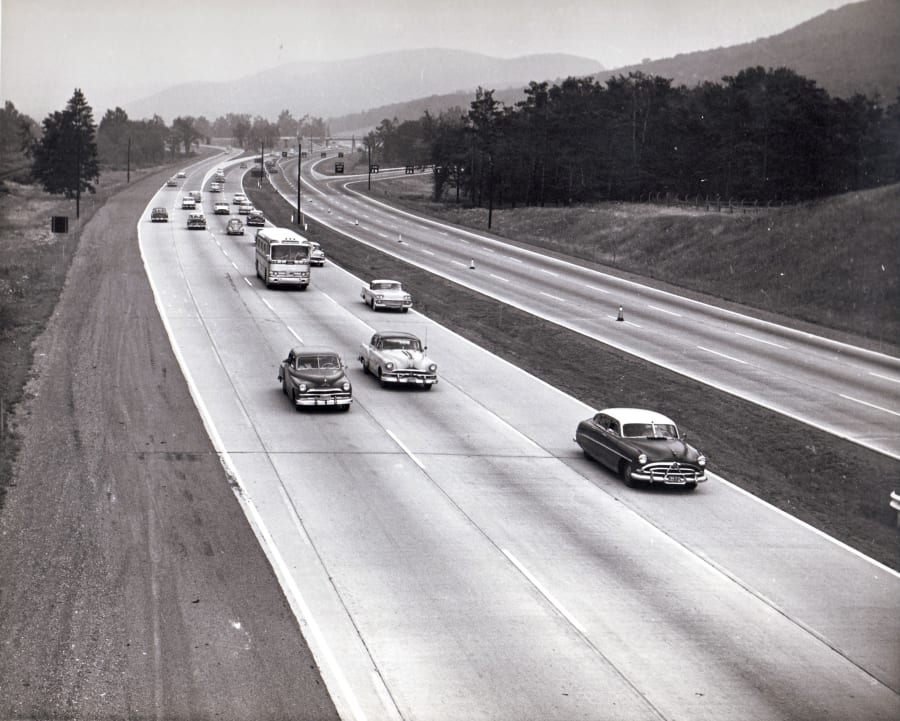
Then came the law that would change everything. On June 29, 1956, President Dwight Eisenhower signed the Federal-Aid Highway Act of 1956, committing roughly 25 billion dollars to build a 41,000-mile national system of interstate and defense highways over the following years. Eisenhower had been shaped by a grueling 1919 Army convoy across the country and again by the speed of Germany's autobahns during the war, and he wanted roads that could move a nation and, if it came to it, an army. The interstates were fast, wide, and safe in a way the old two-lane highways never were.
For the motel of the moment, the new roads were a gift, at least at first. Fresh interchanges sprouted fresh clusters of neon almost overnight, and travelers could cross the country in a fraction of the old time. But the interstates carried a quiet warning inside the boom. Unlike Route 66, which threaded straight through the heart of every small town, the new highways bypassed those towns entirely, with ramps that let drivers skip the main streets altogether. In the glow of the fifties few noticed. The reckoning that logic promised belonged to the decade still to come.
Neon, pools, and the birth of the chain
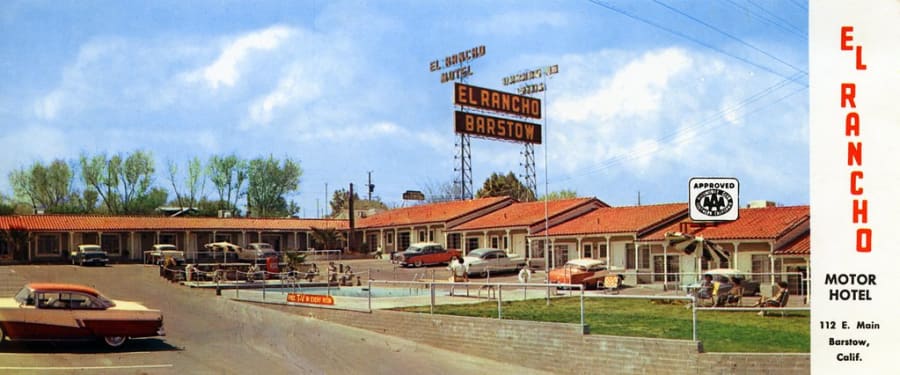
To stand in a motel parking lot at dusk in 1957 was to stand inside an advertisement for the future. The sign came first and mattered most, a towering pylon of neon and flashing bulbs, an arrow you could read from half a mile off, a name spelled in cursive script that hummed and buzzed in the twilight. Beneath it the amenities did their own advertising. A kidney-shaped swimming pool glowed turquoise, families gathered around it in the evening heat, and the promise of air conditioning, sometimes trumpeted as one hundred percent refrigerated air, drew travelers off the sunbaked highways of the Southwest like a mirage that turned out to be real. Inside the rooms, another marvel was arriving, the television set, soon in color, a small miracle bolted to the dresser.
Some motels chased attention with pure fantasy. Travelers could sleep inside a concrete teepee at a Wigwam Village, or check into a tiki-themed court dressed in Polynesian carvings and torchlight, or pass under any number of themed facades built to make the ordinary act of stopping for the night feel like an event. Novelty was a business strategy, and in a crowded market a good gimmick could keep the No Vacancy sign lit all summer.
But the most consequential change of the decade wore no feathers and needed no gimmick. It was the arrival of the standardized chain. A Memphis builder, disgusted after a family road trip spent in cramped, unpredictable motels that charged extra for the children and promised nothing about cleanliness, set out to build something more reliable, and then to make it repeatable. Standardization was the real invention: a traveler should know exactly what to expect whether the sign said Topeka or Tallahassee, and so franchised names, innkeeping schools, and traveling inspectors followed. The independent glowing courts still ruled the roadside in the 1950s, but the chain had been born, and with it a promise of sameness that would slowly reshape the American night.
Questions about 1950s motels
Can you still stay at a 1950s motel today?
Yes. Dozens of motels built in the 1950s are still independently owned and welcoming travelers, many of them lovingly restored with their neon signs, clean mid-century lines, and kidney-shaped pools intact. The stays listed on this page are all still open and bookable.
What did the Federal-Aid Highway Act of 1956 do?
Signed by President Dwight Eisenhower on June 29, 1956, the act committed roughly 25 billion dollars to construct a 41,000-mile national system of interstate highways. The new roads were faster, wider, and safer than the old two-lane highways, and they reshaped American travel by bypassing the small towns that older routes had run straight through.
Why did roadside motels use such elaborate neon signs and architecture in the 1950s?
Most 1950s motels were small independent operations competing for drivers moving at highway speed, so they needed to grab attention in seconds. Towering neon signs, boomerang rooflines in the Googie style, atomic-age motifs, kidney-shaped pools, and novelty themes like teepees and tiki courts all served the same goal, which was to pull a passing car off the road and light up the Vacancy sign one more night.
The motel, decade by decade
This is one chapter in a longer story. Follow the American motel from the estates and cabin camps that came before it, through the neon golden age, to the interstate era that changed everything. To learn more, visit our other history pages: Before the Motel, the 1930s, the 1940s, and the 1960s.