No decade turned on a sharper hinge than the 1940s. For the first years it was a nation at war, its cars up on blocks, its gas measured out in stamps, its highways strangely quiet. For the last years it was a nation let loose, pouring onto the roads in shiny new sedans with the whole family packed in the back and no particular reason to stay home. The same people who had been told that pleasure driving was nearly unpatriotic in 1943 were, by 1947, planning summer vacations by automobile as if the open road had been invented for them.
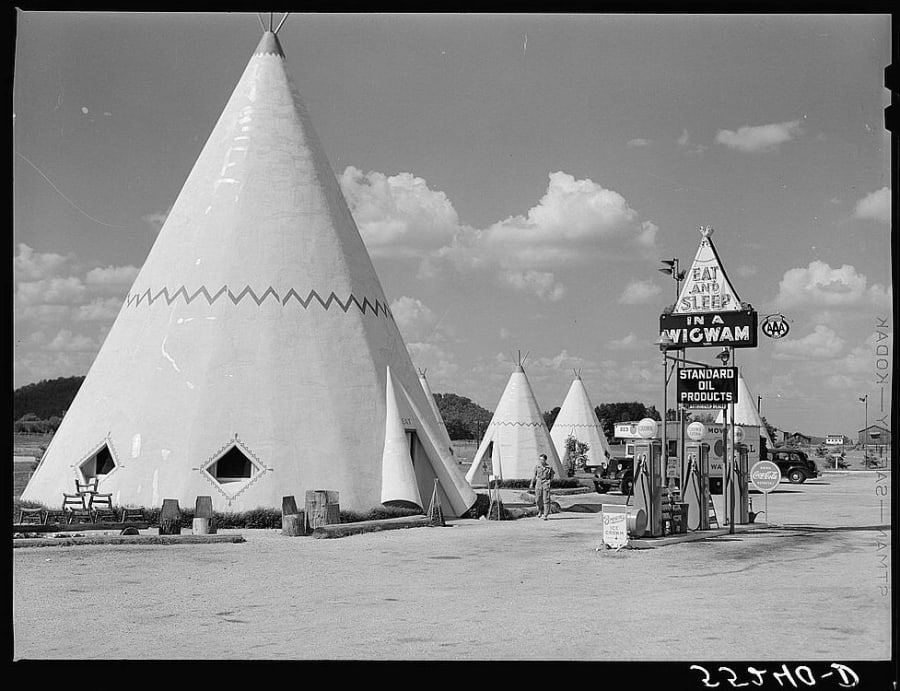
The roadside noticed. The scattered rows of little rental cabins that had sprung up along the highways in the previous decade were about to grow up. Under the pressure of first scarcity and then a flood of new travelers, the cabin court matured into something sleeker and more efficient, a single long building of connected rooms wrapped around a parking lot and lit by a glowing sign. By the end of the 1940s it even had a settled name. People called it a motel, and it was becoming one of the most recognizable features of the American landscape.
A decade split cleanly in two
The 1940s did not ease into anything. On December 7, 1941, the attack on Pearl Harbor pulled the United States into World War II, and within days the country's relationship with the automobile changed completely. Five days after the attack the government banned the manufacture of most new tires for civilian use, and on December 27, 1941, President Roosevelt ordered a tire rationing system. The problem was not oil, which America had in abundance, but rubber. The rubber-producing regions of Southeast Asia had fallen out of Allied reach, and every tire on a family sedan was rubber that could not go to a jeep or a bomber.
Gasoline rationing followed, largely as a way to save those tires by keeping cars off the road. Rationing began on the East Coast in the summer of 1942 and went nationwide on December 1, 1942, the same day a Victory speed limit of thirty-five miles per hour took effect, because higher speeds wore tread away faster. Most drivers carried an A sticker good for only a few gallons a week. Officials promoted the Vacation at Home and outright banned pleasure driving, and in some cities night courts were set up to handle the crowds caught joyriding on rationed fuel.
A country that had spent years being told to stay put discovered it was also, suddenly, prosperous, and all that pent-up energy went out the driveway and onto the highway.
Then the war ended in 1945, and the pendulum swung hard the other way. The stickers came off the windshields, the pumps ran freely again, and a country told for years to stay put discovered it was also, suddenly, prosperous. Wartime work and saving had filled bank accounts, veterans came home by the millions carrying GI Bill benefits, and families grew in the baby boom that began in 1946. All that pent-up energy went out the driveway and onto the highway.
The war, the peace, and the road
The automobile itself had gone silent for most of the war. Detroit stopped building civilian cars on February 22, 1942, and turned its assembly lines over to tanks, aircraft, and trucks. For nearly three years no new passenger car rolled off an American line, and the cars already on the road simply had to last, patched and coaxed along on threadbare tires. When production resumed in the summer of 1945, a nation of drivers with money in hand and nothing to buy created one of the great seller's markets in history.
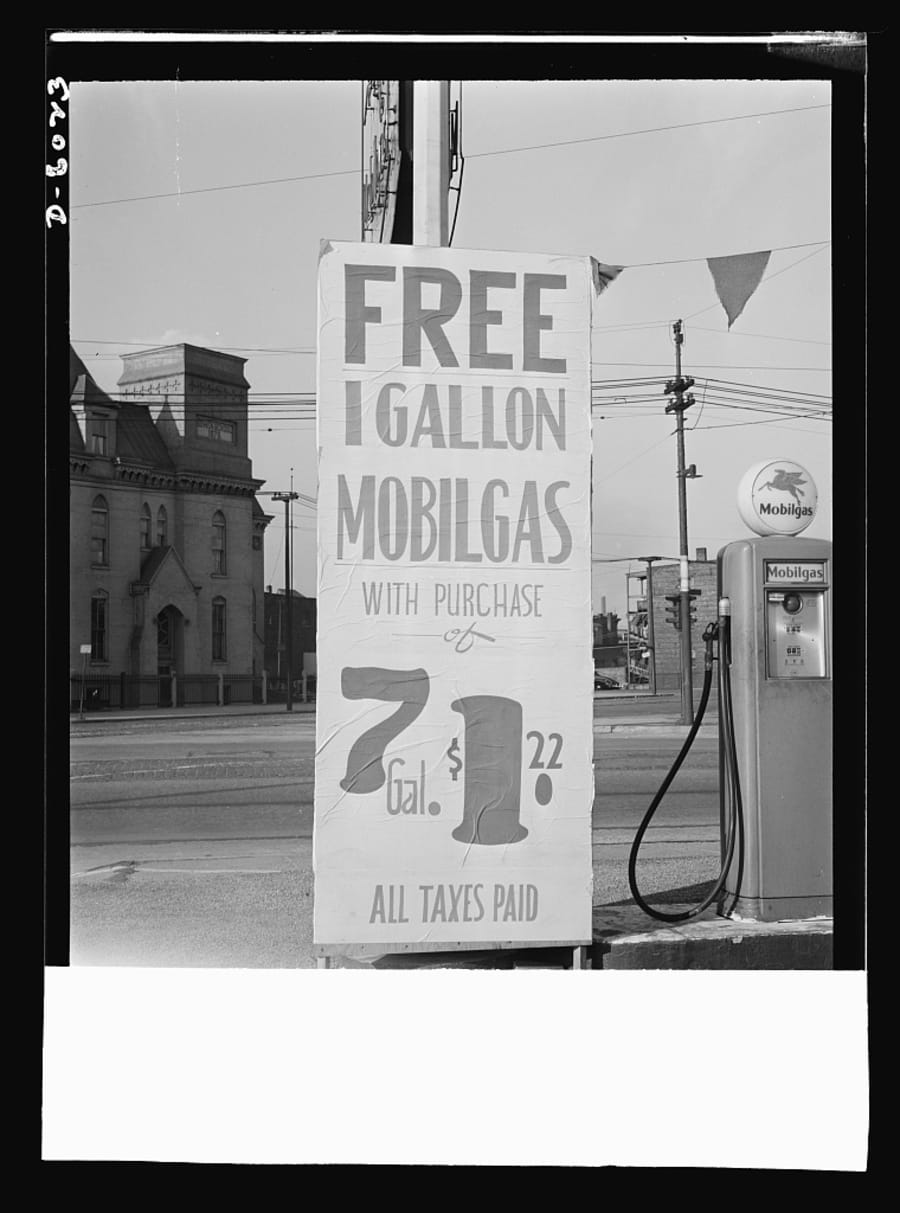
The numbers tell the story of how fast the road refilled. American factories built only about seventy thousand cars in 1945, then roughly 2.1 million in 1946 and around 3.5 million in 1947, and buyers snapped up every one. Highway travel returned to its prewar peak by 1946 and then began climbing at a steady clip that would continue for decades. Along the roadsides, drive-in theaters, drive-in restaurants, and neon-signed motels sprang up to catch the passing traffic.
They traveled on a web of numbered US highways that had been laid out in the previous decades and now carried more cars than ever. These were surface roads that ran straight through the heart of every town, often as its Main Street, so a family crossing the country met each place head-on. The bigger vision was already on paper. A 1944 federal highway act authorized a 40,000-mile national system connecting the major cities, though the great interstate build-out those plans described was still more than a decade off. For now the two-lane US routes, Route 66 chief among them, were where America drove.
The birth of the modern motel
Into this surge of traffic stepped the motel, and the 1940s were the decade it truly came of age. The word had been floating around since the 1920s as a squeeze of motor and hotel, but the thing it described was still settling into its familiar shape. Through the 1930s travelers had stayed in tourist courts and cabin courts, clusters of separate little cottages arranged in a semicircle around a lawn, with the manager's office in the middle. Charming, but wasteful to build and to run.
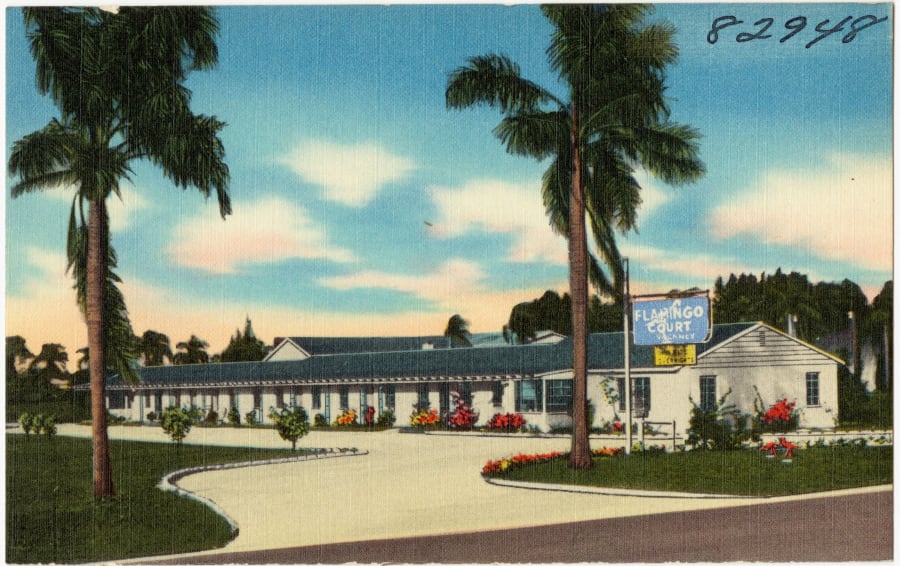
The smarter design had already begun to appear in the late 1930s, and the pressures of the 1940s pushed it to the front. Instead of freestanding cabins, builders strung the rooms together under one long roof, sharing a single foundation, one run of plumbing, one set of wiring. They bent that roofline into an L or a U wrapped around the parking lot, so a guest could pull the car up to the door of the room, with the office anchoring one end. Some operators kept a little portico or an awning over each doorway to preserve the old illusion of a private cottage, but the economics had clearly won.
This was the recognizable motel: connected rooms, off-street parking at the door, an office by the entrance, and out front a sign, more and more of it in neon, throwing colored light across the highway to pull in tired drivers after dark. As postwar travel exploded, this efficient little building became a genuine national industry. The count of motels in America was on its way from roughly twenty thousand around 1940 toward more than triple that number over the following years, one long low silhouette after another along the two-lane roads, waiting for the family sedan to slow down and turn in.
Questions about 1940s motels
Why was driving restricted during World War II?
The core problem was rubber, not fuel. After Japan's advances cut off the rubber-producing regions of Southeast Asia in late 1941, the United States faced a severe tire shortage. Tire rationing was ordered on December 27, 1941, and gasoline rationing followed, spreading nationwide on December 1, 1942, largely as a way to keep cars off the road and preserve their tires. A thirty-five mile per hour Victory speed limit and an official ban on pleasure driving reinforced the effort.
Why did road travel boom so suddenly after the war?
Several forces arrived at once. Detroit had built no civilian cars from February 1942 until the summer of 1945, so pent-up demand was enormous, and wartime wages and saving had left families with money to spend. Millions of veterans came home, the baby boom began in 1946, and rationing ended. Car production leapt from about seventy thousand in 1945 to roughly 2.1 million in 1946, and highway travel returned to its prewar peak that same year before climbing steadily for decades.
How did the motel change during the 1940s?
It matured from a loose cluster of separate cabins into a single connected building. Where the earlier tourist and cabin courts had scattered freestanding cottages around a courtyard, 1940s operators joined the rooms under one long roof, sharing foundation, plumbing, and wiring, and bent that roof into an L or a U around the parking lot with the office at one end and a neon sign out front. This efficient design, increasingly called a motel, became a national industry as postwar travel surged.
The motel, decade by decade
This is one chapter in a longer story. Follow the American motel from the estates and cabin camps that came before it, through the neon golden age, to the interstate era that changed everything. To learn more, visit our other history pages: Before the Motel, the 1930s, the 1950s, and the 1960s.