
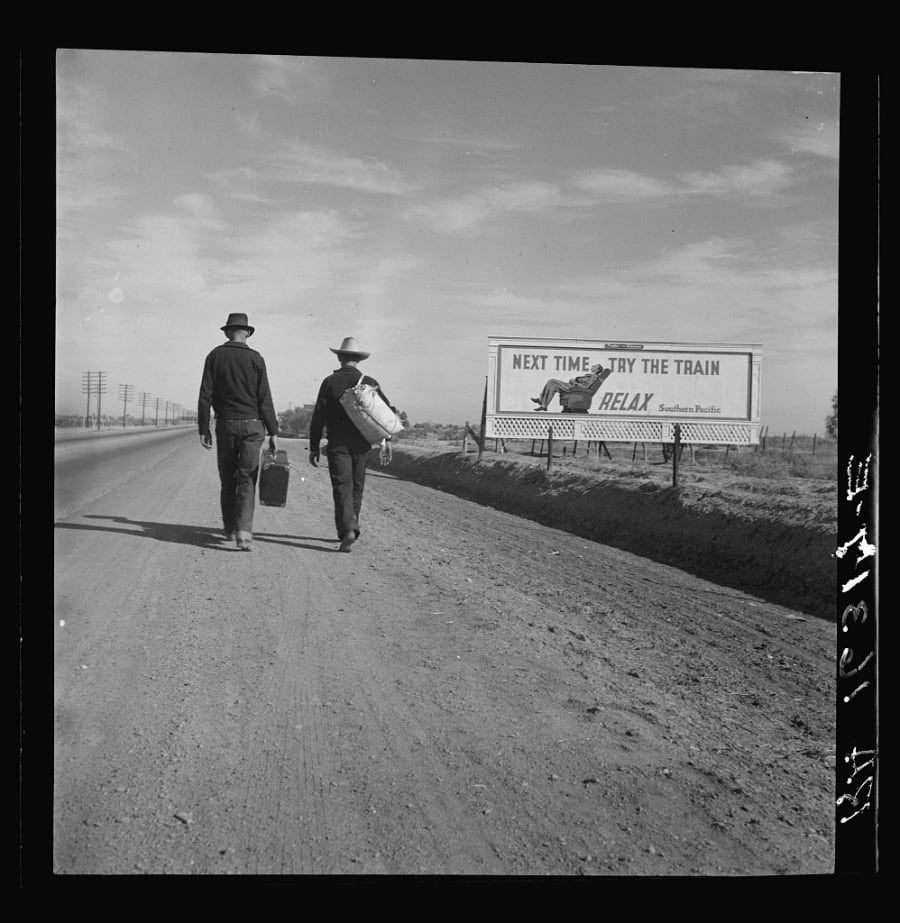
The 1930s were a decade of hardship stacked on hardship. Banks failed, farms blew away, and by some counts a quarter of the workforce stood idle. And yet, against all reason, the automobile kept spreading across the country. A machine that had been a luxury toy in 1910 had become, by the 1930s, something close to a necessity, and even families with almost nothing found a way to keep a car running. That contradiction, poverty and mobility side by side, is the strange engine of the whole decade. When people had no work at home, the car gave them a way to go looking for it somewhere else.
That searching created a demand no railroad had ever answered. The train delivered you to a depot in the center of a city, where a grand hotel waited with a bellhop and a front desk. The car, by contrast, went wherever the road went, and it arrived at odd hours, dusty and tired, on the edge of town. Travelers by automobile did not want a lobby. They wanted a place to pull off the highway, park a few feet from the door, and sleep. Out of that plain need, the American motel began to take its shape.
A country on its knees, and on the move
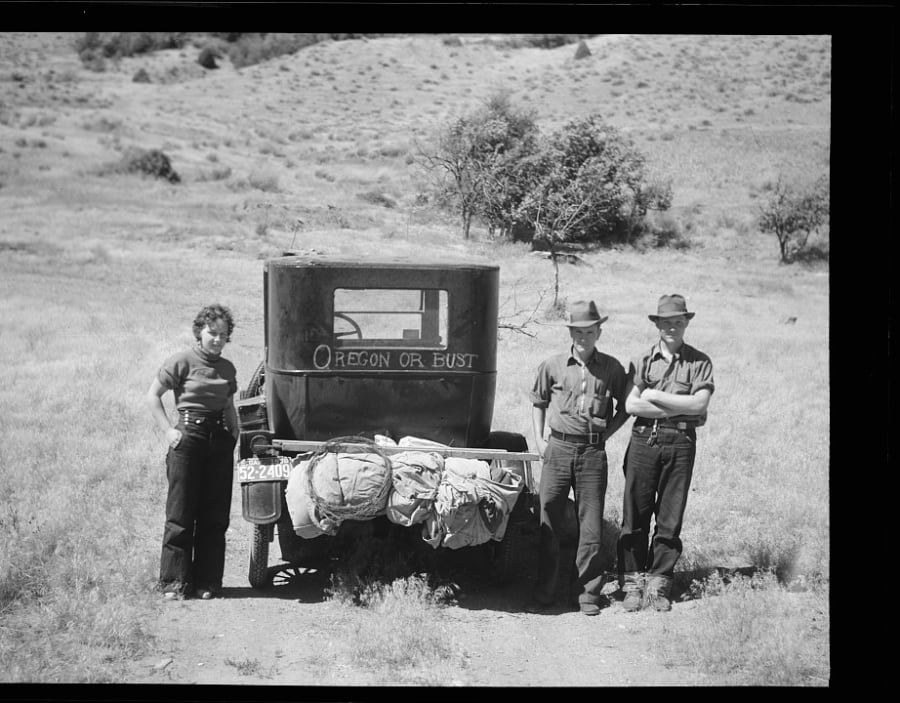
The Great Depression began with the stock market crash of 1929 and settled over the 1930s like a long grey winter. On the southern plains, drought and years of over-plowing turned topsoil into airborne dust, and the storms of the Dust Bowl darkened skies from Texas to the Dakotas. Whole families, ruined by failed crops and unpayable debts, packed what they could onto trucks and headed out. More than two million people left the plains states in that decade, and a large share of them pointed their wheels toward California.
A broke nation was quietly building some of the finest roads it had ever known, and along their shoulders a new kind of lodging took root.
Franklin Roosevelt's New Deal answered the crisis partly with roads. Agencies like the Works Progress Administration, created in 1935, and the Civilian Conservation Corps put millions of unemployed men to work grading, paving, and bridging the nation's highways. Between 1933 and 1938, federal labor crews improved Route 66 and countless other routes, and much of the modern feel of American driving, smoother surfaces and longer paved stretches, dates from these years. It was a peculiar sort of progress: a broke nation building some of the finest roads it had ever known.
The Mother Road and the pull of the West
No highway carried the decade's story like U.S. Route 66. Established in 1926 and running some 2,400 miles from Chicago to Santa Monica, it cut diagonally across the heartland toward the coast. In the 1930s it became the great channel of the Dust Bowl migration, the road that carried the ruined and the hopeful out of Oklahoma and toward the orchards of California. By 1938 it had the distinction of being the first U.S. highway paved end to end, a ribbon of concrete stitched together in the depths of hard times.
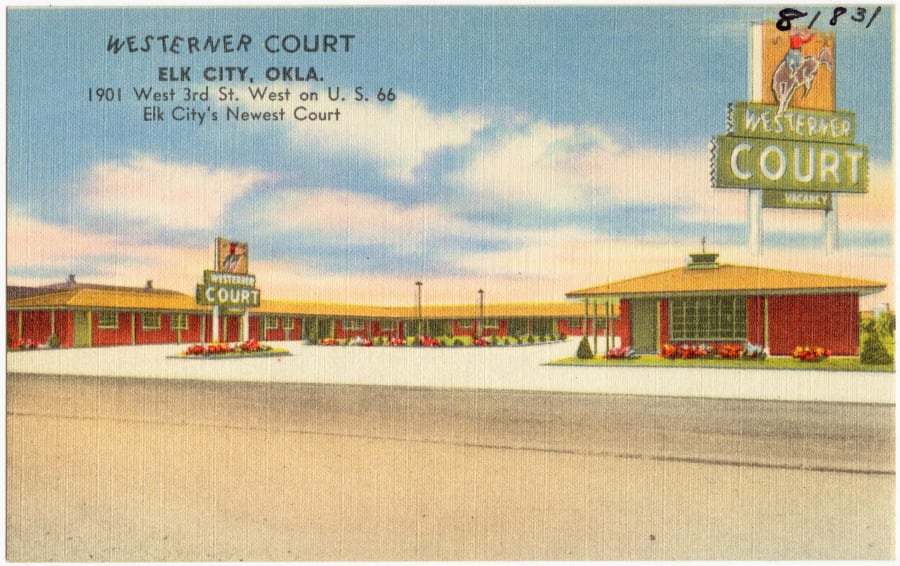
John Steinbeck fixed the road in the national memory forever. Having driven west himself in 1937, he published The Grapes of Wrath in 1939, following the fictional Joad family down the same highway toward a California that did not want them. He gave Route 66 its enduring nickname, the Mother Road, the road of flight. For every family on that pavement, the practical questions were the same ones every traveler faced: where to buy gas, where to find a meal, and where to lay down for the night when the sun dropped behind the mesas.
The answer took shape along the shoulders of the road itself. Where the free municipal campgrounds of the 1920s had let travelers pitch a tent in a city park, those public camps mostly faded by the early 1930s, undone by crowding, rising costs, and the plain fact that there was money to be made from a traveler who needed a bed. Into that gap moved the private roadside businessman, and a whole small economy of gas pumps, lunch counters, and cabins bloomed at the crossroads.
From tents to tourist courts
The lodging that served these travelers evolved in clear stages. First came the auto camp, little more than a patch of ground where you slept in or beside your car. Then came the cabin camp, a scattering of bare wooden shacks you could rent for the night and drive right up to. By the 1930s the smarter operators were building something classier and calling it a tourist court or motor court: a tidy row or horseshoe of individual cabins, each with its own door and often its own carport, arranged around a central lawn or drive, with the owner's office at the head of the U. You parked at your cabin, not down a hall. That single fact, the car within arm's reach of the bed, was the whole idea.
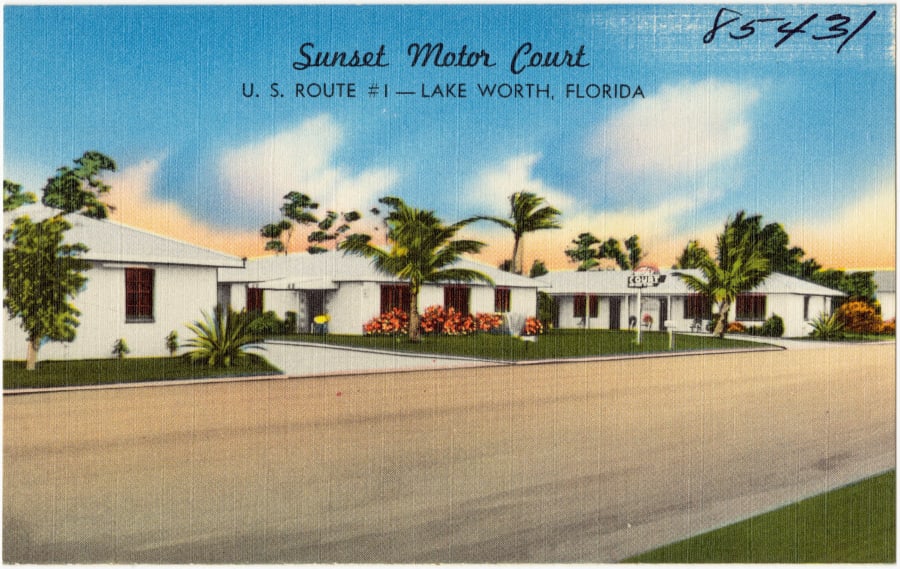
These places were overwhelmingly mom-and-pop enterprises, built and run by families who lived on site and swept the rooms themselves. A court might hold six cabins or twenty, and no two chains looked alike because there were scarcely any chains at all. Some owners reached for a little glamour with Streamline Moderne styling, the rounded corners, horizontal speed lines, and gleaming white stucco that read as modern and clean, a promise of hygiene to a traveler wary of a strange bed. The still-new word for all of it, motel, had been coined back in 1925 by the California architect Arthur Heineman, who shortened motor hotel to fit it on his sign for the Milestone Mo-Tel in San Luis Obispo. Through the 1930s the word spread slowly, jostling with tourist court and motor court, none of them yet the clear winner. The recognizable modern motel, its rooms lined up under a single long roof, was still a decade or more away. But every essential piece of it, the drive-up door, the family owner, the roadside sign, the neighboring gas and diner, was already in place by the time the decade closed.
Questions about 1930s motels
What was a tourist court?
A tourist court, also called a motor court or cottage court, was a cluster of individual rental cabins arranged in a row or horseshoe around a central drive or lawn, usually with the owner's office at the head. Each cabin had its own entrance you could drive right up to, which set it apart from a downtown hotel. Tourist courts were the classier, more respectable step up from the bare cabin camps and public auto camps of the 1920s, and they became the standard roadside lodging of the 1930s.
When was the word motel first used?
The word was coined in 1925 by California architect Arthur Heineman, who blended motor and hotel into Mo-Tel for his new Milestone Mo-Tel in San Luis Obispo. By some accounts he shortened motor hotel simply because the full phrase would not fit on his sign. The term caught on slowly, and through the 1930s it competed with names like tourist court and motor court before eventually winning out.
Why did road travel grow during the Great Depression?
Even as incomes collapsed, the automobile had already woven itself into American life, and many families kept a car running when they could barely afford anything else. Hard times actually pushed people onto the road: Dust Bowl farmers and the unemployed drove west in search of work, most famously along Route 66. At the same time, New Deal programs like the Works Progress Administration paved and improved thousands of miles of highway, making long-distance driving smoother and more common precisely when the country was struggling most.
The motel, decade by decade
This is one chapter in a longer story. Follow the American motel from the estates and cabin camps that came before it, through the neon golden age, to the interstate era that changed everything. To learn more, visit our other history pages: Before the Motel, the 1940s, the 1950s, and the 1960s.