
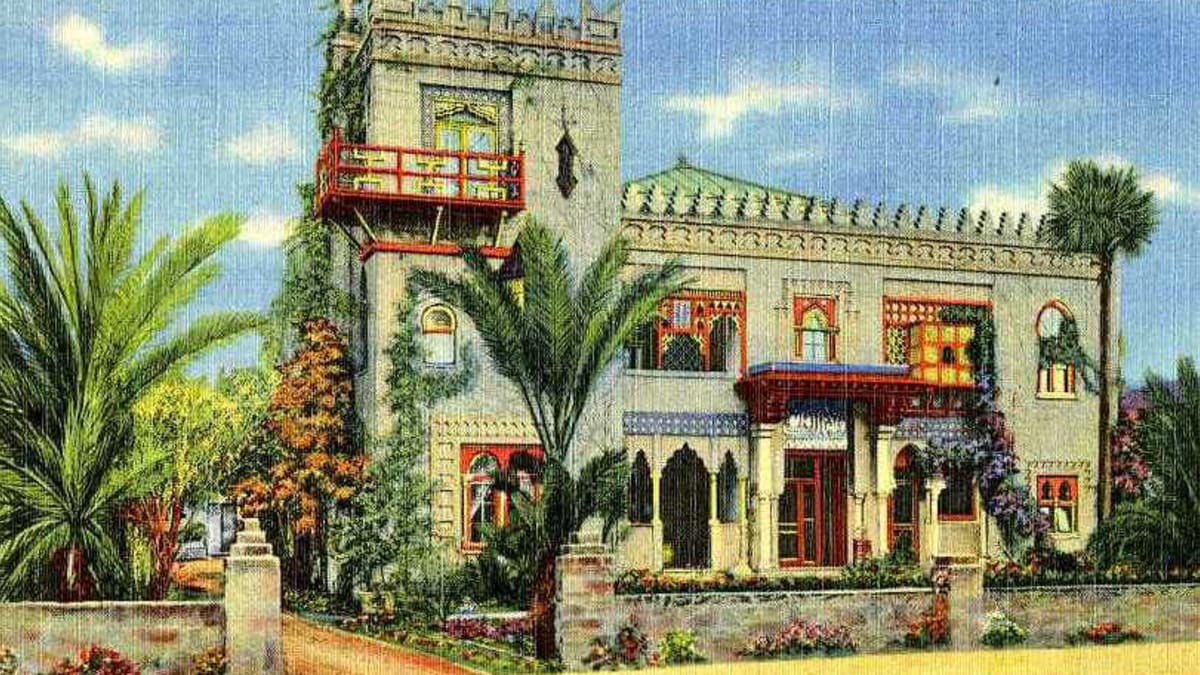
Villa Zorayda Museum
83 King St
St. Augustine, FL
A miniature Alhambra on King Street, a Gilded Age millionaire's Moorish fantasy filled with a lifetime of collected treasures.
The Villa Zorayda is one of the most unusual buildings in a city full of them, a Moorish-revival mansion on King Street modeled loosely on the Alhambra, the medieval Moorish palace in Granada, Spain. It was built in the 1880s by Franklin W. Smith, a wealthy and eccentric Boston businessman and amateur architect who fell in love with St. Augustine and with the exotic architecture of southern Spain.
Smith built the villa as a winter home, and he made it a testing ground for a construction method he championed: casting the walls in place from poured concrete mixed with the local coquina shell. The result was a striking, fireproof structure decades ahead of its time. Today the villa is a museum, filled with the art, antiquities, and curiosities collected by later owners, and it remains a small marvel of imagination in the oldest city in the country.
What Travelers Love
- The exotic Moorish-revival architecture, modeled on Spain's famous Alhambra palace
- The eclectic collection of art, antiquities, and curiosities gathered over a lifetime
- The story of the pioneering poured-concrete construction
- A quieter, more intimate stop amid the crowds of the historic district
Worth Knowing
- It is a small, self-guided or audio-guided museum, so it pairs well with other King Street sites
- The building and collection are historic and delicate, so it is a look-don't-touch experience
- Some pieces in the collection carry old legends worth taking with a grain of salt
- St. Augustine's historic core is busiest midday and in season
Learn about Villa Zorayda Museum
Franklin Smith's Moorish dream
Franklin W. Smith was a Boston hardware magnate, world traveler, and passionate amateur of architecture who dreamed of bringing the great buildings of the world to America. Enchanted by the Alhambra during his travels in Spain, he set out to build his own version in St. Augustine, choosing a portion of that palace as his model and shrinking it to the scale of a private home, which he completed in 1883.
Smith was a man of grand ideas. He imagined educational parks lined with reproductions of world-famous buildings, and the Villa Zorayda was in part a demonstration of what such reproductions could be. His enthusiasm for St. Augustine and its potential as a resort helped inspire the far wealthier Henry Flagler, who soon poured his railroad fortune into transforming the city with the grand hotels that still define its skyline.
Built of poured shell and concrete
The villa's most important innovation was hidden in its walls. Rather than lay stone or brick, Smith cast the structure in place using concrete mixed with the coquina shell abundant on the Florida coast, poured into wooden forms course by course. It was one of the earliest significant uses of this poured-concrete technique in the country, and it produced a building that was strong and fireproof.
The method caught the eye of Henry Flagler, who used the same coquina-concrete construction on a monumental scale for his great St. Augustine hotels, including the building that is now Flagler College. In that sense the modest Villa Zorayda was a proving ground for a technology that reshaped the city. Its survival for well over a century is testament to how well the approach worked.
A house full of treasures
Inside, the villa is decorated in an ornate, romantic style meant to evoke the Moorish world, with carved arches, columns, and intricate patterned detail. Under later owners it filled with an eclectic collection of art and antiquities gathered from around the globe, from Egyptian and Middle Eastern pieces to European furnishings and Asian objects, the kind of wide-ranging personal hoard a well-traveled Gilded Age collector might assemble.
Among the curiosities are pieces wrapped in colorful legend, including an ancient rug said to carry a curse, and other objects whose stories are more folklore than fact. Taken together the collection gives the villa the feel of a private cabinet of wonders, a place shaped by the tastes and travels of the people who lived in it rather than a systematic museum.
Flagler's St. Augustine
The Villa Zorayda belongs to a remarkable moment in St. Augustine's history, when the old Spanish colonial town was reinvented as a fashionable winter resort. Henry Flagler, a co-founder of Standard Oil, extended his railroad down the Florida coast and built lavish hotels here in the 1880s and 1890s, drawing wealthy northerners to escape the cold in a city of Spanish and Moorish fantasy architecture.
That Gilded Age layer sits atop centuries of earlier history, from the Timucua people who first lived along this coast to the Spanish who founded the city in 1565. Walking King Street today, the visitor passes through all of it, and the Villa Zorayda, small and singular among Flagler's grand hotels, is one of the most personal expressions of the era's romantic imagination.
Closest Boutels
The closest Boutel™ stays, so you can turn this stop into an overnight. Each is a place we chose through independent editorial review, never a paid placement.
Details
St. Augustine, FL
Frequently asked questions
What is the Villa Zorayda Museum?
The Villa Zorayda Museum, in historic St. Augustine, Florida, is a striking and unusual historic house museum housed in an exotic mansion modeled after a portion of the famous Alhambra palace in Spain. Built in the late nineteenth century by an eccentric millionaire as a winter home, the Moorish-revival villa features ornate Spanish and Moorish-inspired architecture, intricate details, and a collection of antiques, art, and curiosities gathered by its builder, including a mysterious ancient rug. A one-of-a-kind architectural gem and museum, the Villa Zorayda offers a fascinating glimpse of exotic design and Gilded Age tastes. With its Alhambra-inspired architecture and collections, the Villa Zorayda Museum offers a fascinating destination in Florida.
What can you see at the Villa Zorayda Museum?
You can tour the exotic Moorish-revival mansion modeled on the Alhambra, admiring its ornate Spanish and Moorish-inspired architecture, intricate carvings, tiles, and details, and see the collection of antiques, art, and curiosities gathered by its eccentric builder, including a famous ancient rug said to be thousands of years old with a mysterious legend. The striking architecture and the unusual collections are highlights, offering a one-of-a-kind experience. It is a treat for lovers of architecture and the exotic. With its Alhambra-inspired building and curiosities, the Villa Zorayda Museum offers an engaging visit in St. Augustine, Florida.
When is the best time to visit the Villa Zorayda Museum?
As an indoor historic house museum, the Villa Zorayda Museum is enjoyable year-round in any weather, making it a welcome stop during the hot Florida summer or a rainy day, though checking current days and hours before you go is wise. Fall through spring offers the most pleasant weather for combining a visit with exploring historic St. Augustine on foot. Because it is climate-controlled and unique, the Villa Zorayda Museum makes a reliable and rewarding stop any time of year in St. Augustine, Florida.
Why was the Villa Zorayda built to look like the Alhambra?
The Villa Zorayda was built in the late nineteenth century by an eccentric millionaire who was so captivated by the famous Alhambra palace in Granada, Spain, a masterpiece of Moorish architecture, that he modeled his St. Augustine winter home after a portion of it, recreating its exotic style and details. This reflected the era's fascination with exotic and romantic architecture, as well as the builder's personal passion. The result is a striking, one-of-a-kind building unlike anything else in the city. This unusual inspiration gives the Villa Zorayda Museum its distinctive character in St. Augustine, Florida.
What is near the Villa Zorayda Museum?
The Villa Zorayda Museum is in historic St. Augustine, Florida, near the Lightner Museum, the Castillo de San Marcos, St. George Street with the Oldest Store Museum, and the Bridge of Lions. That makes the Villa Zorayda Museum a fascinating stop to combine with the Lightner Museum, the Castillo de San Marcos, and the other attractions of historic St. Augustine on a visit to Florida.
Nearby
Lightner Museum
0.1 miles away
Everyone photographs Flagler College across the street; fewer step into its sister building.
The Oldest Store Museum area on St. George Street
0.2 miles away
For a quick, free taste of the oldest city, walk St. George Street, the pedestrian lane running through the colonial old town.

Castillo de San Marcos
0.4 miles away
A real fort with a moat, a drawbridge, and cannon is an easy sell. The Castillo de San Marcos on the St.
Bridge of Lions
0.4 miles away
St. Augustine's most photographed crossing, a graceful 1920s Mediterranean Revival drawbridge over Matanzas Bay, guarded at its downtown end by two marble lions named Faithful and Firm.
St. Augustine Alligator Farm Zoological Park
1.6 miles away
Kids remember this one. The Alligator Farm at 999 Anastasia Blvd has been running since 1893 and holds every kind of crocodilian on earth, including a giant saltwater croc named Maximo.
St. Augustine Lighthouse and Maritime Museum
1.7 miles away
A black-and-white spiral brick tower first lit in 1874, rising 165 feet over the nation's oldest port on Anastasia Island.

Vilano Beach
2.0 miles away
Vilano Beach is a wide, easygoing Atlantic beach and retro fishing pier just across the inlet from downtown St. Augustine, one of the finest sunset perches on the coast.

Anastasia State Park
3.0 miles away
Just across the Bridge of Lions from downtown St. Augustine, this barrier-island state park protects four miles of white quartz-sand beach, tall dunes, and the calm Salt Run lagoon for kayaking.