

Castillo de San Marcos
11 S Castillo Dr, St. Augustine, FL
St. Augustine, FL
A star-shaped Spanish fortress built of seashell stone that soaked up cannonballs instead of shattering, guarding the oldest city in the country for more than three centuries.
The Castillo de San Marcos is the oldest masonry fort in the continental United States, a four-pointed star of a fortress that the Spanish began building in 1672 to guard St. Augustine and their claim to Florida. It replaced a series of wooden forts that had rotted or burned, and it has stood on the shore of Matanzas Bay for more than three and a half centuries.
Its secret is the stone. The fort is built almost entirely of coquina, a soft local rock made of countless tiny seashells cemented together over ages. When enemy cannonballs struck the walls, the spongy coquina did not shatter like brick or granite but absorbed the blow, swallowing the shot the way a pillow catches a fist. That strange property helped make the Castillo one of the few forts of its age never taken by force.
What Travelers Love
- The star-shaped bastions and the walk along the gun deck over the bay
- The coquina stone, made of tiny compressed seashells, that absorbed cannon fire
- Living history demonstrations, including the firing of historic cannon
- Watching the light and the water change from the ramparts above Matanzas Bay
Worth Knowing
- The fort is run by the National Park Service and welcomes visitors most days of the year
- Weekend cannon-firing demonstrations draw a crowd, so arrive early for a good spot
- Much of the fort is open to sun and weather, so bring a hat and water in summer
- The surrounding historic district is very walkable, so a stroll pairs naturally with a visit
Learn about Castillo de San Marcos
Three centuries under four flags
The Spanish founded St. Augustine in 1565, decades before the English settled Jamestown or Plymouth, and for a century the town defended itself with flimsy wooden forts. After an English raid burned the settlement, the Spanish crown authorized a permanent stone fortress, and construction of the Castillo began in 1672 and stretched over decades. It anchored Spanish Florida through repeated sieges, including a long English assault in 1702 that burned the town but could not break the fort, whose coquina walls simply swallowed the bombardment.
Over the following two centuries the Castillo flew four flags. Spain ceded Florida to Britain in 1763, then regained it after the American Revolution, and finally handed it to the United States in 1821. The Americans renamed it Fort Marion for a time before its Spanish name was restored. In each era it served as fortress, prison, and garrison, and its walls witnessed the long, often painful sweep of Florida's colonial and early American history.
The stone that saved the fort
Coquina, from the Spanish word for tiny shells, is quarried from beds of ancient shell that formed on nearby Anastasia Island. Freshly cut it is soft and easy to shape, then it hardens as it dries in the air. Its porous, cushioning texture is what let the Castillo survive bombardments that would have cracked a conventional fort, and stunned attackers reported that their cannonballs seemed to sink harmlessly into the walls.
Enslaved and conscripted laborers, Spanish soldiers, free and enslaved Africans, and native workers quarried, hauled, and laid the coquina over many years, and the fort's construction is bound up with the story of the diverse people who built colonial St. Augustine. The walls were once coated in white plaster and painted, so the weathered gray stone visitors see today looked quite different when Spanish soldiers manned its guns.
A place of imprisonment
The Castillo's thick walls made it a prison as often as a fortress. During the American period, native leaders from the Plains and the Southeast were held here as prisoners of war, among them Chiricahua Apache and members of Southern Plains tribes brought far from their homelands in the 1870s and 1880s. Their captivity here is a somber chapter, and the Park Service tells it as part of the fort's full story.
The dark interior rooms, the powder magazines, and the cells all speak to the fort's many uses across three centuries. Visitors can walk the gun deck, peer into the vaulted chambers, and stand on the bastions that once bristled with Spanish cannon, feeling how a single stronghold could serve as shield, barracks, and jail across so many different eras and rulers.
Season by season on the First Coast
Spring and fall are the finest times to visit, with warm dry days, comfortable humidity, and the historic district at its most pleasant for walking between the fort and the old streets. These shoulder seasons draw steady crowds without the peak heat.
Summer is hot and humid with afternoon thunderstorms, and the open ramparts offer little shade, so early morning is the kindest time to climb the walls. Winter is mild and often clear, the quietest season, when the fort and the town feel unhurried, though the occasional cold front can bring a brisk wind off Matanzas Bay.
Closest Boutels
The closest Boutel™ stays, so you can turn this stop into an overnight. Each is a place we chose through independent editorial review, never a paid placement.
Details
St. Augustine, FL
Frequently asked questions
What is the Castillo de San Marcos?
The Castillo de San Marcos, in the historic city of St. Augustine in northeast Florida, is the oldest masonry fort in the continental United States, a magnificent Spanish colonial fortress guarding the harbor. Built by the Spanish in the late seventeenth century from coquina, a distinctive local shellstone, the star-shaped fort has stood for centuries and survived many sieges, its soft coquina walls famously absorbing cannonballs. Now a national monument, the imposing fort offers ramparts, cannons, exhibits, and reenactments, along with beautiful views over the bay. With its historic Spanish fort and coquina walls, the Castillo de San Marcos offers a fascinating destination in Florida.
What is the coquina stone of the Castillo de San Marcos?
The Castillo de San Marcos was built from coquina, a soft, porous shellstone made of compressed shells and quarried locally near St. Augustine, which proved remarkably effective for fortification. Rather than shattering under cannon fire like harder stone, the somewhat spongy coquina absorbed and trapped cannonballs, allowing the fort's walls to withstand bombardment that would have destroyed conventional masonry. This unusual and effective building material is a key reason the fort survived numerous sieges intact over the centuries. Learning about the remarkable coquina walls is a fascinating part of a visit to the Castillo de San Marcos in Florida.
What can you do at the Castillo de San Marcos?
You can explore the historic Spanish fort, walking the ramparts, seeing the cannons and gun deck, touring the rooms and exhibits on the fort's history and the many nations that held it, watching cannon-firing demonstrations and reenactments, and taking in beautiful views over Matanzas Bay and St. Augustine. The historic fortress, the cannons, and the views are highlights, offering a moving connection to colonial history. It is an easy walk to the fort in the historic city. With its Spanish fort, cannons, and history, the Castillo de San Marcos offers a rewarding experience in St. Augustine, Florida.
When is the best time to visit the Castillo de San Marcos?
Fall, winter, and spring offer the most comfortable weather for exploring the largely outdoor fort, with mild temperatures far more pleasant than the hot, humid summer, when midday is very warm and afternoon storms common, so mornings are best then. The fort is open year-round, and checking current hours and any demonstration schedules is wise. St. Augustine's mild winters make it a pleasant off-season stop. For the most comfortable weather to explore the fort, aim for fall through spring at the Castillo de San Marcos in St. Augustine, Florida.
What is near the Castillo de San Marcos?
The Castillo de San Marcos is in historic St. Augustine in northeast Florida, near the Bridge of Lions, St. George Street with the Oldest Store Museum, the Lightner Museum and Villa Zorayda Museum, the St. Augustine Lighthouse, and the St. Augustine Alligator Farm. That makes the Castillo de San Marcos a fascinating stop to combine with the Bridge of Lions, St. George Street, and the other attractions of historic St. Augustine on a visit to Florida.
Nearby
The Oldest Store Museum area on St. George Street
0.3 miles away
For a quick, free taste of the oldest city, walk St. George Street, the pedestrian lane running through the colonial old town.

Villa Zorayda Museum
0.4 miles away
Most visitors walk right past this one on their way to the fort.
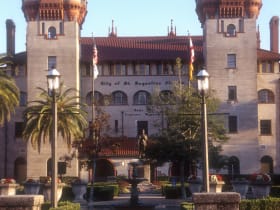
Lightner Museum
0.4 miles away
Everyone photographs Flagler College across the street; fewer step into its sister building.
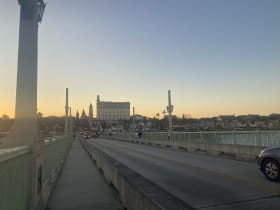
Bridge of Lions
0.5 miles away
St. Augustine's most photographed crossing, a graceful 1920s Mediterranean Revival drawbridge over Matanzas Bay, guarded at its downtown end by two marble lions named Faithful and Firm.
St. Augustine Alligator Farm Zoological Park
1.6 miles away
Kids remember this one. The Alligator Farm at 999 Anastasia Blvd has been running since 1893 and holds every kind of crocodilian on earth, including a giant saltwater croc named Maximo.
St. Augustine Lighthouse and Maritime Museum
1.6 miles away
A black-and-white spiral brick tower first lit in 1874, rising 165 feet over the nation's oldest port on Anastasia Island.

Vilano Beach
1.7 miles away
Vilano Beach is a wide, easygoing Atlantic beach and retro fishing pier just across the inlet from downtown St. Augustine, one of the finest sunset perches on the coast.

Anastasia State Park
3.0 miles away
Just across the Bridge of Lions from downtown St. Augustine, this barrier-island state park protects four miles of white quartz-sand beach, tall dunes, and the calm Salt Run lagoon for kayaking.