
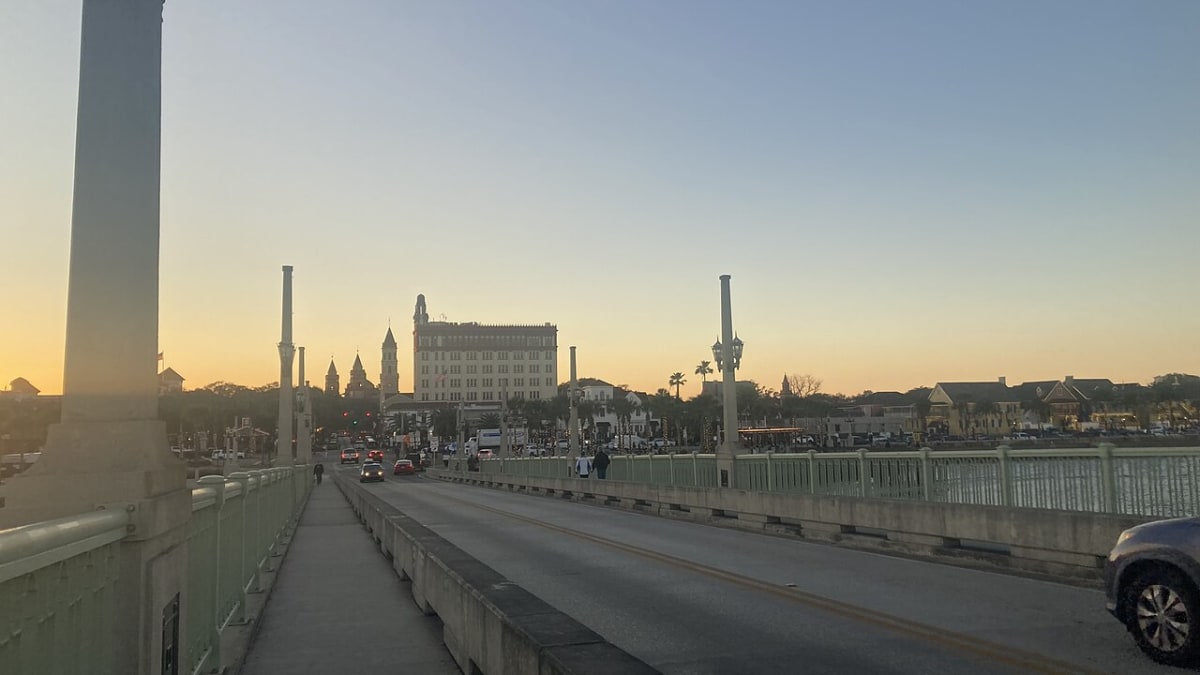
Bridge of Lions
SR A1A over Matanzas Bay
St. Augustine, FL
A graceful Roaring Twenties drawbridge over Matanzas Bay, watched over at its western end by two marble lions named Faithful and Firm.
The Bridge of Lions is the most photographed crossing in Florida's oldest city, a low, elegant span that carries the coastal highway over Matanzas Bay from downtown St. Augustine to Anastasia Island. It is named for the two marble lions that sit at its western end, calm and watchful, and it was built in the 1920s not as a plain piece of infrastructure but as a work of civic pride, dressed in Mediterranean Revival towers and ornament to match the beauty of the town it serves.
Most bridges are things you drive across without a second thought. This one people stop for. They walk out onto it to feel the wind off the bay, they pose beside the lions, and they line the rail when the bascule leaves rise on the half hour to let a sailboat glide through. It is a rare thing, a piece of ordinary transportation that a whole city has decided to love.
What Travelers Love
- The pair of marble lions at the town end, a photograph almost everyone in St. Augustine takes
- Walking the pedestrian span for open water views of the bay, the fort, and the historic skyline
- Watching the bascule bridge swing open on the half hour to let tall sailboats through
- The Mediterranean Revival towers and railings that make it feel more like a monument than a road
Worth Knowing
- It is a working drawbridge that opens on a schedule for boat traffic, so expect a short pause if you time it wrong
- There are sidewalks on both sides, so you can cross on foot from the downtown bayfront in a few minutes
- Parking downtown is tight in season, so it is easiest to walk to the bridge from the historic district
- The best light for the lions and the water is early morning or the hour before sunset
Learn about Bridge of Lions
Built in the boom, saved from the bust
The bridge grew out of Florida's frenzied land boom of the 1920s, when developers were filling marshland and dreaming up new neighborhoods along the coast. A crossing to Anastasia Island was meant to open the far shore to that growth, and rather than build something purely practical, the planners chose a design worthy of an old and proud city. Construction ran from 1925 to 1927, and the finished bridge opened dressed in the Mediterranean Revival style then sweeping Florida, with ornamental towers and detailing that softened its steel-and-concrete bones.
Then the boom collapsed. The great Florida land bubble burst before the decade was out, and much of the grand development that the bridge was supposed to feed never came. The crossing itself, though, was already built and already useful, so it stayed, carrying traffic and quietly becoming one of the defining images of St. Augustine long after the speculators had moved on.
The lions, Faithful and Firm
The bridge takes its name from a pair of white marble lions that recline at its downtown end. They are copies of the famous Medici lions of Florence, Italy, carved in that same country and given to St. Augustine by Dr. Andrew Anderson, a leading citizen, just as the bridge was being finished. Their names, Fiel and Firme, mean Faithful and Firm, and over the decades they became the city's unofficial mascots, keeping their steady vigil over the water.
When the bridge was rebuilt in the 2000s, the lions were carefully lifted from their pedestals and taken away for safekeeping, and their absence was felt so keenly that their return became a small civic event. Today they sit back in their places at the head of the span, still the picture most visitors carry home, a touch of Renaissance Italy standing guard over a Florida bay.
A bridge worth crossing on foot
The Bridge of Lions is a double-leaf bascule bridge, which means the roadway is built in two halves that swing upward from the middle like a pair of gates to let tall boats pass beneath. Watching it open, with the leaves rising and a sailboat slipping through the gap, is one of the small pleasures of a St. Augustine afternoon, and it happens often enough on a busy day that you rarely wait long to see it.
Both sides of the span carry a sidewalk, so the best way to enjoy the bridge is to walk it. From the middle you get an open view back at the town, with the old Spanish fort and the bayfront on one side and the wide Matanzas River running out toward the ocean on the other. By the 1980s the bridge had earned a place on the National Register of Historic Places, and after an extensive early-2000s rehabilitation it was rebuilt to last, so what looks like a period piece is in fact a carefully renewed one.
Visiting the Bridge of Lions
The bridge sits at the heart of St. Augustine, carrying State Road A1A over Matanzas Bay from the downtown bayfront to Anastasia Island. From the historic district it is an easy walk, and since downtown parking fills fast in season, strolling to the bridge from the plaza or the fort is usually simpler than driving to it. Give yourself time to walk out onto the span and back and to visit the lions at the western end.
Because it is a real working drawbridge, it opens on a set schedule to let boats through, so a short pause now and then is part of the experience rather than a nuisance. Come early in the day or near sunset for the softest light on the marble and the water, and pair the crossing with the fort and bayfront on the town side, or the lighthouse and beaches once you reach the island.
Closest Boutels
The closest Boutel™ stays, so you can turn this stop into an overnight. Each is a place we chose through independent editorial review, never a paid placement.
Details
St. Augustine, FL
Frequently asked questions
What is the Bridge of Lions?
The Bridge of Lions, in the historic city of St. Augustine in northeast Florida, is a beautiful and iconic drawbridge spanning the Matanzas Bay, connecting downtown St. Augustine with Anastasia Island. Named for the pair of marble Medici lion statues that guard its western approach, the elegant early-twentieth-century bridge is a beloved landmark, celebrated for its graceful Mediterranean-revival architecture and its lions. A working drawbridge that still lifts for passing boats, it offers lovely views over the bay and the historic city. With its marble lions, historic architecture, and bay setting, the Bridge of Lions offers a delightful destination in Florida.
Why is it called the Bridge of Lions?
The Bridge of Lions is named for the pair of white marble lion statues that stand guard at its western entrance in downtown St. Augustine, sculpted in the style of the famous Medici lions of Florence, Italy, and given to the city when the bridge was built in the nineteen-twenties. The elegant lions have become beloved symbols of the bridge and the city. The bridge and its lions reflect the Mediterranean-revival style popular in the era. These graceful marble lions are why the landmark bears its name, adding to the charm of the Bridge of Lions in St. Augustine, Florida.
What can you do at the Bridge of Lions?
You can walk or drive across the historic drawbridge for lovely views over Matanzas Bay and the St. Augustine skyline, admire the marble lion statues and the graceful architecture, watch the bridge lift for passing boats, photograph the landmark, and explore the historic downtown and waterfront at its western end or Anastasia Island to the east. The lions, the bridge, and the bay views are highlights, an easy and scenic stop in the historic city. With its marble lions, historic charm, and bay views, the Bridge of Lions offers a delightful experience in St. Augustine, Florida.
When is the best time to visit the Bridge of Lions?
Fall through spring offers the most comfortable weather for walking the bridge and enjoying the views, with mild temperatures far more pleasant than the hot, humid summer, while the bridge is scenic year-round and lovely at sunset or when lit in the evening. St. Augustine's mild winters make it a pleasant off-season stop. The bridge pairs well with exploring the historic downtown. For the most comfortable weather to walk the bridge and enjoy the city, aim for fall through spring at the Bridge of Lions in St. Augustine, Florida.
What is near the Bridge of Lions?
The Bridge of Lions is in historic St. Augustine in northeast Florida, spanning Matanzas Bay near the Castillo de San Marcos, St. George Street with the Oldest Store Museum, the Lightner Museum and Villa Zorayda Museum, and, across on Anastasia Island, the St. Augustine Lighthouse and Anastasia State Park. That makes the Bridge of Lions a delightful stop to combine with the Castillo de San Marcos, St. George Street, and the other attractions of historic St. Augustine on a visit to Florida.
Nearby
The Oldest Store Museum area on St. George Street
0.2 miles away
For a quick, free taste of the oldest city, walk St. George Street, the pedestrian lane running through the colonial old town.
Lightner Museum
0.3 miles away
Everyone photographs Flagler College across the street; fewer step into its sister building.

Villa Zorayda Museum
0.4 miles away
Most visitors walk right past this one on their way to the fort.

Castillo de San Marcos
0.4 miles away
A real fort with a moat, a drawbridge, and cannon is an easy sell. The Castillo de San Marcos on the St.
St. Augustine Alligator Farm Zoological Park
1.3 miles away
Kids remember this one. The Alligator Farm at 999 Anastasia Blvd has been running since 1893 and holds every kind of crocodilian on earth, including a giant saltwater croc named Maximo.
St. Augustine Lighthouse and Maritime Museum
1.3 miles away
A black-and-white spiral brick tower first lit in 1874, rising 165 feet over the nation's oldest port on Anastasia Island.

Vilano Beach
1.9 miles away
Vilano Beach is a wide, easygoing Atlantic beach and retro fishing pier just across the inlet from downtown St. Augustine, one of the finest sunset perches on the coast.

Anastasia State Park
2.6 miles away
Just across the Bridge of Lions from downtown St. Augustine, this barrier-island state park protects four miles of white quartz-sand beach, tall dunes, and the calm Salt Run lagoon for kayaking.