
Price Tower
701 S Keeler Ave, Bartlesville, OK
Bartlesville, OK
A slender copper-and-glass tower rising alone from the Oklahoma prairie, the one skyscraper Frank Lloyd Wright ever saw finished.
Price Tower is the only skyscraper Frank Lloyd Wright ever built, a nineteen-story tower of concrete, copper, and glass that rises abruptly from the flat prairie of Bartlesville, Oklahoma. Wright called it the tree that escaped the crowded forest, a design he first drew for a New York City block in the 1920s that finally found its home, decades later, alone on the plains.
Completed in 1956 for the H. C. Price Company, a pipeline construction firm, the tower was built to hold offices, apartments, and the company's own headquarters all in one slim mast. Its floors cantilever out from a central concrete core like branches from a trunk, and its skin of green-patinaed copper louvers and gold-tinted glass make it unlike anything else on the Oklahoma horizon.
What Travelers Love
- Standing beneath the only skyscraper Frank Lloyd Wright ever built
- The tower's copper fins and patterned glass catching the prairie light
- The strange, wonderful sight of a Wright high-rise rising alone above a small town
- The pinwheel floor plan and the way no two sides of the tower look the same
Worth Knowing
- The tower's condition and public access have shifted over the years, so check what is open before you go
- It is a working piece of architecture, not a natural site, so a visit is about design and history
- Downtown Bartlesville is walkable and pairs well with the tower
- Woolaroc, the Frank Phillips ranch and museum, is a rewarding half-day trip nearby
Learn about Price Tower
The tree that escaped the forest
Wright first designed this building in 1927 as St. Mark's-in-the-Bouwerie, a cluster of apartment towers for a crowded block in New York City. The stock market crash of 1929 killed the project, and the drawings sat in his files for a quarter century. When the oilman Harold Price came looking for a headquarters, Wright pulled the old design back out and planted a single tower of it in Oklahoma, calling it the tree that escaped the crowded forest.
The structure works like a tree in more than name. A central concrete core, sunk deep like a taproot, carries the whole load, and each floor cantilevers outward from it, so the outer walls hang free rather than holding the building up. This let Wright wrap the tower in thin copper fins and glass instead of heavy masonry, and it let him rotate the plan into a pinwheel of four unequal quadrants, three for offices and one for two-story apartments.
Oil, pipelines, and a prairie skyscraper
Bartlesville sat at the heart of Oklahoma's early oil wealth. It was here that the first commercial oil well in what would become the state came in around 1897, and the town grew into a headquarters for the industry, most famously for Phillips Petroleum, founded by the brothers Frank and L. E. Phillips. The H. C. Price Company, which built the tower, made its money laying the great cross-country pipelines that carried that oil to market.
That a firm from a small prairie town could commission the era's most famous architect says a great deal about the money and ambition the oil boom brought to Oklahoma. The land had been the Osage Reservation, and the Osage Nation, whose mineral rights made its members among the wealthiest people in the world for a time in the 1920s, remains centered just west of here. The tower is one monument of that oil century, standing over a town the industry built.
A building you can read from the sidewalk
Wright designed almost everything about the tower, down to the furniture, the metal reliefs, and the cast-concrete patterns. The copper louvers that shade the glass have gone green with age, and the whole exterior is a play of verticals and diagonals that changes as you walk around it, since no two faces are the same. Inside, Wright's murals, built-in cabinetry, and a two-story apartment survive as he intended them.
For a small town, having a Wright skyscraper is both a gift and a burden. The tower has passed through several owners and uses over the decades, serving as an arts center, a museum, and a boutique hotel at various times, and its condition and what is open to the public have changed with each chapter. It is best to check ahead, but even seen only from the sidewalk it is one of the most remarkable buildings in the American interior.
Bartlesville and the Osage country
Bartlesville itself is worth a wander, a walkable downtown of early-twentieth-century commercial buildings, with the Bartlesville Community Center, another late Wright-influenced design, nearby. The town's oil-baron history is written into its handsome houses and civic buildings.
Just outside town, the ranch of oilman Frank Phillips, called Woolaroc, spreads across the Osage hills as a wildlife preserve and museum, home to bison, elk, and longhorn cattle and a deep collection of Western and Native American art. The surrounding Osage prairie, tallgrass country rolling to the horizon, is some of the last great unplowed grassland in the country.
Closest Boutels
The closest Boutel™ stays, so you can turn this stop into an overnight. Each is a place we chose through independent editorial review, never a paid placement.
Details
Bartlesville, OK
Frequently asked questions
What is Price Tower?
Price Tower, in Bartlesville, Oklahoma, is a remarkable skyscraper designed by the legendary architect Frank Lloyd Wright, famous as the only realized skyscraper of his career. This striking and unusual tower, rising unexpectedly from the small Oklahoma city, showcases Wright's bold and distinctive design, with a copper-clad, geometric form unlike any ordinary office building. A National Historic Landmark, it has housed offices, apartments, and, at times, an arts center and hotel, and remains a fascinating destination for admirers of architecture and Wright's genius. A unique and historic architectural landmark, it fascinates visitors. With its Wright design, Price Tower offers a compelling destination in Oklahoma.
Why is Price Tower significant?
Price Tower is significant as the only skyscraper ever built from a design by the legendary architect Frank Lloyd Wright, making it a singular realization of his vision for a tall building and a National Historic Landmark. Its bold, geometric, copper-clad design, rising from a small Oklahoma city, embodies Wright's distinctive genius and unconventional approach. As his sole realized skyscraper, it holds a special place in architectural history. Understanding this significance enriches a visit to Price Tower in Oklahoma.
Can you visit Price Tower?
Price Tower is a landmark that has, at various times, offered tours, an arts center, dining, and even hotel stays, allowing visitors to experience Frank Lloyd Wright's only skyscraper up close. Because its offerings and access have changed over time and can vary, checking the current status, tour availability, and hours before you go is important. Confirming current access ahead ensures a rewarding visit to Price Tower in Bartlesville, Oklahoma.
When is the best time to visit Price Tower?
Price Tower can be admired from the outside year-round, while access to tours or any interior experiences depends on its current operations, so checking the current status and schedule before you go is important. The mild months are pleasant for exploring Bartlesville alongside a visit. For the fullest experience, confirm current tour availability and hours before visiting Price Tower in Oklahoma.
What is near Price Tower?
Price Tower is in Bartlesville, Oklahoma, within reach of the historic Bartlesville area, the Woolaroc museum and wildlife preserve nearby, and the routes toward Tulsa to the south. That makes Price Tower a compelling stop to combine with the other attractions of the Bartlesville and Tulsa area on a visit to Oklahoma.
Nearby
Ed Galloway's Totem Pole Park
36 miles away
Ed Galloway's Totem Pole Park: a few miles east of Foyil off Route 66, northeast of Claremore.
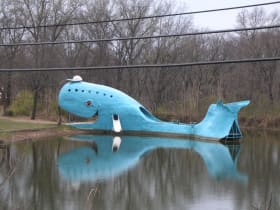
Blue Whale of Catoosa
41 miles away
Blue Whale of Catoosa: on Route 66 just east of Catoosa, northeast of Tulsa.
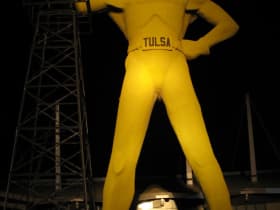
The Golden Driller
42 miles away
The Golden Driller: outside the Tulsa Expo Center on the fairgrounds, east of downtown. Free, always accessible outdoors.