

Meteor Crater
I-40 Exit 233, Winslow, AZ
Winslow, AZ
A vast bowl gouged from the high desert by a meteorite in a single blinding instant, one of the best-preserved impact craters anywhere on Earth.
Meteor Crater is one of the best-preserved impact craters on the surface of the Earth, a colossal bowl nearly a mile wide and hundreds of feet deep punched into the flat high desert of northern Arizona. It was blasted out in a single, violent instant when a chunk of iron and nickel from space slammed into the ground at tremendous speed, some fifty thousand years ago.
The crater looks almost too regular to be natural, a great rounded pit rimmed by tilted rock and rubble, and for a long time scientists argued over how it formed. The story of how it was finally proven to be the scar of a meteorite, and the role it later played in training astronauts for the moon, makes it far more than a hole in the ground. It is a window into the violence of the cosmos and a landmark in the science of impacts.
What Travelers Love
- Standing on the rim of an enormous, near-perfect impact crater
- The sheer scale of a hole nearly a mile across gouged in a single instant
- The story of how science proved a meteorite made it
- The link to Apollo astronaut training that happened here
Worth Knowing
- This is a privately owned and operated site, out on the open desert off Interstate 40
- The rim is exposed to sun and wind, so bring a hat, water, and a windbreaker
- For safety and preservation, you view the crater from rim overlooks rather than climbing in
- It is a short detour off the interstate, easy to pair with a longer road trip
Learn about Meteor Crater
The day the sky fell
About fifty thousand years ago, when the mammoths and giant ground sloths still roamed this region, a lump of iron and nickel tens of meters across came screaming out of the sky and struck the plateau at enormous speed. The energy released in that instant was staggering, vaporizing much of the meteorite and blasting a vast bowl out of solid rock, flinging debris for miles and heaving the surrounding layers of stone upward into a raised rim.
The impact would have been catastrophic for anything nearby, a blast far beyond any explosion humans have ever made. The dry desert climate and the crater's age have preserved it beautifully, so that what you see today is very close to what the impact left behind, a fresh-looking wound in the earth that has barely healed across all those thousands of years.
Proving it came from space
For years after settlers noticed the crater, its origin was disputed. Many geologists assumed it was the remains of a volcano, since impact craters were poorly understood at the time. In the early twentieth century a mining engineer named Daniel Barringer became convinced a meteorite had made it and even sank shafts hoping to find a huge buried mass of iron ore to mine, though most of the meteorite had actually vaporized on impact.
The crater still carries his name, the Barringer Crater, and though his mining dream failed, his conviction helped push the science forward. Decades later the geologist Eugene Shoemaker studied the site closely and found the telltale minerals that only form under the shock of a violent impact, settling the question for good. Meteor Crater became a proving ground for the whole field of impact science, showing the world what a fresh meteorite crater really looks like.
Training for the moon
Because it is such a clear and accessible example of an impact crater, Meteor Crater became a classroom for the space age. In the years before the moon landings, Apollo astronauts came here to train, walking the rim and the crater country to learn how to recognize impact features, collect rock samples, and understand the kind of cratered terrain they would find on the lunar surface.
That connection gives the crater a special place in the story of exploration. The same forces that carved this bowl have shaped the moon and the other worlds of the solar system, pockmarked by countless impacts over billions of years. Standing on the rim, it is easy to feel the link between this quiet stretch of Arizona desert and the pitted faces of distant planets and moons.
Visiting the rim
The crater is a privately owned attraction, with a visitor center perched on the rim and viewpoints that let you look out over the enormous bowl. From the overlooks the scale slowly sinks in: the far wall is nearly a mile away, and the crater is deep enough to swallow tall buildings, yet the whole thing was made in a single moment. Exhibits and films inside tell the science and history, and guided rim walks add context.
The setting is pure high desert, wide open and exposed, so wind and sun can be strong on the rim. It makes an easy and memorable stop off the interstate, especially paired with the nearby wonders of the plateau, and it leaves most visitors with a new sense of just how dramatically the sky can reach down and reshape the ground.
Closest Boutels
The closest Boutel™ stays, so you can turn this stop into an overnight. Each is a place we chose through independent editorial review, never a paid placement.
Lantern Light Inn & Wedding Gardens
Boutel+3085 W State Rte 89A, Sedona, AZ
46 miles away|Learn More ›
Christopher Creek Lodge
Boutel1355 Christopher Creek Loop, Christopher Creek, AZ
49 miles away|Learn More ›
Details
Winslow, AZ
Frequently asked questions
What is Meteor Crater?
Meteor Crater, in the high desert between Winslow and Flagstaff in northern Arizona, is one of the best-preserved meteorite impact craters on Earth. Created roughly fifty thousand years ago when a nickel-iron meteorite slammed into the plain, the crater is nearly a mile across and hundreds of feet deep, a staggering scar of cosmic force. A privately owned attraction with a visitor center, exhibits, and rim viewpoints, it offers a jaw-dropping look at planetary science and even served as a training site for Apollo astronauts.
What can you do at Meteor Crater?
You can gaze out over the immense crater from several rim observation platforms, explore an engaging visitor center with exhibits on meteorites, impacts, and space exploration, see an actual meteorite fragment, and, when offered, join a guided rim walk for a closer look and more of the story. A short film and interactive displays deepen the experience. The sheer scale of the crater, best appreciated from the rim overlooks, makes even a short visit memorable and awe-inspiring for all ages.
Can you go down into Meteor Crater?
No, visitors are not permitted to hike down into the crater itself, both to protect the fragile site and for safety, so the experience is enjoyed from the rim observation areas rather than the crater floor. Guided rim walks, when available, take you along portions of the crater's edge for different vantage points and interpretation, but not inside. The rim viewpoints, telescopes, and platforms provide excellent views across and into the vast bowl, so you can fully appreciate its scale from above.
When is the best time to visit Meteor Crater?
As an exposed high-desert site, spring and fall offer the most comfortable weather for enjoying the rim viewpoints and any guided walks, while summer is hot and windy and winter cold, though the visitor center provides shelter year-round. Mornings tend to be calmer, as the open plain can get very windy. The attraction is open year-round with set daily hours, so checking current hours and rim-walk availability before you go helps you plan, and bringing sun protection is wise.
What is near Meteor Crater?
Meteor Crater sits off Interstate 40 between Winslow and Flagstaff, near Winslow's La Posada Hotel and Standin' on the Corner Park, with Homolovi State Park and Petrified Forest National Park to the east and the volcanic monuments, Lowell Observatory, and Grand Canyon reachable via Flagstaff to the west. That makes Meteor Crater an easy and fascinating stop on a northern Arizona or Route 66 road trip, pairing planetary science with the region's other high-desert and Route 66 attractions.
Nearby
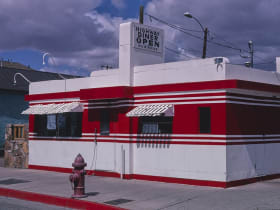
Historic Route 66, Flagstaff to Winslow
7.4 miles away
The Route 66 alignment east of Flagstaff passes through Winona (you need to know it) and ends at the famous Standin' on the Corner park in Winslow.
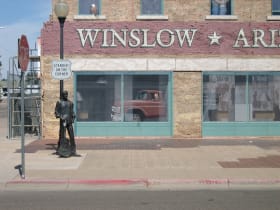
Standin' on the Corner Park
18 miles away
Standin' on the Corner Park in downtown Winslow has the mural (painted by John Pugh) and bronze statue of a man with a guitar hitchhiking - the scene described in Take It Easy by the Eagles.

La Posada Hotel
18 miles away
La Posada (1930, Spanish for "the resting place") was the last great Fred Harvey Company hotel on the Santa Fe line and Mary Colter's masterpiece.

Homolovi State Park
22 miles away
Homolovi protects the remains of ancestral Hopi villages built along the Little Colorado River between roughly 1260 and 1400 CE.
Red Rock Scenic Byway
45 miles away
Red Rock Scenic Byway follows AZ-179 for about seven miles between the Village of Oak Creek and Sedona, threading past some of the most photographed red rock in the Southwest.