

Homolovi State Park
9181 AZ-87, Winslow, AZ
Winslow, AZ
Ancestral Hopi villages on the high desert above the Little Colorado, a sacred place along the Hopi migration story and a stop on the road to the mesas.
Homolovi State Park preserves a group of ancestral Hopi villages on the high desert above the Little Colorado River, just north of Winslow. Hopi ancestors farmed the river bottom and built pueblos here in the centuries before they moved on to the mesas farther north, and the sites remain a living part of Hopi heritage rather than a dead ruin.
The Hopi name Homolovi means place of the little hills, and to the Hopi these villages are a chapter in the long story of their migrations across this land, a story that ended at the mesa-top villages where the Hopi live today. Arizona created the state park in part to protect the sites from looters who had dug into them for pottery, and it manages the park in close partnership with the Hopi Tribe, so a visit here is a chance to stand in a place the Hopi still hold sacred.
What Travelers Love
- Standing among ancestral Hopi village sites that are still living heritage to the Hopi today
- The scatter of ancient pottery sherds visible on the ground, left in place
- Wide-open high desert views toward the Hopi mesas and the Painted Desert
- Big skies and dark nights for stargazing far from any city
Worth Knowing
- These are sacred ancestral sites, so leave every pottery sherd, stone, and artifact exactly where it lies
- Stay on the marked trails and treat the ruins with the respect owed a living Hopi heritage place
- The high desert has little shade, so carry water and sun protection, especially in the warm months
- The park works with the Hopi Tribe, so any interpretive events are a special chance to learn from Hopi voices
Learn about Homolovi State Park
An ancestral Hopi home
The Hopi trace their history through a long series of migrations, and the villages at Homolovi were among the places their clans lived along the way. Between roughly the thirteenth and late fourteenth centuries, Hopi ancestors settled here on the Little Colorado, farming cotton, corn, beans, and squash in the river bottom and building substantial pueblos of stone and adobe, some with hundreds of rooms.
In time the people moved north to the mesas where the Hopi villages stand today, some of them among the oldest continuously inhabited settlements in North America. But the ancestors were never forgotten. To the Hopi, the spirits of those who lived at Homolovi remain part of the place, and clan members still return to these sites, which is why the park is treated not as an archaeological curiosity but as a sacred and living link to the Hopi past and present.
Saving the sites
For much of the twentieth century the Homolovi sites were badly damaged by pot hunters, people who dug illegally into the ruins in search of the fine painted pottery the villages were known for, destroying the sites in the process. The looting grew so severe that protecting what remained became urgent.
In response, Arizona established Homolovi as a state park in the 1990s, one of the first state parks created primarily to preserve a Native cultural site. The park works closely with the Hopi Tribe, which considers the villages sacred, and today the sites are protected, studied with care, and shared with visitors in a way that honors Hopi wishes. The many pottery sherds still scattered on the ground are left in place, both to preserve the record and to respect the site, a quiet reminder to take only photographs.
The high desert and the river
Homolovi lies in open, windswept high desert, a country of grass, saltbush, and low hills under an enormous sky, with the Hopi mesas visible to the north and the colored badlands of the Painted Desert not far off. The Little Colorado River winds through, often shallow or dry but capable of running strong after rain and snowmelt, the lifeline that once made farming possible here.
The wildlife is the wildlife of the high desert, pronghorn drifting across the flats, jackrabbits and cottontails, coyotes, and hawks riding the wind, with lizards and the occasional rattlesnake among the rocks. It is not a lush landscape, but it has the spare beauty of wide-open plateau country, and its dark, clear night skies make it a fine place to camp under the stars.
Season by season
Spring and fall are the most comfortable times to visit, with mild days for walking the sites and cool, clear nights for camping and stargazing. Spring can be windy, as this open country often is, but the temperatures are pleasant.
Summer is hot and largely shadeless, best enjoyed in the early morning or evening, and the late-summer monsoon can bring dramatic storms sweeping across the plateau. Winter is cold, quiet, and often snow-dusted, the high desert at its most austere, and a striking time to have the ancient villages nearly to yourself.
Closest Boutels
The closest Boutel™ stays, so you can turn this stop into an overnight. Each is a place we chose through independent editorial review, never a paid placement.
Christopher Creek Lodge
Boutel1355 Christopher Creek Loop, Christopher Creek, AZ
53 miles away|Learn More ›
Details
Winslow, AZ
Frequently asked questions
What is Homolovi State Park?
Homolovi State Park, near Winslow in northeastern Arizona, protects the ancestral pueblo sites of the Hopi people, who call the area Homol'ovi, meaning place of the little hills. Along the Little Colorado River, the park preserves the remains of villages inhabited centuries ago by the ancestors of today's Hopi, along with pottery shards, petroglyphs, and rich cultural heritage. With interpretive trails, a visitor center, and a strong connection to living Hopi traditions, Homolovi offers a respectful and fascinating window into the region's deep Native history.
What can you see at Homolovi State Park?
You can walk trails to the excavated pueblo ruins, where the outlines of ancient villages and scattered pottery shards reveal the lives of the ancestral Hopi, view petroglyphs, and learn about Hopi culture and archaeology at the visitor center. The park also offers camping, birdwatching, and quiet high-desert scenery along the Little Colorado River. Because these sites remain sacred to the Hopi, visitors are asked to treat them with respect, staying on trails and leaving all artifacts and shards exactly where they lie.
Can you take pottery shards or artifacts from Homolovi?
No, absolutely not. Removing pottery shards, artifacts, or any objects from Homolovi is illegal and deeply disrespectful, since these sites are sacred ancestral places to the Hopi people and are legally protected. Even seemingly small pieces are part of the archaeological and cultural record. Visitors should look but never touch or take, staying on designated trails and leaving everything undisturbed. Honoring this rule preserves the site's integrity and respects the living Hopi community whose ancestors built and inhabited these villages.
When is the best time to visit Homolovi State Park?
Spring and fall offer the most comfortable temperatures for walking the trails and exploring the sites, while summer is hot and can bring afternoon monsoon storms, so early visits are best then, and winter is cold but quiet. The high-desert light is beautiful in the gentler hours of morning and evening. Checking current park hours and any cultural events before you go is worthwhile, and any mild, dry day rewards a respectful visit to this culturally significant place.
What is near Homolovi State Park?
The park is near Winslow along historic Route 66, close to the restored La Posada Hotel and the famous Standin' on the Corner Park, with Meteor Crater and Petrified Forest National Park within reach and the Hopi mesas to the north. Flagstaff and the Grand Canyon lie to the west. That makes Homolovi State Park a meaningful and scenic stop to combine with Winslow's attractions and the other high-desert wonders on a northern Arizona and Route 66 road trip.
Outside the Park

La Posada Hotel
3.9 miles away
La Posada (1930, Spanish for "the resting place") was the last great Fred Harvey Company hotel on the Santa Fe line and Mary Colter's masterpiece.
Standin' on the Corner Park
3.9 miles away
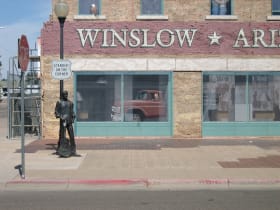
Standin' on the Corner Park in downtown Winslow has the mural (painted by John Pugh) and bronze statue of a man with a guitar hitchhiking - the scene described in Take It Easy by the Eagles.

Meteor Crater
22 miles away
Meteor Crater (officially Canyon Diablo Crater) is a well-preserved impact crater 0.75 miles in diameter and 550 feet deep, formed by a nickel-iron meteorite about 50,000 years ago.
Historic Route 66, Flagstaff to Winslow
27 miles away
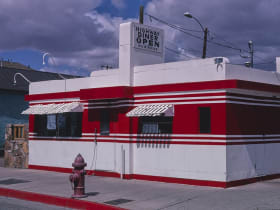
The Route 66 alignment east of Flagstaff passes through Winona (you need to know it) and ends at the famous Standin' on the Corner park in Winslow.

Petrified Forest National Park
48 miles away
Rainbow-colored fossil logs from a 200-million-year-old forest, set in the painted badlands.