

La Posada Hotel
213 N Kinsley Ave, Winslow, AZ
Winslow, AZ
The last great railroad hotel of the Southwest, dreamed up as a Spanish hacienda by architect Mary Colter, saved from the wrecking ball and brought back to life beside the tracks in Winslow.
La Posada is widely called the last great railroad hotel of the American Southwest, and it may be the finest surviving work of Mary Colter, the visionary architect behind so many landmarks of the Grand Canyon. Built for the Fred Harvey Company and the Santa Fe Railway and opened in 1930, it was designed as an imagined Spanish hacienda, a rambling estate with a made-up history that Colter invented down to the last detail.
The hotel closed in 1957 as train travel faded and nearly met the wrecking ball, its rooms gutted for railroad offices. In the 1990s new owners bought the derelict building and began a long, loving restoration, replanting the gardens, refilling the halls with art, and returning it to a hotel. Today it stands beside the tracks in Winslow as one of the great preservation stories of the region, a working monument to the golden age of rail.
What Travelers Love
- Mary Colter's architecture and the feel of a grand old Southwest railroad hotel
- Sunken gardens, tiled floors, and long arcaded halls hung with art
- Watching the freight trains roll past just outside the windows
- The story of the hotel's rescue from demolition and its careful revival
Worth Knowing
- The building is a working piece of history, so its charm comes with the quirks of an old hotel
- Trains pass close and often, part of the experience but audible at night
- The grounds, gardens, and art are worth exploring even for a short stop
- Winslow is a small high-desert town, so evenings are quiet and the air can be cool
Learn about La Posada Hotel
Mary Colter's masterpiece
Mary Colter was one of the few prominent women architects of her era, and she spent decades designing buildings for the Fred Harvey Company along the Santa Fe line, including several of the most beloved structures at the Grand Canyon. La Posada, meaning the resting place, was the project she cared for most and the one over which she had the greatest control, and she poured herself into every corner of it.
She conceived the hotel as the sprawling ranch home of a fictional Spanish don, complete with an invented family history that shaped the layout, the furnishings, and even where the wear and patina should fall. She chose the tiles, the ironwork, the gardens, and the art, aiming for a building that felt as though it had grown over generations rather than been built all at once, and the result is a place of unusual warmth and imagination.
The Harvey House and the railroad
La Posada was a Harvey House, part of the chain of hotels and restaurants the Fred Harvey Company ran along the Santa Fe Railway to feed and shelter travelers in an age before dining cars were common. The famous Harvey Girls, young women who served in crisp uniforms with a reputation for order and hospitality, staffed the dining room, and the hotel hosted movie stars, presidents, and ordinary passengers alike during its heyday.
The Santa Fe line still runs right past the front door, and freight trains rumble by around the clock, close enough to feel. That connection to the rails is central to the hotel's identity; it was built by and for the railroad, and its revival preserves a way of travel that shaped the whole Southwest, when the train was how you crossed this vast country.
Rescue and revival
After the hotel closed in 1957, the railroad stripped its interior and used the shell as division offices, and by the late twentieth century the building was slated for demolition. A group of preservationists and new owners stepped in, bought it, and began the enormous task of bringing it back, room by room, garden by garden, working from Colter's original vision and old photographs.
The restoration replanted the sunken gardens and orchards, reopened the long tiled halls, and filled the public rooms with art, much of it by one of the owners, a painter. The dining room reopened as a celebrated restaurant, and the hotel took in guests again. The revival of La Posada stands as proof of how much can be saved when a place is loved enough to fight for it.
Winslow and the plateau
The hotel anchors Winslow, a Route 66 railroad town on the high Colorado Plateau that saw hard times when the interstate bypassed it and the trains stopped stopping. Downtown a corner park marks the line from the Eagles song Take It Easy, and travelers come to stand on the corner, giving the small town a cheerful claim to fame.
The country around Winslow rewards exploring. The Painted Desert and Petrified Forest lie to the east, the ancient pueblo ruins of Homolovi State Park sit just north of town, and the Hopi mesas rise beyond, homeland of the Hopi people who have farmed this plateau for many centuries. La Posada makes a comfortable and characterful base for all of it.
Closest Boutels
The closest Boutel™ stays, so you can turn this stop into an overnight. Each is a place we chose through independent editorial review, never a paid placement.
Christopher Creek Lodge
Boutel1355 Christopher Creek Loop, Christopher Creek, AZ
52 miles away|Learn More ›
Details
Winslow, AZ
Frequently asked questions
What is the La Posada Hotel?
La Posada Hotel, in Winslow, Arizona, is a beautifully restored historic railroad hotel considered the masterpiece of architect Mary Colter, who designed it for the Fred Harvey Company and the Santa Fe Railway. Opened in 1930 in a romantic Spanish hacienda style, it once welcomed train travelers in grand fashion, then fell into decline before a loving restoration brought it back to life. Today, with its lush gardens, elegant interiors, art, and acclaimed restaurant, La Posada is a treasured landmark and a destination in its own right.
Can you visit La Posada without staying overnight?
Yes, visitors are welcome to explore much of La Posada even without booking a room, wandering the beautifully restored public spaces, gardens, and grounds, admiring the art and architecture, browsing, and dining at the acclaimed Turquoise Room restaurant, though reservations for meals are recommended. Simply strolling the hacienda-style halls and gardens offers a wonderful sense of the golden age of rail travel. Its location beside the active railroad tracks also makes it a fascinating stop for train and history enthusiasts.
Why is La Posada historically significant?
La Posada is significant as arguably the finest surviving example of the grand railroad hotels of the Fred Harvey era and as a crowning work of Mary Colter, one of the Southwest's most influential architects. Built to serve Santa Fe Railway passengers, it embodies the romance of early twentieth-century train travel and Southwestern design. After nearly being lost, its restoration saved a National Historic Landmark, and today it stands as a living tribute to the elegance of the Harvey Houses and the era they represent.
When is the best time to visit La Posada Hotel?
La Posada is enjoyable year-round, with the gardens loveliest in the milder months of spring and fall, and Winslow's high-desert summers hot but manageable and winters cool. As an indoor and garden destination, it works in any season, and its restaurant and public spaces are a welcome retreat any time. Whether stopping for a meal, an overnight stay, or simply to admire the landmark, checking current hours for the restaurant and any tours before you go helps you plan.
What is near the La Posada Hotel?
La Posada is in Winslow, right along historic Route 66, near the famous Standin' on the Corner Park celebrating the Eagles song, with Homolovi State Park and its ancestral Hopi ruins, Meteor Crater, and Petrified Forest National Park all within reach. Flagstaff and the road to the Grand Canyon lie to the west. That makes La Posada a wonderful centerpiece or overnight base for a Route 66 and northern Arizona road trip through the high desert.
Nearby
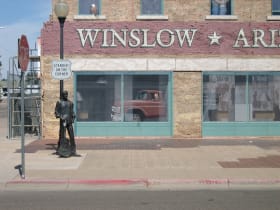
Standin' on the Corner Park
0.0 miles away
Standin' on the Corner Park in downtown Winslow has the mural (painted by John Pugh) and bronze statue of a man with a guitar hitchhiking - the scene described in Take It Easy by the Eagles.

Homolovi State Park
3.9 miles away
Homolovi protects the remains of ancestral Hopi villages built along the Little Colorado River between roughly 1260 and 1400 CE.

Meteor Crater
18 miles away
Meteor Crater (officially Canyon Diablo Crater) is a well-preserved impact crater 0.75 miles in diameter and 550 feet deep, formed by a nickel-iron meteorite about 50,000 years ago.
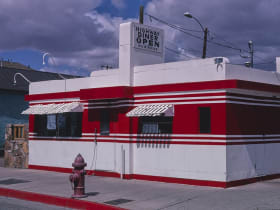
Historic Route 66, Flagstaff to Winslow
23 miles away
The Route 66 alignment east of Flagstaff passes through Winona (you need to know it) and ends at the famous Standin' on the Corner park in Winslow.

Petrified Forest National Park
52 miles away
Rainbow-colored fossil logs from a 200-million-year-old forest, set in the painted badlands.