


Lewis and Clark Salt Works
Lewis and Clark Way at Beach Drive
Seaside, OR
A small circle of blackened stones a few steps from the beach, where five men of the Corps of Discovery spent a soggy winter boiling the Pacific down into salt for the long walk home.
By the winter of 1805, the Lewis and Clark Expedition had crossed a continent and reached the Pacific, and it was nearly out of one humble but essential supply: salt. They needed it to season their food and, above all, to preserve meat for the two-thousand-mile walk back east. So the captains sent a small party down the coast to make some, the only way they could, by boiling the ocean.
What is left of that camp is easy to miss: a low circle of fire-blackened stones set behind a fence in a Seaside neighborhood, a few steps from the beach. It is modest to the point of being humble. But this is the spot, or as near as anyone has been able to fix it, where the Corps of Discovery reached the sea's edge and turned salt water into the salt that carried them home.
What Travelers Love
- Standing on the exact stretch of coast where the expedition ended its long push to the sea
- The oddness of a two-hundred-year-old landmark tucked between beach cottages, free and always open
- Pairing it with the Promenade and the beach a block away for a full morning of Seaside history
- Walking the salt trail idea in reverse, connecting it in your mind to Fort Clatsop up the coast
Worth Knowing
- This is a small, quiet monument, a reconstructed rock cairn behind a low fence, not a big attraction; the reward is the history and the setting, not the size
- It is a National Park Service site, free and open at all hours, on a residential street, so be considerate of the neighbors
- Pair it with Fort Clatsop, a short drive north, to see both ends of the expedition's winter
- There is little parking right at the site, so it is easiest to walk over from the beachfront
Learn about Lewis and Clark Salt Works
Worth their salt
From their winter quarters at Fort Clatsop, the expedition sent out a detachment in late December 1805 to find a good place to make salt. On the first day of 1806 the men settled on this beach, close to fresh water and driftwood for fuel and to Native villages that could help feed them. They built a furnace of stones set with five kettles and got to work.
It was miserable, patient labor. For roughly seven weeks a rotating crew gathered seawater, let it settle, and kept it boiling day and night through the cold coastal rain, cooking off the water until only salt remained. Three men, Joseph Field, William Bratton, and George Gibson, did most of the tending. By the time they broke camp on February 20, 1806, they had produced about three and a half bushels of salt, which Captain Lewis pronounced excellent, fine, strong, and white.
In Clatsop country
The saltmakers did not survive that winter alone. They were guests in the homeland of the Clatsop people and their coastal neighbors, who lived along these estuaries and beaches, and who traded food and knowledge with the newcomers throughout the expedition's stay. The camp on the beach existed at the sufferance and with the help of the people who had lived here for countless generations.
That connection is also how the site was remembered. The precise spot might have been lost for good, except that a Clatsop woman named Jenny Michel, born in 1816, carried the knowledge of where the salt cairn had stood, and her testimony, together with the old rockpile itself, is what let later generations mark the place. The Clatsop and their descendants are still part of this coast, not a closed chapter of it.
Lost and found again
After the expedition left, the salt works was forgotten for the better part of a century, its stones settling into the sand as Seaside grew up around it. In 1900 the Oregon Historical Society reestablished the site, guided by Jenny Michel's account and the surviving pile of rocks, and reconstructed the low stone cairn you see today.
It is now part of Lewis and Clark National Historical Park, whose pieces are scattered around the mouth of the Columbia. A ranger sometimes appears in period dress in summer, but most of the year it is just the cairn, the fence, and the sound of the surf a block away, which is somehow fitting for a place that was always more about grit than grandeur.
Making a visit of it
Set your expectations right and the salt works is a small delight. It takes only a few minutes to see, so the move is to walk over from the beachfront, read the marker, and let the imagination do the rest: five soaked men, a smoking furnace, and the endless gray Pacific that had been their goal.
Then make a loop of the history. Fort Clatsop, a short drive north, is the reconstructed fort where the expedition spent that rainy winter, linked to this beach by the old salt trail the men walked. Seaside itself marks the western terminus of the Lewis and Clark Trail, with a statue of the captains at the beachfront turnaround, so a single morning can trace the very end of their journey to the sea.
Closest Boutels
The closest Boutel™ stays, so you can turn this stop into an overnight. Each is a place we chose through independent editorial review, never a paid placement.
Details
Seaside, OR
Frequently asked questions
What is the Lewis and Clark Salt Works?
It marks the spot in what is now Seaside where members of the Lewis and Clark expedition made salt during the winter of 1806. While the Corps of Discovery wintered nearby at Fort Clatsop, a small crew came to the beach here and boiled seawater in kettles over a stone furnace for weeks to produce salt, which was essential for preserving food on the long journey home. A reconstructed cairn now marks the site.
What is there to see at the Salt Works today?
It is a small, quiet historic site: a reconstructed stone furnace, or cairn, with kettles, set behind a low fence with interpretive signs telling the story. It sits right in a residential Seaside neighborhood a short walk from the beach and promenade, so it is a quick but meaningful stop rather than a large attraction. It is free to visit and open at any time.
Why did Lewis and Clark need to make salt here?
By the time the expedition reached the Pacific and settled in for the winter, they had run out of salt, which before refrigeration was vital for preserving the meat they would need for the return trip east. So they scouted the coast, chose this spot near fresh seawater and a friendly Native village, and spent nearly fifty days boiling seawater day and night to make it. The effort speaks to how hard survival was on the expedition.
How long does a visit take, and what is nearby?
The site itself takes only a few minutes to see and read about, so most people combine it with other Seaside sights. It is steps from the beach and the town's famous Promenade, and it pairs naturally with a visit to Fort Clatsop, the reconstructed winter fort a short drive away, to understand the whole chapter of the expedition's coastal stay.
Is there a special time to visit the Salt Works?
You can stop by any time year-round, but two moments stand out. Visiting in the damp chill of winter helps you imagine the smoky, soggy conditions the salt makers endured. And in the fall, a living-history event in Seaside brings costumed interpreters to the beach to recreate the salt-making process over open fires, a memorable way to see the history come alive.
Nearby
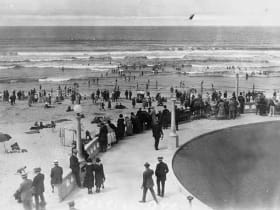
Seaside Promenade and Turnaround
0.5 miles away
Seaside's mile-and-a-half oceanfront boardwalk, the classic Oregon coast Prom, running along the wide Pacific beach to a landmark Turnaround circle where a Lewis and Clark statue marks the end of thei...
Seaside Aquarium
0.8 miles away
The hand-feeding harbor seal experience at Seaside Aquarium is one of the most memorable hands-on wildlife moments kids can have on the Oregon coast - seals come right up to the edge of the pool to ta...

Gearhart Beach
2.8 miles away
A wide, dune-backed public beach on the quiet north Oregon coast, just above Seaside.

Ecola State Park
4.9 miles away
Ecola State Park drapes over Tillamook Head just north of Cannon Beach, with bluff-top viewpoints over sea stacks, Haystack Rock, and the lonely offshore Tillamook Rock Lighthouse.

Haystack Rock
7.1 miles away
One of the tallest sea stacks you can walk right up to at low tide, ringed by tide pools and topped by nesting puffins, standing off the beach at Cannon Beach.
Fort Stevens State Park
15 miles away
At the wild northwest tip of Oregon where the Columbia River meets the Pacific, Fort Stevens stacks a Civil War through World War II coastal fort, the rusted beach wreck of the Peter Iredale, and warm...
Oswald West State Park
16 miles away
A rainforest-backed cove on the north Oregon coast, named for the governor who saved the state's beaches for the public.
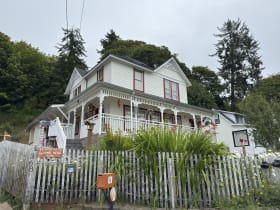
The Goonies House
16 miles away
The hillside Victorian in Astoria that played Mikey's house in the 1985 movie The Goonies still stands above the Columbia River, at the top of its long gravel drive in the oldest town in the Pacific N...
Neahkahnie Mountain Summit
17 miles away
The summit view from Neahkahnie Mountain is one of the best non-alpine lookouts on the Oregon coast: Manzanita, Nehalem Bay, Tillamook Bay, and the horizon of the Pacific all at once.
South Jetty of the Columbia River
18 miles away
Drive to the end of Clatsop Spit in Fort Stevens State Park, near Hammond west of Astoria, to reach the South Jetty, where the mighty Columbia River pours into the Pacific across the Graveyard of the...

Manzanita Beach
18 miles away
Seven miles of wide, uncrowded sand curving south from Manzanita beneath Neahkahnie Mountain, one of the highest headlands on the Oregon coast.
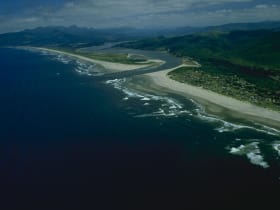
Nehalem Bay State Park
20 miles away
A four-mile sand spit just south of Manzanita, off US-101, sealing quiet Nehalem Bay off from the open Pacific.