
Neahkahnie Mountain Summit
7830 Twana Trce
Nehalem, OR
One of the highest points on the Oregon coast, wrapped in whale-watching views, wildflower meadows, and a Spanish-treasure legend that people dug for over a century.
Neahkahnie Mountain is a great basalt headland on the north Oregon coast, one of the highest points that rises directly out of the Pacific. From the summit, reached by a steep forest trail inside Oswald West State Park, the land falls away to Manzanita's long beach, the mouth of Nehalem Bay, the Coast Range behind, and open ocean ahead. On a clear day it is one of the finest views on the coast, and twice a year gray whales spout in the water below.
The mountain carries a story as well. For more than a century, treasure hunters believed a chest of Spanish gold lay buried in its slopes, guided by marked rocks and the wreck of a galleon whose beeswax cargo still washes up on the beaches nearby. Nobody has ever found the treasure, and the digging has been banned for decades, but the legend has left Neahkahnie known, only half in jest, as the mountain of a thousand holes.
What Travelers Love
- Standing at one of the highest viewpoints on the Oregon coast, with the beach and Nehalem Bay laid out far below
- Scanning the water for gray whales, which pass close offshore twice a year
- Wildflower-lined trail edges and open, breezy meadows near the top
- The mountain's centuries-old buried-treasure story, still unsolved and now legally off-limits to diggers
Worth Knowing
- The summit is exposed, so fog and hard wind can erase the view; pick a clear day if you can
- The trail is steep and forested and turns muddy and slick in the wet months, so bring real shoes
- Digging for the fabled treasure is illegal on state park land, and always has been a legend, not a proven fact
- Cliff edges near the top drop hundreds of feet, so keep well back and mind children and dogs
Learn about Neahkahnie Mountain Summit
The place of the god
The name Neahkahnie comes from the Tillamook language and is generally understood to mean the place of the god, or the place of the supreme deity. The mountain has long held meaning for the Nehalem-Tillamook people, a Salish-speaking group who used its lower slopes for thousands of years, hunting and gathering and deliberately setting fires on the sunny southwestern face to keep the meadows open for deer and elk. Neahkahnie figures in their oral traditions, including the story cycles of Ice and South Wind from the time of creation.
These are living peoples. After treaties in the 1850s, many Tillamookan families were pressured onto the Siletz and Grand Ronde reservations, and their descendants today are enrolled in the Confederated Tribes of Siletz Indians and the Confederated Tribes of Grand Ronde. Other Nehalem descendants belong to the Clatsop-Nehalem Confederated Tribes, which has long sought federal recognition. European and American settlement of the surrounding coast came in the nineteenth century, and it was settlers walking the nearby beaches who found the chunks of beeswax and bits of foreign porcelain that fed the treasure lore.
The beeswax wreck and the buried-treasure legend
The treasure story rests on a real event. Sometime around 1693, a Spanish Manila galleon, now believed to be the Santo Cristo de Burgos, sailed far off its Acapulco-bound course and wrecked on this stretch of coast. Its cargo included large quantities of beeswax stamped with shipping marks, along with Chinese porcelain and silk. For more than two hundred years, chunks of that wax and shards of that porcelain have washed onto the beaches around Manzanita and the Nehalem spit, and in 2018 a special issue of the Oregon Historical Quarterly concluded the wreck was most likely that 1693 galleon. Fishermen recovered timbers believed to be from the ship in 2022, though the main hull has never been located.
The legend that grew around the wreck is another matter, well documented as a story but never proven. It holds that Spanish sailors buried a chest on the mountain, and a grim version says they killed an enslaved man and buried him atop it, gambling that the site would be left undisturbed. In the 1870s a settler reportedly found stones marked with arrows and letters, which some read as a coded map, and generations of hopefuls dug hundreds of holes across the slopes. Two treasure hunters died in a collapsing excavation in the 1930s. No treasure was ever found. Oregon stopped issuing digging permits in 1989, and in 1991 the State Land Board made the ban on the mountain and its beaches permanent.
A headland built by ancient lava
Neahkahnie stands roughly 1,680 feet high, rising about 1,600 feet almost straight from the beach, which makes it one of the highest points directly on the Oregon coast. Its dark rock is basalt from the Columbia River Basalt Group. Around 15 to 16 million years ago, immense floods of lava erupted from vents in northeastern Oregon, followed the ancestral Columbia River channel all the way to the sea, and here forced their way into older marine sediments as a thick sill of tough rock. That hard basalt is what has resisted the ocean and left the headlands and sea stacks strung along this coast.
The mountain's western face has eroded into steep cliffs that drop as much as six hundred feet to the surf. The summit is reached by the North and South Neahkahnie Mountain trails, which are part of the Oregon Coast Trail. The climb runs through Sitka spruce and Douglas fir, eases near a saddle, and opens onto a view south over Manzanita, Nehalem Bay, the long beach, and the Coast Range, with the Pacific filling the horizon. A fire lookout once stood on top. Trail mileage varies by which trailhead you start from, so check the length for the route you choose before you set out.
Meadows, forest, and whales
The upper and north-facing slopes hold a dense coastal forest of Sitka spruce, western hemlock, and western red cedar, with Douglas fir lower down and an understory thick with salal and swordfern. The open, historically fire-kept grassy slopes and the trail edges bloom with wildflowers, best in late spring and early summer, and they line the path near the beginning and the end of the climb.
The summit is a fine place to watch for gray whales as they migrate close offshore. Raptors such as bald eagles and peregrine falcons range this coast, and the exposed cliffs and updrafts are good country for them, though the birds you actually see will depend on the day. The point of Neahkahnie is really its openness: after the closed-in forest, the top gives you sky, sea, and distance all at once.
Season by season
Late spring and early summer bring the wildflowers and the best odds of a clear, dry climb, with the meadows at their brightest and the trail firm underfoot.
Summer is the most reliable stretch for a wide-open view, warm and settled, though the coast can still deliver fog that rolls in and hides everything within minutes.
Whale watching peaks twice: southbound around late December into early January, and northbound from late March through June, when Oregon runs its organized Whale Watch Weeks.
Fall and winter are the wettest and windiest. The forest trail turns muddy and slick, the exposed summit takes the full brunt of coastal storms, and the view is often socked in, so sure footing and a weather check matter most then.
Closest Boutels
The closest Boutel™ stays, so you can turn this stop into an overnight. Each is a place we chose through independent editorial review, never a paid placement.
Details
Nehalem, OR
Frequently asked questions
How hard is the Neahkahnie Mountain hike?
It is a moderately challenging climb, gaining well over eight hundred feet to a summit that stands some 1,600 feet above the beach. There are two approaches: the southern trail is the gentler and more popular, especially with families, while the northern route is steeper and rougher. Either way it is a real uphill effort of a few miles round trip, and the payoff at the top is one of the finest coastal views in Oregon.
What is the legend of buried treasure on Neahkahnie Mountain?
The mountain is wrapped in one of the Oregon coast's most enduring legends: that survivors of a wrecked Spanish galleon buried a treasure on its slopes centuries ago. Generations of hopeful diggers have searched for it, and while no trove has ever been found, the story adds a note of mystery to the climb. The mountain's Native American name reflects its power too, meaning roughly the place of the supreme deity.
What will I see from the top of Neahkahnie Mountain?
On a clear day, a sweeping panorama of the northern Oregon coast: the long arc of Neahkahnie Beach, the town of Manzanita, and the coastline running south to the mouth of Nehalem Bay, with the open Pacific stretching to the horizon. In the right seasons you may spot migrating gray whales far below. The catch is the weather, since this coast is often foggy, so a clear day is a real gift.
What should I wear and watch out for on the trail?
Sturdy shoes with good grip are essential, because the tread is often loose, rooty, and muddy, especially after rain, and it can be overgrown in places. Bring layers for the exposed, breezy summit, and near the top take care around the steep, unfenced drop-offs to the ocean, keeping children close. Trekking poles help some hikers on the rougher, steeper sections.
When is the best time to hike Neahkahnie Mountain?
Summer and early fall give the best odds of the clear skies that make the summit view worthwhile, along with drier, firmer trail. The mountain is hikeable much of the year, but in the wet months the path is muddier and the top is often lost in cloud. Aim for a clear-weather day, start with enough daylight, and enjoy one of the coast's great short climbs.
Nearby

Manzanita Beach
1.6 miles away
Seven miles of wide, uncrowded sand curving south from Manzanita beneath Neahkahnie Mountain, one of the highest headlands on the Oregon coast.
Oswald West State Park
1.8 miles away
A rainforest-backed cove on the north Oregon coast, named for the governor who saved the state's beaches for the public.
Nehalem Bay State Park
3.1 miles away
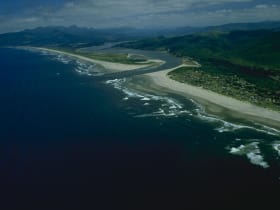
A four-mile sand spit just south of Manzanita, off US-101, sealing quiet Nehalem Bay off from the open Pacific.

Haystack Rock
10 miles away
One of the tallest sea stacks you can walk right up to at low tide, ringed by tide pools and topped by nesting puffins, standing off the beach at Cannon Beach.

Ecola State Park
13 miles away
Ecola State Park drapes over Tillamook Head just north of Cannon Beach, with bluff-top viewpoints over sea stacks, Haystack Rock, and the lonely offshore Tillamook Rock Lighthouse.
Lewis and Clark Salt Works, Seaside
17 miles away
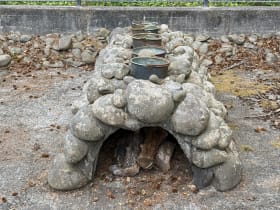
Most people in Seaside never leave the Promenade, so this small stone ring on a quiet corner goes unnoticed.
Seaside Promenade and Turnaround
18 miles away
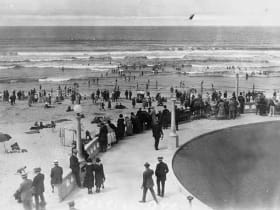
Seaside's mile-and-a-half oceanfront boardwalk, the classic Oregon coast Prom, running along the wide Pacific beach to a landmark Turnaround circle where a Lewis and Clark statue marks the end of thei...
Seaside Aquarium
18 miles away
The hand-feeding harbor seal experience at Seaside Aquarium is one of the most memorable hands-on wildlife moments kids can have on the Oregon coast - seals come right up to the edge of the pool to ta...

Gearhart Beach
20 miles away
A wide, dune-backed public beach on the quiet north Oregon coast, just above Seaside.