
Winthrop
Riverside Ave
Winthrop, WA
A whole town dressed as a frontier outpost, wooden boardwalks and false-front stores along Riverside Avenue, at the sunny eastern foot of the North Cascades.
Winthrop looks like a set from a Western, and that is entirely on purpose. Along Riverside Avenue, the storefronts wear false fronts and weathered wood, the sidewalks are raised wooden boardwalks, and hitching rails and period signs complete the frontier picture. Since 1972 a local ordinance has required the commercial district to keep this pioneer-era appearance, a decision that turned a fading timber and mining town into one of the most distinctive small towns in Washington.
What saves Winthrop from feeling like a gimmick is that the history underneath is real. This was a genuine frontier outpost, and one block off the main street the actual pioneer buildings the whole town imitates still stand, preserved as an open-air museum. The theme is a costume, but it is worn over real bones.
What Travelers Love
- Strolling a genuine Old West main street of boardwalks, hitching rails, and false-front stores
- The open-air Shafer Museum, where the real pioneer buildings behind the theme still stand
- Sunny valley weather with the North Cascades rising all around
- Being at the trailhead of one of the largest cross-country ski and mountain-bike trail networks in the country
Worth Knowing
- The Western look is a deliberate design code, not a movie set, and locals live and work behind the facades
- The Methow Valley is a four-season destination; summer trails and river, and winter cross-country skiing, are the big draws
- The North Cascades Highway west of town closes over the passes in winter, so plan your approach accordingly
- It is a small, popular town, so summer weekends and festivals bring crowds and full lodging
Learn about Winthrop
Guy Waring and the founding of Winthrop
In 1891 a Harvard-educated adventurer named Guy Waring arrived in the remote Methow Valley, saw opportunity among the scattered miners and ranchers, and opened the area's first general store. He built a home, a trading post, and the beginnings of a town, giving it the name Winthrop. Waring was a man of the frontier and of the East at once, and his story links this dusty valley to some surprising places.
One of Waring's Harvard connections was the writer Owen Wister, who spent time in this country. Wister went on to write The Virginian, the novel that largely invented the modern Western, and the Methow Valley is often cited among the landscapes that shaped it. The town that grew up around Waring's store carried that frontier spirit into the twentieth century, through timber, mining, and ranching, before reinventing itself for a new age.
The Shafer Museum and the real buildings
Just above the main street stands the Shafer Historical Museum, and it is the key to understanding Winthrop. At its heart is Guy Waring's own log home from 1897, a stout building locals call the Castle, surrounded by original pioneer-era structures gathered from around the valley, cabins, a schoolhouse, a print shop, and displays of mining, logging, and farming gear.
The museum came to be in the 1940s, when a local merchant named Simon Shafer bought Waring's old home and preserved it, and it grew from there into the open-air collection you can walk today. It is the difference between a themed street and a historic town: the false fronts downtown are modeled on exactly this, the genuine article, still standing a block away.
The Methow Valley in every season
Winthrop is the hub of a valley beloved by anyone who moves under their own power. In summer the surrounding mountains and rivers offer hiking, mountain biking, fishing, and rafting, and the dry, sunny climate makes it a welcome contrast to the wet west side of the Cascades. Wildflowers carpet the hillsides in spring, and larches turn the high country gold in fall.
Winter is when the valley truly comes into its own. The Methow supports one of the largest networks of groomed cross-country ski trails in the country, lacing the valley floor and hills for miles, and Winthrop becomes a Nordic town, its boardwalks dusted with snow. Whatever the season, the town sits at the trailhead.
Gateway to the North Cascades
Winthrop's setting is as much a draw as its main street. The town sits at the sunny eastern end of the North Cascades Highway, State Route 20, which climbs west from the valley over Washington Pass and Rainy Pass into some of the most rugged mountain country in the Lower 48. In the warmer months, the drive over the passes from Winthrop is one of the great scenic routes in the state.
That gateway role shapes the rhythm of the town. In summer and fall, travelers pour through on their way to or from the high country, and Winthrop is the place to fuel up, eat, and sleep before or after the mountains. In winter, when snow closes the passes, the town turns inward and becomes a quiet Nordic hub, its boardwalks lined with skiers instead of mountain bikers.
Closest Boutels
The closest Boutel™ stays, so you can turn this stop into an overnight. Each is a place we chose through independent editorial review, never a paid placement.
Details
Winthrop, WA
Frequently asked questions
What is Winthrop, Washington?
Winthrop is a charming town in the scenic Methow Valley of north-central Washington, beloved for its Old West theme, with a historic downtown featuring wooden boardwalks, western-style storefronts, and a frontier atmosphere. Set amid the beautiful mountains at the eastern gateway to the North Cascades Highway, Winthrop serves as a hub for outdoor recreation year-round, from hiking, biking, fishing, and river floating in summer to world-class cross-country skiing on the Methow Trails in winter. Combining Old West charm, a lovely mountain setting, and abundant outdoor adventure, Winthrop offers a delightful and picturesque destination in the Methow Valley of Washington.
What can you do in Winthrop?
You can stroll the Old West-themed downtown with its boardwalks, shops, restaurants, and saloons, hike and mountain bike the extensive trails, fish and float the Methow River, visit local museums, and in winter enjoy the renowned Methow Trails cross-country ski network, one of the largest in the country. The surrounding Methow Valley and North Cascades offer endless recreation and scenery. Winthrop's charm and outdoor access make it a wonderful base. With its Old West character, mountain setting, and year-round recreation from biking to cross-country skiing, Winthrop offers a delightful and adventurous destination in north-central Washington.
Why is Winthrop a good base for the North Cascades?
Winthrop is an ideal base because it sits at the eastern end of the spectacular North Cascades Highway, putting the dramatic scenery of Washington Pass, Diablo Lake, and North Cascades National Park within easy reach for day trips during the highway's open season, while offering charming lodging, dining, and its Old West atmosphere as a home base. The surrounding Methow Valley also provides abundant recreation right at hand. This combination of proximity to the North Cascades, ample amenities, and its own appeal makes Winthrop a convenient and delightful base for exploring the magnificent mountains of northern Washington.
When is the best time to visit Winthrop?
Winthrop is a year-round destination, with summer and early fall ideal for hiking, biking, river activities, and driving the open North Cascades Highway, and fall bringing beautiful color, while winter is prime for cross-country skiing on the famous Methow Trails and enjoying the snowy Old West town. Spring is pleasant as the valley greens up, though the mountain highway remains closed until late spring. For summer recreation and the scenic drive, aim for summer through early fall, and for cross-country skiing, visit in winter. Winthrop's charm and recreation make it rewarding across seasons.
What is near Winthrop?
Winthrop is in the Methow Valley of north-central Washington, at the eastern gateway to the North Cascades Highway, within reach of the Washington Pass Overlook, Diablo Lake, and North Cascades National Park to the west during the highway's open season, the Methow Trails, and the Methow River. That makes Winthrop a charming base to combine with the North Cascades Highway, Washington Pass, Diablo Lake, and the other attractions of northern Washington on a visit to the state.
Nearby
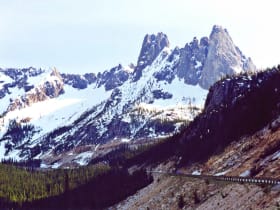
North Cascades Highway (SR-20)
0.0 miles away
One of the great mountain scenic drives in the country, climbing over Washington Pass past the granite spires of Liberty Bell Mountain and the turquoise water of Diablo Lake.
Methow Trails
0.5 miles away
A community-built web of about 120 miles of trail centered on Winthrop, this becomes North America's largest groomed cross-country ski network in winter and free hiking and mountain-biking singletrack...

Washington Pass Overlook
22 miles away
Washington Pass Overlook is right off SR-20 near milepost 162, roughly 30 miles west of Winthrop.

Cascade Pass
41 miles away
Cascade Pass is a classic alpine hike in the North Cascades, climbing switchbacks through forest and meadow to a high pass surrounded by glaciated peaks, hanging glaciers, and tumbling waterfalls.

North Cascades National Park
51 miles away
Jagged alpine peaks and more than 300 glaciers, one of the most rugged ranges in the lower 48.