
Waioli Mission House
Kuhio Highway, Hanalei
Hanalei, HI
A restored 1830s mission home and green shingled church set among the taro fields of Hanalei, a quiet window into Kauai's mission era.
Waioli Mission House is a restored home from 1836, one of the oldest surviving structures on Kauai, set among the taro fields of Hanalei with the green wall of the mountains rising behind. Built during the era when American Protestant missionaries had come to the Hawaiian Islands, it housed mission families for the better part of a century and has been carefully preserved and furnished to reflect that period, a rare and intimate glimpse into nineteenth-century life on the north shore.
The house sits beside the Waioli Huiia Church, a distinctive green shingled building that remains an active congregation and a Hanalei landmark, and together with a mission hall they form a small historic compound. The story it tells is a complicated one, of faith, cultural encounter, and change, but the buildings themselves are quietly beautiful, and the setting among the loi, the irrigated taro patches, is unforgettable.
What Travelers Love
- A genuinely old Hawaii building, restored and furnished to its mission-era look
- The green shingled Waioli Huiia Church beside it, a Hanalei landmark
- The setting among taro fields with the mountains rising behind
- A quiet, uncommercial stop amid the busy north shore
Worth Knowing
- The mission house is shown on limited days and hours, often by docent, so check before planning a visit
- It is a small historic site; a visit pairs naturally with the church and the town
- Photography and respectful quiet are appreciated inside a preserved historic home
- Parking in Hanalei is limited, so allow time
Learn about Waioli Mission House
The mission era on Kauai
American Protestant missionaries first reached the Hawaiian Islands in 1820, arriving into a Hawaiian society that had recently set aside its traditional religious system. Missions were established across the islands, and Hanalei on Kauai's remote north shore became one of them. Missionary families came to live, preach, teach, and translate, and the buildings they raised, including this house, were among the first Western-style structures in these districts.
Waioli Mission House was built in 1836 and became home to mission families, most enduringly associated with the Wilcox family, who lived in and cared for the house and left a lasting mark on Hanalei and Kauai. The house was later restored and opened as a museum by descendants, furnished with period pieces to show how a mission family lived, and it stands today as one of the best-preserved examples of its kind in the islands.
The mission era reshaped Hawaiian life in profound and often painful ways, bringing a written form of the Hawaiian language and widespread literacy on one hand, and contributing to the erosion of traditional practices and land tenure on the other. Waioli holds that history honestly, a place to reflect on a pivotal and complicated chapter rather than to celebrate it uncritically.
The house and church
The mission house is a modest, well-proportioned home restored to its nineteenth-century appearance, with period furnishings, and a visit, often led by a docent, walks through the rooms and the daily life they held. Nearby stands the mission hall, an earlier structure on the site, and the three buildings together tell the story of the mission station.
The most visible landmark is the Waioli Huiia Church, its green shingled walls and steep roof set against the mountains, an American Gothic form adapted to the tropics. It remains an active church with a Hawaiian-language heritage, and its presence gives the historic compound a living continuity, still gathering a congregation as it has for generations.
Hanalei and its taro
The mission house sits within one of the great agricultural landscapes of Hawaii. The Hanalei Valley behind the town is a patchwork of loi kalo, irrigated taro fields, that have been worked for centuries and today produce a large share of the taro grown in the state, the plant at the heart of Hawaiian culture and diet. The Hanalei River and the surrounding wetlands also form a national wildlife refuge protecting endangered Hawaiian waterbirds.
This setting is inseparable from the site's meaning. The missionaries arrived into a valley already shaped by generations of Hawaiian farming, and the taro fields that frame the mission house today are the same living tradition, continuous with the Hawaiian world the mission entered. The famous Hanalei Valley Lookout, just up the road, takes in the whole green expanse.
Visiting and the north shore around it
Waioli is a small, quiet historic site, and part of its charm is how little it has been commercialized. The mission house is typically open on limited days and often shown by a docent who can bring the rooms and their stories to life, so it rewards a bit of planning ahead. A visit fits comfortably into a north shore day alongside the town, the bay, and the valley lookout.
Hanalei itself repays lingering. The crescent of Hanalei Bay, ringed by green mountains laced with waterfalls after rain, is one of the loveliest on Kauai, with a historic pier reaching into the water. The town's low-key shops and eateries, the taro fields, and the road west toward Haena and the Na Pali coast make the mission house a natural anchor for exploring the whole north shore at an unhurried pace.
Closest Boutels
The closest Boutel™ stays, so you can turn this stop into an overnight. Each is a place we chose through independent editorial review, never a paid placement.
Details
Hanalei, HI
Frequently asked questions
What is the Waioli Mission House?
The Waioli Mission House, in Hanalei on the north shore of Kauai, Hawaii, is a historic mission house from the early nineteenth century, a well-preserved example of the missionary era in Hawaii, set amid the lush Hanalei Valley scenery. Built by Christian missionaries who came to Hawaii long ago, the historic wooden house, along with a nearby historic mission hall, is preserved with period furnishings and interprets the missionary era, a period of profound and complex change for Native Hawaiians and their culture. Its historic architecture and setting make it a fascinating window into a pivotal era. A historic and thought-provoking house museum, it educates visitors. With its history, the Waioli Mission House offers a compelling destination in Hawaii.
What is the history of the Waioli Mission House?
The Waioli Mission House was built in the early nineteenth century by Christian missionaries who came to Hawaii from the mainland, part of the missionary era that brought profound and complex changes to the islands and to Native Hawaiian culture, religion, and society. The house and nearby mission hall are preserved as historic sites interpreting this period, which had far-reaching and sometimes difficult consequences for Native Hawaiians. Approaching this history with awareness of its complexity is appropriate. Understanding this history enriches a visit to the Waioli Mission House in Hawaii.
What can you see at the Waioli Mission House?
You can see the well-preserved early nineteenth-century mission house with its period furnishings, the nearby historic mission hall, and the lush Hanalei Valley setting, learning about the missionary era in Hawaii and its impact. The historic house, the period furnishings, the mission hall, and the scenic setting are the draws, offering a fascinating look at a pivotal era. The preserved house and its history are highlights. Approaching the site with awareness of its complex history enriches a visit to the Waioli Mission House in Hawaii.
When is the best time to visit the Waioli Mission House?
The house is generally open for visits or tours on a limited schedule, so checking the current hours and any tour times before you go is important, while the north shore is loveliest and driest in the summer months. Because it keeps limited hours, planning ahead helps. For a visit, check the current schedule, ideally in the drier months, at the Waioli Mission House in Hawaii.
What is near the Waioli Mission House?
The Waioli Mission House is in Hanalei on the north shore of Kauai, Hawaii, within reach of the Hanalei Valley Lookout, the town of Hanalei, Kee Beach and the Napali Coast farther along the road, and the Limahuli Garden. That makes the Waioli Mission House a compelling stop to combine with the Hanalei Valley Lookout and the other attractions of the Kauai north shore on a visit to Hawaii.
Nearby
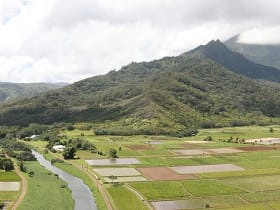
Hanalei Valley Lookout
1.8 miles away
Everyone drives past the turnout, but pulling in rewards you with the north shores signature view.
Haena Wet and Dry Caves
4.3 miles away
Caves right off the road always win with kids, and Haena has two kinds.
Limahuli Garden and Preserve
4.8 miles away
Most north-shore visitors race to Ke e Beach and never turn in at Limahuli, just before the road end. That is a mistake.
Ke e Beach
5.2 miles away
In summer this is the gentlest snorkel-and-swim on the north shore for kids.

Na Pali Coast and the Kalalau Trail
5.3 miles away
This is the landscape Kauai is famous for, and it starts right at the road end.
Waimea Canyon State Park
14 miles away
The Grand Canyon of the Pacific, a mile-wide gorge of rust-red and green cliffs plunging over 3,000 feet into western Kauai.
Polihale State Park
19 miles away
At the far western end of Kauai, past Waimea and Kekaha, paved Highway 50 gives out and a rough dirt cane road runs several miles to Polihale, one of the longest and widest beaches in Hawaii.