
Limahuli Garden and Preserve
5-8291 Kuhio Highway
Hanalei, HI
A three-quarter-mile self-guided loop through stone taro terraces that have been farmed for centuries, set in a valley where the whole mountain-to-sea way of caring for land is still practiced.
Limahuli Garden and Preserve wraps around the base of Makana, the notched green peak that towers over Kauai's north shore near Haena. It is one of the gardens of the National Tropical Botanical Garden, but it does not feel like a botanical collection so much as a valley that has been loved and worked for a very long time. A self-guided loop of about three-quarters of a mile climbs past terraced pond fields of kalo, or taro, built from stacked lava rock, then winds up through native forest with the ocean opening out below.
What sets Limahuli apart is that it protects a nearly complete ahupuaa, the traditional Hawaiian land division that runs from the mountain ridges down to the reef. Native Hawaiians understood a valley as a single connected system, mauka to makai, mountain to sea, and Limahuli is one of the best places anywhere to see that idea still being practiced. The taro terraces here are not a reconstruction behind glass. They are farmed, the water still runs through them, and the knowledge that built them is carried forward by the people who steward the valley today.
What Travelers Love
- Walking among ancient lava-rock terraces where kalo, or taro, is still grown by hand
- Native and canoe plants labeled and cared for, many of them found nowhere else on Earth
- Sweeping views up to Makana peak and back down the valley toward the sea
- A quiet, unhurried loop that feels tended and alive rather than staged for visitors
Worth Knowing
- Visits are by advance reservation, and the garden is closed on some days each week, so plan ahead
- The self-guided loop is about three-quarters of a mile with uneven stone steps and some steady grades, so wear real walking shoes
- This is an active cultural and conservation site, so stay on the marked path and leave plants, rocks, and terraces undisturbed
- North-shore weather turns wet quickly and the nearby valley has flooded in the past, so check conditions before you drive out
Learn about Limahuli Garden and Preserve
A valley farmed for centuries
The stone terraces that step up the lower valley are called loi kalo, irrigated pond fields for growing taro. Hawaiians built them here generations ago by stacking lava rock into low walls and channeling cold stream water from terrace to terrace, a system so well engineered that some of these same walls still hold water today. Taro, or kalo, is far more than a crop in Hawaiian culture. In the origin traditions kalo is an elder sibling of the Hawaiian people, and caring for it is understood as caring for family.
At Limahuli that relationship is ongoing. The loi are actively tended, the water still flows through the old channels, and the pounded root becomes poi, the staple food at the heart of Hawaiian meals and gatherings. Walking the loop, you are looking at agriculture that has been practiced in this exact spot across many lifetimes, kept alive rather than preserved as a relic.
Higher up, the path passes plantings that tell the longer story of how people and plants arrived in Hawaii. Among them are canoe plants, the species the first Polynesian voyagers carried with them across the Pacific to sustain new island homes, kalo and ulu, or breadfruit, among them.
Mountain to sea, one connected system
Behind the small public garden rises the far larger Limahuli Preserve, a protected upper valley that climbs toward the ridgeline and is not open for general visiting. Together the garden and preserve safeguard almost the entire ahupuaa of Limahuli, from the crest of the mountains down to the shoreline, a rare thing in modern Hawaii where valleys are so often divided among many owners and uses.
That intactness is the point. In the traditional view, what happens on the high ridges shapes the streams, the taro terraces, the estuary, and finally the reef, so the health of the whole depends on tending every part. Limahuli lets you stand inside a working example of that idea, with the forested heights above you and the ocean below, joined by the same water.
The valley has also been recognized for how well its natural and cultural landscape has been cared for, and it has served as a model for restoring native ecosystems and traditional land practice elsewhere in the islands.
Native plants and the birds and creatures of the valley
Hawaii is one of the most isolated places on Earth, and the plants that reached it evolved in seclusion into forms found nowhere else. Many of those native species are now rare, and Limahuli is partly a refuge for them, with labeled native trees, shrubs, and ferns growing along the upper loop. Alongside them grow the canoe plants brought by early voyagers, so the garden reads almost like a timeline of arrivals.
Listen and watch for native forest birds moving through the canopy, and for seabirds riding the wind along the towering cliffs of this coast. In the streams, native Hawaiian gobies called oopu make one of the natural world's more astonishing journeys, with young that are swept to the sea and then climb back up the island's waterfalls to mature in the fresh water above.
The plantings and the surrounding forest also shelter the pollinators and smaller creatures that keep a native system working. Part of the garden's purpose is simply to give these island species room to persist against the pressures that have pushed so many of them to the edge.
Makana and the story above the garden
The dramatic peak that presides over Limahuli is Makana, whose fluted green face rises steeply behind the valley. In earlier times this was the site of a spectacular tradition in which skilled men climbed to a promontory near the summit and hurled firebrands of lit, fast-burning wood out into the night. Updrafts along the cliff carried the burning brands far out in long arcs of light, a display watched from canoes and the shore below.
The cliffs of this coast are also known to many visitors from film, having stood in for remote tropical worlds on screen, though the enduring story here is the older one written into the land itself. Seen from the garden loop, Makana anchors the whole valley and is a reminder of how completely this place was known, named, and used long before it was ever a garden to visit.
Because Makana and the surrounding heights gather so much rain, waterfalls thread the cliffs after storms and the streams run cold and clear, feeding the very taro terraces you walk among below.
Closest Boutels
The closest Boutel™ stays, so you can turn this stop into an overnight. Each is a place we chose through independent editorial review, never a paid placement.
Details
Hanalei, HI
Frequently asked questions
What is the Limahuli Garden and Preserve?
The Limahuli Garden and Preserve, on the north shore of Kauai, Hawaii, is a stunning botanical garden and nature preserve set in a lush tropical valley beneath the dramatic cliffs, celebrated for its beauty and its dedication to native Hawaiian plants and culture. Part of a national tropical botanical garden, Limahuli features ancient stone terraces, native and Polynesian-introduced plants, taro fields, streams, and breathtaking valley and ocean views, all interpreting the deep connection between the land, the plants, and Native Hawaiian culture. Its beauty and cultural significance make it a treasured destination. A gorgeous and meaningful botanical garden, it delights visitors. With its plants and valley, the garden offers a compelling destination in Hawaii.
What can you see at the Limahuli Garden and Preserve?
You can walk the garden trails through a lush tropical valley, see ancient stone terraces, native Hawaiian and Polynesian-introduced plants, taro fields, and streams, and take in breathtaking views of the valley, cliffs, and ocean, all while learning about the connection between the land, plants, and Native Hawaiian culture. The lush valley, the native plants, the ancient terraces, and the stunning views are the draws, making it a beautiful and meaningful visit. The valley scenery and the cultural heritage are highlights. Approaching it with respect, the Limahuli Garden offers a rewarding experience in Hawaii.
Why is the Limahuli Garden and Preserve significant?
The Limahuli Garden and Preserve is significant for its beauty and its dedication to preserving native Hawaiian plants, the ancient agricultural terraces, and the deep connection between the land and Native Hawaiian culture, offering a place where visitors can learn about traditional Hawaiian relationships with the land and the importance of protecting native species. Set in a valley of great natural and cultural importance, it honors this heritage. Approaching it with respect for the culture and land enriches the experience. Understanding this significance deepens a visit to the Limahuli Garden and Preserve in Hawaii.
When is the best time to visit the Limahuli Garden and Preserve?
The garden can be visited year-round, with the drier summer months generally more settled on the north shore, while winter can bring heavy rain, and it is generally open on a schedule that may require reservations, so checking current hours and reservation requirements before you go is important. The lush valley is beautiful in any season. For the most settled conditions and to secure a spot, check current hours and reservations, ideally in the drier months, at the Limahuli Garden and Preserve in Hawaii.
What is near the Limahuli Garden and Preserve?
The Limahuli Garden and Preserve is on the north shore of Kauai, Hawaii, within reach of Kee Beach, the Napali Coast, the Haena caves, and the Hanalei Valley. That makes the Limahuli Garden a compelling stop to combine with Kee Beach and the other attractions of the Kauai north shore on a visit to Hawaii.
Nearby
Haena Wet and Dry Caves
0.5 miles away
Caves right off the road always win with kids, and Haena has two kinds.
Ke e Beach
0.5 miles away
In summer this is the gentlest snorkel-and-swim on the north shore for kids.

Na Pali Coast and the Kalalau Trail
0.6 miles away
This is the landscape Kauai is famous for, and it starts right at the road end.

Waioli Mission House
4.8 miles away
In a town that is all about the bay, this is the human-history gem people walk right past.
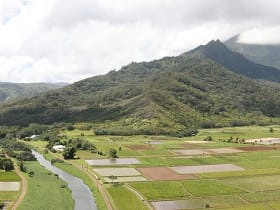
Hanalei Valley Lookout
6.3 miles away
Everyone drives past the turnout, but pulling in rewards you with the north shores signature view.
Waimea Canyon State Park
12 miles away
The Grand Canyon of the Pacific, a mile-wide gorge of rust-red and green cliffs plunging over 3,000 feet into western Kauai.
Polihale State Park
15 miles away
At the far western end of Kauai, past Waimea and Kekaha, paved Highway 50 gives out and a rough dirt cane road runs several miles to Polihale, one of the longest and widest beaches in Hawaii.

Captain Cook Monument
19 miles away
A stone statue marking where Captain Cook first landed in Hawaii on January 20, 1778, the first meeting of the islands and the outside world.