
Ke e Beach
Haena, HI
Where the highway finally ends on Kauai's north shore, a reef-ringed lagoon sits beneath the green cliffs that begin the Na Pali Coast.
Kēʻē Beach is where the road runs out on Kauai. After winding through Hanalei and across a string of historic one-lane bridges, the highway simply ends here, at a reef-sheltered lagoon tucked beneath soaring green cliffs. Those cliffs are the beginning of the Nā Pali Coast, the roadless, folded wall of mountains that guards Kauai's northwest shore, and Kēʻē is the doorway to it.
It is a beach of two moods. In summer the fringing reef calms the water into a lagoon fine for snorkeling; in winter the same coast is battered by some of the most powerful surf in the islands. Whatever the season, it is a place with deep cultural roots, home to a sacred site tied to the very origins of hula.
What Travelers Love
- A reef-protected lagoon that is often calm enough for snorkeling in summer
- The dramatic view up the green cliffs where the Na Pali Coast begins
- Standing at the literal end of the road on Kauai's north shore
- The trailhead to the famous Kalalau Trail starting right here
Worth Knowing
- Out-of-state visitors must reserve entry and parking to Haena State Park in advance, or arrive by the North Shore shuttle
- The reef protects the lagoon mainly in summer; in winter this coast sees powerful, dangerous surf
- There is no lifeguard beyond the state-park staffing, so check conditions and never turn your back on the sea
- Even a short walk on the Kalalau Trail needs sturdy shoes and can be very muddy and slick
Learn about Ke e Beach
The birthplace of hula
On the slopes just above Kēʻē stands Kaulu Paoa Heiau, a sacred site long associated with hula. In Hawaiian tradition this area is tied to Laka, the goddess of hula, and to Pele's sister Hiʻiaka, and it is regarded by many as a birthplace or ancient home of the dance. Hula practitioners still honor and visit the site today.
Because it is a heiau, a Hawaiian temple, the site is sacred ground. Visitors are asked to treat it with reverence: stay on established paths, do not climb on or move its stones, and do not leave objects or build rock piles, which can disturb a living place of worship.
This deep cultural layer is easy to miss if you come only for the beach, but it is central to what Kēʻē is. The place is not just scenic, it is storied, and the two are inseparable.
The reef and the lagoon
A fringing reef curves across the mouth of Kēʻē, and in the calm of summer it turns the inner water into a sheltered lagoon. On settled days this is one of the north shore's better spots to snorkel over coral and reef fish, close to shore and out of the main swell.
That calm is seasonal and never guaranteed. When surf is up, water can surge across and through the reef, and a channel that drains the lagoon can pull hard toward open water. Reading the ocean, and staying out when it is rough, matters here more than at a gentle protected bay.
As at any Hawaiian reef, the coral is alive and fragile. Standing on it or touching it does lasting harm, so the practice is to float above and let it be.
Gateway to the Na Pali Coast
Kēʻē is the trailhead for the Kalalau Trail, the celebrated and strenuous path that runs eleven miles along the Nā Pali Coast to Kalalau Beach. Even walking only the first stretch, to Hanakāpīʻai Beach, gives a taste of the coast's grandeur, though it is rugged, often muddy, and not to be underestimated.
Beyond the trailhead the Nā Pali cliffs rise in green, fluted folds straight from the sea, a coastline with no road, reachable only on foot, by boat, or from the air. From the beach you can look up into where that wilderness begins.
Access to both the beach and the trail now runs through Hāʻena State Park's reservation and shuttle system, put in place to ease crowding and protect the area, so planning ahead is part of any visit.
Season by season
Summer, roughly May through September, brings the calmest water, when the reef lagoon is most swimmable and snorkeling is at its best. It is the season most visitors picture.
Winter transforms the same beach. Large north swells send heavy, dangerous surf onto this coast, currents strengthen, and the lagoon can churn, so the water is often no place to enter.
Rain is common on the north shore year round and is what keeps the cliffs so green. It can also make the Kalalau Trail treacherously slick and, in heavy storms, close the road that leads here.
Closest Boutels
The closest Boutel™ stays, so you can turn this stop into an overnight. Each is a place we chose through independent editorial review, never a paid placement.
Details
Frequently asked questions
What is Kee Beach?
Kee Beach, at the very end of the road on the north shore of Kauai, Hawaii, is a beautiful and beloved beach at the start of the famous Napali Coast, offering golden sand, a reef-protected lagoon, and stunning views of the dramatic Napali cliffs. The lovely beach sits where the road ends and the wild Napali Coast begins, with a lagoon that in calm conditions offers snorkeling, along with breathtaking views of the towering green cliffs, making it one of the most scenic beaches on the island. Its beauty and setting make it a treasured destination. A gorgeous and scenic beach, it delights visitors. With its beauty and views, Kee Beach offers a compelling destination in Hawaii.
What can you do at Kee Beach?
You can relax on the golden sand, snorkel in the reef-protected lagoon in calm conditions, take in the breathtaking views of the Napali cliffs, and, from here, access the start of the famous Kalalau Trail along the Napali Coast. The lovely beach, the snorkeling lagoon, the stunning Napali views, and the trailhead access are the draws, making it a scenic destination. The Napali cliff views and the beach are highlights. With its beauty, Kee Beach offers a rewarding experience in Hawaii.
Is Kee Beach safe for swimming, and what should I know?
Kee Beach's reef-protected lagoon can offer calmer waters for snorkeling in good conditions, but the ocean here can become very dangerous, with strong currents and rough surf especially in winter and when swells are up, and drownings have occurred, so swimming and snorkeling only in calm conditions, heeding all warnings and any lifeguard guidance, never entering rough water, and being cautious of currents are essential. Access to the beach and the Napali area also requires reservations, so planning ahead is important. Respecting ocean conditions and planning access ensure a safe visit to Kee Beach in Hawaii.
When is the best time to visit Kee Beach?
The summer months generally bring calmer ocean conditions to the north shore, making them the best time for snorkeling in the lagoon, while winter brings large swells, rougher surf, and dangerous conditions, so the calmer season is safest for the water. Because access requires reservations and conditions vary, checking current requirements and ocean conditions before you go is essential. For calm water and snorkeling, aim for the summer months, and reserve access ahead, at Kee Beach in Hawaii.
What is near Kee Beach?
Kee Beach is at the end of the road on the north shore of Kauai, Hawaii, within reach of the Napali Coast and the start of the Kalalau Trail, the Haena wet and dry caves, the Limahuli Garden and Preserve, and the Hanalei Valley. That makes Kee Beach a compelling stop to combine with the Napali Coast and the other attractions of the Kauai north shore on a visit to Hawaii.
Nearby
Limahuli Garden and Preserve
0.2 miles away
Most north-shore visitors race to Ke e Beach and never turn in at Limahuli, just before the road end. That is a mistake.

Na Pali Coast and the Kalalau Trail
0.6 miles away
This is the landscape Kauai is famous for, and it starts right at the road end.
Haena Wet and Dry Caves
0.7 miles away
Caves right off the road always win with kids, and Haena has two kinds.

Waioli Mission House
5.0 miles away
In a town that is all about the bay, this is the human-history gem people walk right past.
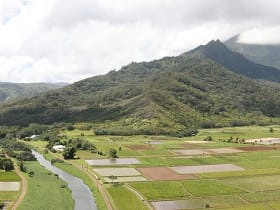
Hanalei Valley Lookout
6.5 miles away
Everyone drives past the turnout, but pulling in rewards you with the north shores signature view.
Waimea Canyon State Park
12 miles away
The Grand Canyon of the Pacific, a mile-wide gorge of rust-red and green cliffs plunging over 3,000 feet into western Kauai.
Polihale State Park
15 miles away
At the far western end of Kauai, past Waimea and Kekaha, paved Highway 50 gives out and a rough dirt cane road runs several miles to Polihale, one of the longest and widest beaches in Hawaii.

Captain Cook Monument
19 miles away
A stone statue marking where Captain Cook first landed in Hawaii on January 20, 1778, the first meeting of the islands and the outside world.