

The Getty Center
1200 Getty Center Drive
Los Angeles, CA
A billion-dollar hilltop of gleaming stone pavilions, a garden that is itself a work of art, and one of the great free views in Los Angeles, all reached by a little electric tram up the mountain.
The Getty Center is the rare great museum where the building, the garden, and the view compete with the paintings for your attention, and nobody minds. Architect Richard Meier spent more than a decade designing it, and when it opened in 1997 it had cost well over a billion dollars: a campus of pavilions clad in rough, fossil-flecked travertine stone and off-white metal, set on a Brentwood hilltop and reached by a driverless electric tram that glides up the mountain from the parking garage below.
It is all free. The oil fortune of J. Paul Getty endowed a trust deep enough that anyone can walk in without paying admission; the only cost is parking your car. Inside are European paintings, drawings, sculpture, and photographs, with Van Gogh's Irises among the headliners. Outside are terraces with views clear to the Pacific and Robert Irwin's Central Garden, a piece of living land art the artist called a sculpture in the form of a garden. Few places in Los Angeles give you this much for the price of a parking space.
What Travelers Love
- It is completely free to enter; you pay only for parking, which feels remarkable for a museum this grand
- The tram ride up the hillside from the parking structure, a small thrill that sets the tone
- Robert Irwin's Central Garden, a living artwork of streams and azaleas that changes with the seasons
- Panoramic views over Los Angeles to the ocean, especially in the golden light before sunset
Worth Knowing
- Admission is free, but you pay to park at the base and a timed reservation is often required, so check ahead and book
- You reach the museum by riding the electric tram up from the parking structure; plan a little extra time for the trip up and down
- Much of the pleasure is outdoors, so comfortable shoes help; the terraces and garden are as much the point as the galleries
- Late afternoon is magical for the light on the stone and the views, but that is also the busiest and warmest time
Learn about The Getty Center
Meier's hill of stone and light
Richard Meier is known for crisp white architecture, and the Getty is his masterwork, but the site made him bend his rules. The Getty family wanted warmth and a connection to the land, so alongside his signature enameled panels Meier clad much of the campus in Italian travertine, sawn to expose the fossils and shells locked inside the stone. Run your hand along a wall and you can feel leaves and shells millions of years old. The pavilions step across the ridge so that the buildings, the sky, and the city below are always part of the same picture.
Getting there is half the fun. You park at the bottom of the hill and ride a three-car electric tram up the slope to the museum on the ridge, a short, quiet climb that separates the place from the freeway roar below and makes arriving feel like an event. By the time you step off at the top, the whole basin has opened up beneath you.
A garden that is a work of art
The Central Garden is not a decorative afterthought; it is a commissioned artwork by Robert Irwin, and he meant it that way. A stream tumbles down a stone course toward a pool where azaleas are planted in a floating maze, surrounded by more than five hundred kinds of plants chosen to shift constantly through the year. Irwin inscribed a line into the design: always changing, never twice the same. Come back in a different month and it genuinely is a different garden.
Beyond it the grounds keep giving. There are terraces and lawns, a cactus garden perched on a south promontory with one of the best views on the whole campus, and quiet corners to sit with the city laid out below. Many visitors spend as much time outside as in the galleries, and the Getty is designed to reward exactly that.
The art, and the sister villa by the sea
The collection at the Center concentrates on European art before the twentieth century: paintings, drawings, illuminated manuscripts, sculpture, and decorative arts, along with a strong holding of photography. The single most famous canvas is Vincent van Gogh's Irises, but there is Gauguin, Rembrandt-era work, and rooms of French furniture and manuscripts to reward a slow wander. Because admission is free, it is an easy place to visit for just an hour or for a whole day.
It is worth knowing that the Getty has a second home. The Getty Villa, out on the coast toward Malibu, is a separate site built to look like an ancient Roman country house and devoted to the arts of Greece, Rome, and the Etruscans. The Center is the modern hilltop of European painting and architecture; the Villa is the classical world by the sea. Both are free, and together they make a remarkable one-two of Los Angeles art.
Visiting the Getty Center
The Getty sits right off the 405 in Brentwood, on the west side of Los Angeles, which makes it easy to reach but often busy. Admission is free, but you pay to park at the base of the hill and a timed reservation is frequently required, so book ahead and give yourself time to park, ride the tram up, and ride it back down.
Aim for a clear day, and if you can, stay into the late afternoon, when the low sun warms the travertine and the view stretches from the downtown towers to the glint of the Pacific. Wear shoes you can walk in, because the terraces, the garden, and the cactus overlook are as much the reason to come as anything hanging on the walls.
Closest Boutels
The closest Boutel™ stays, so you can turn this stop into an overnight. Each is a place we chose through independent editorial review, never a paid placement.
Details
Los Angeles, CA
Frequently asked questions
What is the Getty Center?
The Getty Center, perched on a hilltop in the Brentwood area of Los Angeles, is a world-renowned art museum and cultural complex celebrated for its stunning modern architecture, beautiful gardens, spectacular city views, and exceptional art collection. Designed by architect Richard Meier, its gleaming travertine pavilions house European paintings, drawings, sculpture, decorative arts, and photography, including works by masters like Van Gogh. Reached by a scenic tram ride up the hill, and free to enter, the Getty Center offers a magnificent blend of art, architecture, gardens, and views, making it one of LA's premier destinations.
Is the Getty Center free?
Yes, admission to the Getty Center is free, a generous offering to the public, though parking charges a fee, and reservations for parking or entry may be required at times, so checking current requirements before you go is wise. Once you arrive and park, a tram carries you up the hill to the museum. The free admission covers the galleries, gardens, and grounds. This makes the Getty an exceptional value, so plan for the parking fee and any reservations, and enjoy the world-class art, architecture, and views at no admission cost.
What can you see at the Getty Center?
You can explore galleries of European paintings including works by Van Gogh, Monet, and other masters, along with sculpture, drawings, decorative arts, illuminated manuscripts, and photography, admire the striking modern architecture, stroll the beautiful Central Garden and grounds, and take in sweeping views of Los Angeles and, on clear days, the ocean. Special exhibitions rotate throughout the year. The tram ride up adds to the experience. With its art, architecture, gardens, and views, the Getty Center offers a rich and memorable cultural outing for art lovers and casual visitors alike.
When is the best time to visit the Getty Center?
The Getty is enjoyable year-round, with clear days offering the best views of the city and ocean from the hilltop, and spring especially lovely for the gardens. Weekdays and earlier in the day tend to be less crowded than weekends. Because much of the experience is indoors, it is a great choice in any weather, though the gardens and views are best on clear days. Checking current hours, parking, and any reservation requirements before you go helps you plan. Allow several hours to enjoy the art, gardens, and views.
What is near the Getty Center?
The Getty Center is in the Brentwood area of West Los Angeles, near the neighborhoods of Westwood and Bel-Air, the UCLA campus, and within reach of the beaches of Santa Monica and Malibu, the sister museum the Getty Villa in Pacific Palisades, and the wider attractions of Los Angeles. That makes the Getty Center a cultural highlight to combine with the west side's neighborhoods, the beaches, the Getty Villa, and the many other sights of Los Angeles on a Southern California visit.
Nearby
Mulholland Drive Overlook
5.3 miles away
Mulholland Drive runs 24 miles along the crest of the Santa Monica Mountains from Cahuenga Pass (at US-101) to Leo Carrillo State Beach on the Pacific Coast Highway.

Getty Villa
5.6 miles away
Just off the Pacific Coast Highway at the eastern edge of Malibu, the Getty Villa is a full-scale recreation of an ancient Roman country house, modeled on a seaside villa buried by Vesuvius in the yea...
La Brea Tar Pits
6.9 miles away
The La Brea Tar Pits in the Miracle Mile district of Los Angeles are active asphalt seeps that have been trapping and preserving animals since before the last ice age.

TCL Chinese Theatre
7.9 miles away
The world-famous 1927 pagoda movie palace on Hollywood Boulevard, its towering red columns, carved dragon, and guardian lions marking one of the most recognizable buildings in film.
Hollywood Walk of Fame
8.6 miles away
A free open-air monument of more than 2,800 brass-and-terrazzo stars set into the sidewalks of Hollywood Boulevard and Vine Street, honoring a century of film, TV, music, radio, and stage.
Griffith Park
10 miles away
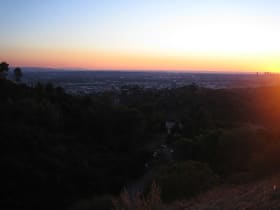
Griffith Park covers 4,310 acres in the eastern Santa Monica Mountains within Los Angeles, making it one of the largest urban parks in North America.

Griffith Observatory
10 miles away
A free public observatory high on Mount Hollywood in Griffith Park, open since 1935.
Malibu Pier
12 miles away
A historic 1905 wooden fishing pier with white Cape Cod towers, right on the Pacific Coast Highway in central Malibu and now a free California State Parks landmark.
Carbon Beach
12 miles away
Malibu's famed Billionaire's Beach, a public strand below a wall of celebrity mansions that took decades of court fights to keep open.

Channel Islands National Park
47 miles away
Five undeveloped islands off the California coast, home to plants and animals found nowhere else on Earth.