
La Brea Tar Pits
5801 Wilshire Blvd
Los Angeles, CA
A place in the middle of the city where the ground still bubbles up sticky asphalt, exactly as it did when it swallowed mammoths and saber-toothed cats.
For tens of thousands of years, natural asphalt has seeped to the surface here, forming shallow, sticky pools that shimmer under a skin of dust and water. Animals that wandered in could not get out, and predators that came to feed on them were caught in turn. Over time the asphalt preserved their bones almost perfectly, layer upon layer, until this one city block became one of the richest Ice Age fossil sites on earth.
What makes it extraordinary is that it is still happening, in the middle of Los Angeles. The pools still bubble, new fossils still turn up, and paleontologists still work the site every day. You can stand on a lawn off Wilshire Boulevard and look straight down into the deep past.
What Travelers Love
- Standing at active asphalt seeps that still bubble and trap leaves and insects today
- Seeing walls of real dire wolf skulls and the fossils of saber-toothed cats and mammoths
- Watching paleontologists clean and sort Ice Age bones in the working lab
- A genuine fossil site in the middle of the second-largest city in the country
Worth Knowing
- The bubbling pools are asphalt, not tar, and they are sticky and toxic, so the fenced pits are for looking only
- The grounds and outdoor pits are free to walk; the museum with the collections is ticketed
- It is a favorite school-trip destination, so weekday mornings can be busy with groups
- Summer in Los Angeles is hot and the park is partly exposed, so bring water and sun protection
Learn about La Brea Tar Pits
How the trap works
Crude oil rises along a fault beneath this part of Los Angeles, and as its lighter parts evaporate at the surface, what is left is a heavy, sticky asphalt. In warm weather it softens into pools that are easy to walk into and nearly impossible to escape.
A large plant-eater caught in the asphalt would draw predators, which then became stuck as well, which is why the site holds so many meat-eaters. Only a small amount of asphalt is needed to trap even a big animal, and the same slow burial that killed them also protected their bones for the ages.
The Ice Age menagerie
The fossils recovered here map out the animals that lived around Los Angeles during the last Ice Age: mammoths and mastodons, ground sloths, ancient bison and horses, and predators like the saber-toothed cat, which is the California state fossil, and the dire wolf.
The dire wolf is the site's most famous resident. Hundreds of their skulls have come out of the asphalt, and a wall of them at the museum is one of the most striking displays in any natural history collection. The pits have also yielded countless smaller creatures, from birds and insects to plants and pollen, that together reconstruct a whole lost world.
A working excavation in the city
The Tar Pits are not a finished dig. Paleontologists continue to excavate deposits on the grounds, and a glass-walled lab lets visitors watch scientists clean, identify, and catalog fossils that came out of the asphalt.
One find, a partial mammoth skeleton nicknamed Zed, was uncovered during nearby construction and moved here for study, a reminder that the fossil beds extend far beyond the fenced pits and under the surrounding neighborhood.
Hancock Park and the Miracle Mile
The pits sit in Hancock Park, a shady green square in one of Los Angeles's densest districts. The land was once part of a Mexican-era ranch and later an oil field before the fossil riches were recognized and the site was donated for preservation.
The block has become one of the city's great cultural clusters. The Los Angeles County Museum of Art and the Academy Museum of Motion Pictures are next door, and the Grove and the historic Farmers Market are a short walk away, so the Tar Pits fold easily into a full day in the city.
Closest Boutels
The closest Boutel™ stays, so you can turn this stop into an overnight. Each is a place we chose through independent editorial review, never a paid placement.
Details
Los Angeles, CA
Frequently asked questions
What are the La Brea Tar Pits?
The La Brea Tar Pits, in the heart of Los Angeles's Miracle Mile district, are a world-famous Ice Age fossil site where natural asphalt, or tar, has bubbled up for tens of thousands of years, trapping and preserving prehistoric animals. One of the richest fossil deposits on Earth, the pits have yielded countless remains of mammoths, mastodons, saber-toothed cats, dire wolves, and more. With an on-site museum displaying the fossils, active excavation, and bubbling tar pits right in a city park, the La Brea Tar Pits offer a fascinating and unique window into prehistoric California.
What can you see at the La Brea Tar Pits?
You can view the bubbling tar pits in the surrounding park, including a large lake pit with life-size mammoth models, tour the on-site museum displaying thousands of Ice Age fossils, from towering mammoth and mastodon skeletons to saber-toothed cats and dire wolves, watch paleontologists at work in the fossil lab, and see ongoing excavations. Interactive exhibits explain how the animals were trapped and preserved. With its real tar pits, spectacular fossils, and active science, the site offers an engaging and educational experience for all ages right in the city.
Are the La Brea Tar Pits good for kids?
Yes, the La Brea Tar Pits are a wonderful, engaging destination for children, who are captivated by the giant Ice Age fossils like mammoths and saber-toothed cats, the bubbling tar pits with their mammoth models, and the chance to watch scientists cleaning fossils in the lab. Interactive and hands-on exhibits make learning fun. The combination of real prehistoric creatures, active science, and the fascinating tar pits sparks curiosity and imagination. It is an entertaining and educational outing that appeals to kids and adults alike in the middle of Los Angeles.
When is the best time to visit the La Brea Tar Pits?
As a museum with an outdoor park, the tar pits are enjoyable year-round in LA's mild climate, with the indoor museum comfortable in any weather and the surrounding park pleasant on clear days. Weekdays and mornings tend to be less crowded than weekends. Checking current hours and any special programs or tours before you go helps you plan. Allowing a couple of hours lets you enjoy both the museum and the outdoor pits. The consistently mild weather means almost any time is good for a visit.
What is near the La Brea Tar Pits?
The La Brea Tar Pits are in the Miracle Mile district of Los Angeles, right next to the Los Angeles County Museum of Art and near other Museum Row attractions, with the shopping and dining of the Fairfax and Beverly Hills areas nearby and Hollywood a short drive away. That makes the La Brea Tar Pits an easy cultural stop to combine with the neighboring art museum, Museum Row, and the many other attractions of central Los Angeles on a Southern California visit.
Nearby

TCL Chinese Theatre
2.8 miles away
The world-famous 1927 pagoda movie palace on Hollywood Boulevard, its towering red columns, carved dragon, and guardian lions marking one of the most recognizable buildings in film.
Hollywood Walk of Fame
3.1 miles away
A free open-air monument of more than 2,800 brass-and-terrazzo stars set into the sidewalks of Hollywood Boulevard and Vine Street, honoring a century of film, TV, music, radio, and stage.
Mulholland Drive Overlook
4.5 miles away
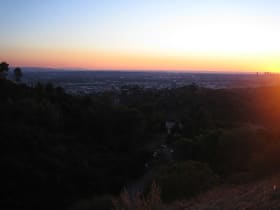
Mulholland Drive runs 24 miles along the crest of the Santa Monica Mountains from Cahuenga Pass (at US-101) to Leo Carrillo State Beach on the Pacific Coast Highway.
Griffith Park
4.9 miles away
Griffith Park covers 4,310 acres in the eastern Santa Monica Mountains within Los Angeles, making it one of the largest urban parks in North America.

Griffith Observatory
4.9 miles away
A free public observatory high on Mount Hollywood in Griffith Park, open since 1935.

The Getty Center
6.9 miles away
The Getty Center is a free hilltop art museum of gleaming travertine pavilions above Brentwood, with a living Central Garden by Robert Irwin and sweeping views over Los Angeles to the Pacific.

Getty Villa
12 miles away
Just off the Pacific Coast Highway at the eastern edge of Malibu, the Getty Villa is a full-scale recreation of an ancient Roman country house, modeled on a seaside villa buried by Vesuvius in the yea...
Malibu Pier
18 miles away
A historic 1905 wooden fishing pier with white Cape Cod towers, right on the Pacific Coast Highway in central Malibu and now a free California State Parks landmark.
Carbon Beach
19 miles away
Malibu's famed Billionaire's Beach, a public strand below a wall of celebrity mansions that took decades of court fights to keep open.

Channel Islands National Park
54 miles away
Five undeveloped islands off the California coast, home to plants and animals found nowhere else on Earth.