

Getty Villa
17985 Pacific Coast Highway
Pacific Palisades, CA
An entire Roman country house rebuilt above the Pacific, with two thousand years of Greek and Roman art inside and free to walk into.
The Getty Villa is one of the most unusual museums in America: a working recreation of an ancient Roman country house, built full size on a canyon hillside above the Pacific. It was the idea of the oil magnate J. Paul Getty, who had gathered a large collection of Greek, Roman, and Etruscan antiquities and wanted a home for them that felt like the world they came from. Rather than a modern glass box, he chose to rebuild the kind of seaside villa a wealthy Roman would have owned two thousand years ago.
The model was a real building, the Villa dei Papiri at Herculaneum, a grand house buried by the eruption of Mount Vesuvius in the year 79 and only partly excavated. Getty's architects took its floor plan and proportions and raised the whole thing again in California, complete with painted walls, colonnaded courtyards, marble floors, and formal gardens. Inside, the antiquities are displayed so you move through the ancient world in a setting that ancient people would have recognized, and it costs nothing to walk in.
What Travelers Love
- A convincing full-scale Roman villa, not a gallery pretending to be one, with columns, frescoes, and marble underfoot
- Formal Roman gardens with a long reflecting pool, box hedges, and Mediterranean herbs, all free to wander
- Rooms of Greek and Roman marble, bronze, and pottery arranged so the ancient world feels close
- The open-air theater and the hillside view down the canyon to the Pacific
Worth Knowing
- Admission is free, but a timed entry ticket is required and must be reserved ahead of your visit, especially on weekends
- Parking is by advance reservation and carries a fee, so plan the arrival before you set out on the coast highway
- It is a large site with indoor galleries and outdoor gardens, so give it a half day and wear comfortable shoes
- Photography without flash is generally welcome, and the gardens are as much of the visit as the galleries
Learn about Getty Villa
How a Roman villa ended up above Malibu
J. Paul Getty began collecting classical art in the 1930s, and by the 1950s he had opened a small gallery next to his ranch house on this hillside. The collection quickly outgrew it. Instead of building a conventional museum, Getty made a bold choice: he would recreate an entire ancient Roman villa to hold his Greek and Roman pieces, so that the art and its architecture belonged together. The building opened in 1974.
The house he chose to copy was the Villa dei Papiri, a lavish seaside residence outside the Roman town of Herculaneum on the Bay of Naples. When Vesuvius erupted in the year 79, the same eruption that destroyed nearby Pompeii, it buried the villa under volcanic mud that hardened and preserved it. Only part of it has ever been dug out, so Getty's architects filled in the unknown sections using other ancient Roman houses as guides. The result is not a guess but a careful reconstruction, from the tall columns to the bright wall paintings copied from real Roman rooms.
Walking through the ancient world
Inside, the Getty Villa holds around forty-four thousand Greek, Roman, and Etruscan objects that span from about 6,500 BC to 400 AD, with well over a thousand on display at any time. The galleries are arranged by theme and time, so you can follow gods and heroes, daily life, athletics, and the theater through marble statues, painted vases, carved gems, bronze figures, and glass. Among the most famous pieces are the Victorious Youth, a rare life-size Greek bronze pulled from the sea, and the Lansdowne Heracles, a powerful Roman marble.
The galleries surround open courtyards, so light and air move through the museum the way they would have in a real Roman house. After a renovation completed in the 2010s, the collection was rearranged in a clear chronological path that helps a first-time visitor make sense of centuries of art without needing to be an expert. Because so much of the setting is a recreation of a lived-in home, children and adults alike tend to grasp the ancient world here in a way a plain gallery rarely allows.
The gardens and the theater
The gardens are as much of the visit as the art, and they are free to wander. The grand Outer Peristyle is a formal Roman garden built to the exact proportions of the one at the Villa dei Papiri, a long rectangle of clipped hedges, bronze statues, and Mediterranean plants around a reflecting pool more than two hundred feet long. Smaller courtyard gardens grow the herbs, fruit trees, and flowers a Roman household would actually have used for food, medicine, and offerings, which makes them a quiet lesson in daily ancient life.
The villa also has an open-air theater, modeled on the stepped stone theaters of the ancient world and set into the hillside facing the building's grand front. In the warm months it hosts staged productions of Greek and Roman plays under the evening sky. Even on an ordinary afternoon it is a fine place to sit, look back at the columned facade, and take in the view down the green canyon toward the Pacific.
Visiting the Getty Villa
The villa sits just off the Pacific Coast Highway at the eastern end of Malibu, an easy drive up the coast from Santa Monica. Admission is free, which is unusual for a collection of this quality, but you must reserve a timed entry ticket in advance, and parking is by advance reservation and carries a fee. Both fill up on weekends, so booking a day or two ahead is the difference between an easy arrival and a turned-away one.
Plan for a half day. It takes time to walk the galleries, sit in the gardens, and let the recreation do its work, and rushing undercuts the whole point of the place. Comfortable shoes help, since the grounds are large and terraced into the hillside. When you leave, the coast highway carries you straight back into the beaches and mountains of Malibu, so the villa slots easily into a coastal road trip rather than demanding a trip of its own.
Closest Boutels
The closest Boutel™ stays, so you can turn this stop into an overnight. Each is a place we chose through independent editorial review, never a paid placement.
Details
Pacific Palisades, CA
Frequently asked questions
What is the Getty Villa?
The Getty Villa, on the coast between Santa Monica and Malibu in the Pacific Palisades area of Los Angeles, is a stunning museum dedicated to the arts and cultures of ancient Greece, Rome, and Etruria. Housed in a recreation of an ancient Roman country house inspired by a villa buried by Vesuvius, it displays a superb collection of classical antiquities amid beautiful gardens, fountains, and architecture overlooking the ocean. The immersive setting transports visitors to the ancient Mediterranean world. Free to enter, the Getty Villa offers a magical blend of ancient art, architecture, and gardens in a spectacular coastal location.
Do you need reservations for the Getty Villa?
Yes, the Getty Villa typically requires a free timed-entry ticket or reservation to visit, even though admission itself is free, so you should reserve in advance rather than simply showing up, and parking charges a fee. Reservations help manage capacity at the popular site. Checking the current ticketing and reservation requirements before you go is essential to ensure entry. Once you have your reservation and arrive, you can enjoy the galleries, gardens, and grounds at no admission cost, so plan ahead for the ticket and parking fee.
What can you see at the Getty Villa?
You can explore galleries filled with ancient Greek, Roman, and Etruscan sculpture, pottery, jewelry, and artifacts, wander the beautiful recreated Roman gardens with their fountains, pools, and colonnades, admire the architecture inspired by an ancient villa, and enjoy ocean views from the hillside setting. Special exhibitions, an outdoor theater, and educational programs add to the experience. The immersive design makes you feel transported to the ancient Mediterranean. With its classical art, gardens, and stunning architecture in a coastal setting, the Getty Villa offers a uniquely beautiful and enriching cultural visit.
When is the best time to visit the Getty Villa?
The Getty Villa is enjoyable year-round thanks to the mild coastal climate, with clear days especially lovely for the gardens and ocean views, and spring beautiful for the blooming gardens. Weekdays tend to be less crowded than weekends. Because reservations are required and timed, booking ahead for your preferred time is the key step. Checking current hours, ticketing, and parking before you go helps you plan. Allow a few hours to enjoy the galleries and gardens, and aim for a clear day to fully appreciate the setting.
What is near the Getty Villa?
The Getty Villa is in the Pacific Palisades on the coast between Santa Monica and Malibu, near the beaches of the area, the sister museum the Getty Center in Brentwood, and within reach of the attractions of Santa Monica, Malibu's coastline, and the wider Los Angeles region. That makes the Getty Villa a cultural highlight to combine with the beaches of Santa Monica and Malibu, the Getty Center, and the many other sights of Los Angeles on a Southern California coastal visit.
Nearby

The Getty Center
5.6 miles away
The Getty Center is a free hilltop art museum of gleaming travertine pavilions above Brentwood, with a living Central Garden by Robert Irwin and sweeping views over Los Angeles to the Pacific.
Malibu Pier
6.4 miles away
A historic 1905 wooden fishing pier with white Cape Cod towers, right on the Pacific Coast Highway in central Malibu and now a free California State Parks landmark.
Carbon Beach
6.6 miles away
Malibu's famed Billionaire's Beach, a public strand below a wall of celebrity mansions that took decades of court fights to keep open.
Mulholland Drive Overlook
11 miles away
Mulholland Drive runs 24 miles along the crest of the Santa Monica Mountains from Cahuenga Pass (at US-101) to Leo Carrillo State Beach on the Pacific Coast Highway.
La Brea Tar Pits
12 miles away
The La Brea Tar Pits in the Miracle Mile district of Los Angeles are active asphalt seeps that have been trapping and preserving animals since before the last ice age.

TCL Chinese Theatre
13 miles away
The world-famous 1927 pagoda movie palace on Hollywood Boulevard, its towering red columns, carved dragon, and guardian lions marking one of the most recognizable buildings in film.
Hollywood Walk of Fame
14 miles away
A free open-air monument of more than 2,800 brass-and-terrazzo stars set into the sidewalks of Hollywood Boulevard and Vine Street, honoring a century of film, TV, music, radio, and stage.
Griffith Park
16 miles away
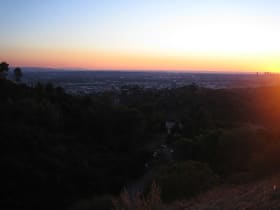
Griffith Park covers 4,310 acres in the eastern Santa Monica Mountains within Los Angeles, making it one of the largest urban parks in North America.

Griffith Observatory
16 miles away
A free public observatory high on Mount Hollywood in Griffith Park, open since 1935.

Channel Islands National Park
42 miles away
Five undeveloped islands off the California coast, home to plants and animals found nowhere else on Earth.