
Muhammad Ali Center
144 N 6th St, Louisville, KY
Louisville, KY
A six-story tribute to a Louisville boy who became one of the most famous people on earth, built as much around his convictions as his boxing.
The Muhammad Ali Center rises six stories above downtown Louisville, a museum and cultural center devoted to the boxer, activist, and humanitarian who was born in this city as Cassius Clay in 1942. It is not a shrine to trophies. The building is organized around six core principles Ali named as the guides of his life: confidence, conviction, dedication, respect, giving, and spirituality.
Inside, the galleries move between the roar of the ring and the quiet of conscience. You watch him float and sting against Sonny Liston and George Foreman, then follow the harder chapters, his refusal to be drafted for the Vietnam War, the stripping of his title, and his long second act as a global peacemaker. It is a hometown story that became a world story.
What Travelers Love
- The immersive galleries that trace the six core principles Ali lived by
- Archival footage of the fights, the poetry, and the interviews in his own voice
- A training-room area where you can shadowbox and feel the speed bag rhythm
- The way the center frames him as a humanitarian and activist, not only a boxer
Worth Knowing
- The center is thoughtfully paced, so give yourself a couple of unhurried hours
- It is part of downtown Museum Row, easy to pair with the Slugger Museum next door
- Some galleries deal with civil rights and personal loss, worth a word to younger kids
- Parking is easiest in the nearby downtown garages rather than on the street
Learn about Muhammad Ali Center
A Louisville boy named Cassius Clay
The champion the world knew as Muhammad Ali began as Cassius Marcellus Clay Jr., born in Louisville's West End in 1942, the son of a sign painter and a domestic worker. The often-told origin has a twelve-year-old Cassius reporting his stolen bicycle to a police officer named Joe Martin, vowing to whip whoever took it. Martin, who trained young boxers at a local gym, told him he had better learn to fight first, and set him on the path.
Louisville was a segregated city when Clay grew up, and the sting of that shaped him. He won a gold medal at the 1960 Rome Olympics and came home a champion, only to run into the same closed doors. The center does not tidy this away. It uses his roots to explain the man, the fast hands and the fast mouth, but also the conscience that would cost him his title and years of his prime.
The name, the stand, and the exile
After winning the heavyweight title from Sonny Liston in 1964, the young champion announced he had joined the Nation of Islam and would be known as Muhammad Ali. It was a jarring break for much of the public, and many refused for years to use the new name. Ali insisted, calling his birth name a slave name and claiming the right to define himself.
In 1967 Ali refused induction into the military, citing his religious beliefs and famously saying he had no quarrel with the Vietnamese. He was stripped of his title, barred from boxing, and convicted of draft evasion, losing several of his best fighting years while the case worked its way up. The Supreme Court overturned the conviction in 1971. The center treats this stand as the center of his legacy, the moment a great athlete became a symbol of conscience.
Inside the galleries
The exhibits are built to be walked through rather than simply read. A recreated training area lets visitors shadowbox and try the rhythm of the speed bag, and a theater immerses you in the atmosphere of a title fight. Archival film runs throughout, so you hear Ali's voice, the poetry and the taunts and the tenderness, rather than only reading about him.
Upstairs, the mood shifts from the ring to the wider world. Displays follow his humanitarian work, his lighting of the Olympic flame in Atlanta in 1996 with hands trembling from Parkinson's disease, and his decades as a globe-crossing goodwill figure. The six-principle framework threads through the whole building, turning a sports museum into something closer to a museum of character.
Museum Row and the wider legacy
The Ali Center anchors Louisville's Museum Row on West Main Street, a district of red-brick facades and cast-iron storefronts that also holds the Louisville Slugger factory, the science center, and a cluster of galleries and distillery visitor rooms. It is an easy place to spend a full day on foot.
Ali died in 2016, and Louisville turned out in the tens of thousands to line the streets for his funeral procession, which wound past his boyhood home and the gym where he first learned to box. The center keeps that connection alive, reminding visitors that the most famous man of his age never stopped calling this river city home.
Closest Boutels
The closest Boutel™ stays, so you can turn this stop into an overnight. Each is a place we chose through independent editorial review, never a paid placement.
Details
Louisville, KY
Frequently asked questions
What is the Muhammad Ali Center?
The Muhammad Ali Center, in downtown Louisville, Kentucky, is a museum and cultural center honoring the life, legacy, and ideals of Muhammad Ali, the legendary boxer and humanitarian who was born and raised in Louisville. More than a sports museum, the center celebrates Ali not only as one of the greatest boxers of all time but as a courageous champion of civil rights, social justice, and peace, whose convictions and character inspired the world. Through moving exhibits, memorabilia, films, and interactive displays, it shares his story and the core principles he lived by. An inspiring tribute to a global icon, it moves and educates visitors. With its powerful exhibits, the Muhammad Ali Center offers a meaningful destination in Kentucky.
Who was Muhammad Ali?
Muhammad Ali was one of the greatest and most famous athletes in history, a boxer born and raised in Louisville, Kentucky, who became a three-time world heavyweight champion known for his extraordinary skill, charisma, and confidence. Beyond boxing, Ali became a powerful and courageous figure in the struggle for civil rights and social justice, famously standing by his convictions at great personal cost, and later a global humanitarian and ambassador for peace. His life and principles made him an inspiration around the world. The center honors this legacy, making the Muhammad Ali Center a meaningful destination in Kentucky.
What can you see at the Muhammad Ali Center?
You can explore moving exhibits on Muhammad Ali's life and boxing career, his role in the civil rights movement and his stand on his convictions, his humanitarian work, and the core principles he championed, along with memorabilia, films, and interactive displays, including a chance to try elements of boxing training. The powerful exhibits, the celebration of Ali's courage and character, and the interactive features are the highlights, offering an inspiring and thought-provoking experience. It honors both the athlete and the humanitarian. With its exhibits and inspiration, the Muhammad Ali Center offers a rewarding visit in Louisville, Kentucky.
When is the best time to visit the Muhammad Ali Center?
As an indoor museum, the Muhammad Ali Center is enjoyable year-round in any weather, making it a great stop in any season in downtown Louisville. It can be busier on weekends and around special events or exhibitions. Because hours can vary, checking the current schedule before you go is wise. Allowing time to absorb the meaningful exhibits is worthwhile. Because it is indoors, the Muhammad Ali Center makes a rewarding stop any time of year in Louisville, Kentucky.
What is near the Muhammad Ali Center?
The Muhammad Ali Center is in downtown Louisville, Kentucky, within reach of the Louisville Slugger Museum, the Kentucky Derby Museum at Churchill Downs, the Big Four Bridge, the Louisville Mega Cavern, and downtown Louisville. That makes the Muhammad Ali Center a meaningful stop to combine with the Louisville Slugger Museum, the Kentucky Derby Museum, and the other attractions of Louisville on a visit to Kentucky.
Nearby

Louisville Slugger Museum and Factory
0.4 miles away
You cannot miss it: a 120-foot baseball bat leaning against the building downtown.

Falls of the Ohio State Park
1.3 miles away
This is deep time you can walk on. At the Falls of the Ohio in Clarksville, the river has stripped bare a 380-million-year-old fossil coral reef, one of the largest exposed Devonian fossil beds in the...
Conrad-Caldwell House Museum
1.7 miles away
Most Derby visitors never wander into Old Louisville, which is exactly why this stop feels like a secret. The Conrad-Caldwell House at 1402 St.

Big Four Bridge
1.7 miles away
For a quick, free stretch of the legs with a big view, walk out onto the Big Four Bridge at Waterfront Park.
Howard Steamboat Museum
2.3 miles away
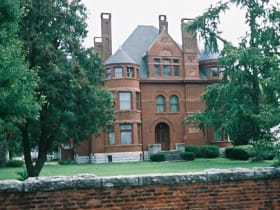
This one surprises people twice over. The Howard Steamboat Museum at 1101 E Market St fills a 22-room Victorian mansion the Howard shipbuilding family raised beside their Jeffersonville shipyard, whic...

Colonel Sanders Grave
2.6 miles away
Follow the yellow line. Cave Hill Cemetery on Baxter Avenue is a lush 296-acre garden cemetery and arboretum, and its most-visited resident is Colonel Harland Sanders, the white-suited founder of KFC,...

Kentucky Derby Museum at Churchill Downs
3.8 miles away
Even kids who know nothing about horse racing get swept up here.

Cherokee Park
4.2 miles away
Cherokee Park is one of the finest surviving works of Frederick Law Olmsted, the father of American landscape architecture, who shaped New York's Central Park before laying out Louisville's park syste...
Louisville Mega Cavern
5.5 miles away
There is a whole hidden world under Louisville, and you can zip line through it.

Corydon Capitol State Historic Site
20 miles away
Ask most people where Indianas first capital was and they will guess wrong. It was Corydon, and the original statehouse still stands on the town square at 202 E Walnut St.