
Corydon Capitol State Historic Site
301 E Walnut St, Corydon, IN
Corydon, IN
In a sturdy little limestone building on a leafy town square, Indiana's founders wrote a constitution and launched a state, the first capitol of Indiana.
Corydon Capitol State Historic Site preserves the very building where Indiana became a state. In 1816, delegates gathered in this sturdy blue-limestone structure to write the constitution that admitted Indiana to the Union, and for the next decade Corydon served as the young state's first capital. The building is modest by the standards of grand statehouses, but its plainness is part of its power, a frontier capitol raised by a new state with big ambitions and limited means.
The site is more than the capitol alone. A short walk away stood the great Constitution Elm, under whose branches the delegates are said to have worked on hot summer days, and the historic town square around the building still carries the feel of early-1800s Indiana. Together with a Civil War battlefield on the town's edge, Corydon offers a concentrated dose of the state's founding history in one small, walkable place.
What Travelers Love
- The sturdy blue-limestone capitol where Indiana's first constitution was framed
- The story of the Constitution Elm, the tree that shaded the state's founders
- A walkable historic town square lined with early-1800s buildings
- The nearby Civil War battlefield, site of one of the few Northern battles
Worth Knowing
- The capitol is small, so pair it with the historic town square and nearby sites to fill a visit
- Interpretation is led by guides, so check the schedule for tours before arriving
- Cave country lies nearby, so it is easy to combine Corydon with an underground tour
- The town hosts festivals through the year, so check the calendar if you want to catch or avoid a crowd
Learn about Corydon Capitol State Historic Site
Where Indiana became a state
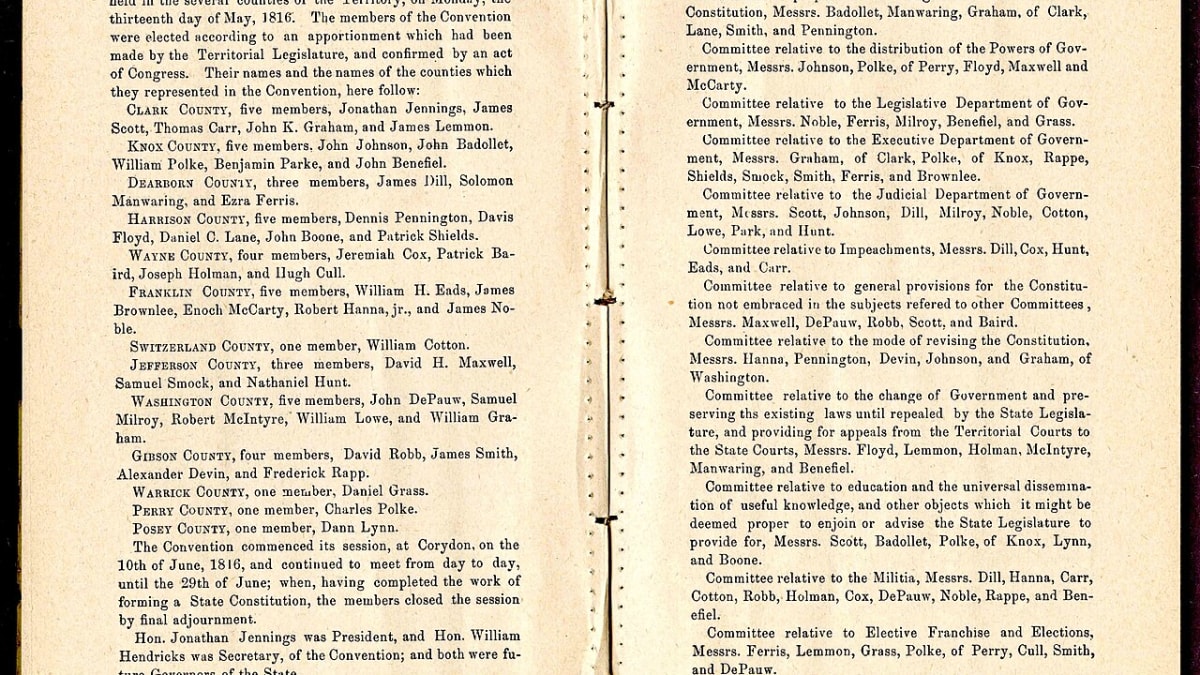
In 1816, the Indiana Territory was ready to seek statehood, and delegates from across the region convened in Corydon to draft a constitution. The building they used, a two-story structure of local blue limestone, had been raised only a few years earlier to serve the territory's courts and government. That summer, the delegates hammered out the framework of a new state, and by the end of the year Indiana had joined the Union.
Corydon then served as the capital of the new state until the government moved north to the more central location of Indianapolis in the mid-1820s. During those years the little limestone building was the seat of Indiana's legislature and the heart of its public life. That such a consequential chapter played out in so modest a structure is exactly what makes the site memorable, a reminder that great beginnings often start small.
The Constitution Elm
One of the most beloved stories of Corydon concerns a huge elm tree that once stood near the capitol. As the tale goes, the summer of 1816 was so hot that the delegates sometimes left the stuffy building and worked in the cool shade of the great elm, and the tree became known ever after as the Constitution Elm. It grew into a cherished local symbol of the state's founding.
The original tree eventually died of disease, but its memory was preserved in a fitting way. The trunk was protected within a stone shelter that still stands as a monument, keeping the story alive for visitors. The Constitution Elm remains one of Indiana's founding legends, and a stop at its monument is a natural companion to touring the capitol building itself.
The Ohio Valley and its first peoples
Long before delegates met in Corydon, this hill and river country was part of the homelands of Native nations. Indiana is the homeland of the Miami, who call themselves Myaamia, along with the Shawnee, the Lenape or Delaware, the Potawatomi, and the Wea, Piankeshaw, and Kickapoo. They lived, hunted, and traveled through the Ohio Valley for generations before the treaties and settlement that opened the region to statehood.
The state's founding was bound up with the pressure and displacement of these nations, whose lands were taken through a series of treaties in the early 1800s. In the following decades, the Potawatomi were forced west on the deadly march remembered as the Trail of Death. These are living peoples with continuing communities today, and their long presence is an essential part of the fuller story of how Indiana came to be.
The town and the battlefield
Corydon itself rewards a wander. The historic town square around the capitol still carries the character of an early Indiana settlement, with old buildings, shops, and a courthouse that keep the past close. It is an easy, pleasant place to walk, and its small-town charm makes the founding history feel human and near at hand.
On the edge of town lies a Civil War battlefield, the site of a brief clash during a Confederate raid into the North, one of the few times the war reached Indiana soil. Together with the nearby cave country of southern Indiana, the battlefield gives visitors reasons to linger. A trip to Corydon can easily fill a day, weaving together the state's birth, the Civil War, and the karst landscape all around.
Closest Boutels
The closest Boutel™ stays, so you can turn this stop into an overnight. Each is a place we chose through independent editorial review, never a paid placement.
Details
Corydon, IN
Frequently asked questions
What is the Corydon Capitol State Historic Site?
The Corydon Capitol State Historic Site, in Corydon in southern Indiana, preserves the historic building that served as Indiana's first state capitol, where the state's founding took place, a significant landmark of Indiana history. Corydon was Indiana's first capital, and it was here that the state's first constitution was written and the early government met in the sturdy limestone capitol building, which the site preserves along with related historic structures, offering exhibits and tours on the founding of the state. Its role in Indiana's birth makes it a fascinating and important destination. A historic and significant landmark, it educates visitors. With its history, the Corydon Capitol offers a compelling destination in Indiana.
Why is Corydon important to Indiana history?
Corydon is important as Indiana's first state capital, where the state's first constitution was written and the early government met when Indiana became a state, making it the birthplace of Indiana government. The historic limestone capitol building and related sites preserve this founding heritage, and the town remains proud of its role in the state's beginnings. Its place in Indiana's founding gives it lasting significance. Understanding this history enriches a visit to the Corydon Capitol State Historic Site in Indiana.
What can you see at the Corydon Capitol State Historic Site?
You can tour the historic limestone capitol building that served as Indiana's first statehouse, see related historic structures, and explore exhibits on the founding of the state and early Indiana government. The historic capitol building, the related sites, and the exhibits on Indiana's founding are the draws, offering a fascinating look at the state's birth. The first statehouse and its history are highlights. With its history, the Corydon Capitol State Historic Site offers a rewarding visit in Indiana.
When is the best time to visit the Corydon Capitol State Historic Site?
As a mostly indoor historic site, the Corydon Capitol can be enjoyed in various seasons, with tours offered on a schedule, so checking the current hours before you go is wise. The mild months are pleasant for exploring historic Corydon alongside a visit. For a visit, check current hours at the Corydon Capitol State Historic Site in Indiana.
What is near the Corydon Capitol State Historic Site?
The Corydon Capitol State Historic Site is in Corydon in southern Indiana, within reach of historic Corydon, the Ohio River country, Marengo Cave, and the routes toward Louisville and the Falls of the Ohio to the east. That makes the Corydon Capitol State Historic Site a compelling stop to combine with the other attractions of southern Indiana on a visit to the state.
Nearby

Marengo Cave
16 miles away
Marengo Cave is one of only a handful of show caves in Indiana and the most decorated, a National Natural Landmark tucked into the wooded karst hills at 400 E State Rd 64.

Kentucky Derby Museum at Churchill Downs
19 miles away
Even kids who know nothing about horse racing get swept up here.
Conrad-Caldwell House Museum
20 miles away
Most Derby visitors never wander into Old Louisville, which is exactly why this stop feels like a secret. The Conrad-Caldwell House at 1402 St.
Muhammad Ali Center
20 miles away
Louisville's greatest son was not a horse or a bottle of bourbon but a boxer, and this is where the city tells his story.