
Lava Tree State Monument
Pahoa, HI
A short loop through a rainforest full of standing stone chimneys, each one a mold left where lava hardened around a living tree.
Lava Tree State Monument preserves one of the more curious sights on Hawaii Island: a forest of standing stone chimneys, each one a hollow cast of a tree that once lived here. In 1790 a fast lava flow swept through this rainforest, pooling around the trunks of ʻōhiʻa trees. The wet, living wood chilled the lava against it into a hard shell, and when the flow drained away and the trees later burned out, these upright molds were left behind.
The result is a short, shady loop through what feels like a petrified grove, dozens of rough black pillars rising from a floor of ferns and fresh forest. It is an easy walk with an outsized payoff, a clear and vivid record of the moment fire met forest, frozen in stone.
What Travelers Love
- Walking among dozens of standing lava tree molds, like a stone forest
- An easy, flat loop trail shaded by tropical rainforest
- A vivid, hands-on lesson in how lava and forest collide
- The quiet, off-the-beaten-path feel of rural Puna
Worth Knowing
- The loop is short and mostly flat, a quick and easy stop rather than a long hike
- Puna is one of the rainiest parts of the island, so expect showers and slick spots and bring bug protection
- Watch for cracks and uneven ground off the paved path, a reminder of the area's volcanic ground
- There is little in the way of services here, so come prepared
Learn about Lava Tree State Monument
How a lava tree forms
A lava tree mold is made when fluid lava floods through a forest and surrounds a living, water-filled tree. The moisture in the trunk cools the lava touching it, hardening a shell of rock around the wood before the rest of the flow can drain away.
When the lava level drops, that hardened collar is left standing, and the tree inside eventually burns or rots away, leaving a hollow stone chimney in the exact shape of the trunk. Some of the molds here even preserve the texture of bark on their inner walls.
It is worth noting the difference between this and a lava tube: a tube is a drained channel underground, while a lava tree is an upright mold above ground. Both record the movement of lava, but in very different ways.
The flow of 1790
The molds at this site date to a lava flow in 1790, part of Kīlauea's long and restless history. The flow was fast and fluid, exactly the conditions needed to race through a forest and cast its trees before draining onward toward the sea.
Hawaii Island is the youngest and most volcanically active of the main Hawaiian Islands, built by five volcanoes of which Kīlauea and Mauna Loa remain active. In Puna, fresh flows are not ancient history but a recurring fact of life, most recently in a major 2018 eruption not far away.
In Hawaiian tradition, the volcano's creative and destructive power is embodied by Pele, goddess of the volcano, whose presence shapes the land here again and again. The lava trees are one small, frozen chapter of that ongoing story.
A rainforest reclaiming the rock
Puna is one of the wettest districts on the island, and its abundant rain has draped the old flow in green. The loop trail passes through lush rainforest where ferns, vines, and new ʻōhiʻa grow among the stone molds, a picture of the forest steadily reclaiming the lava.
The ʻōhiʻa lehua, the tree that was cast here, is a keystone of Hawaiian forests and one of the first plants to colonize new lava. Its red blossoms are sacred in Hawaiian tradition, associated with the volcano goddess, so the pairing of ʻōhiʻa and lava here runs deep.
The contrast of dark rock and vivid greenery is much of the monument's appeal, a place where destruction and regrowth stand side by side within a few steps.
Season by season
There is no wrong season to visit, but Puna is rainy year round and wettest in the winter months, when the forest is at its lushest and the trail at its slickest.
Summer tends to be a little drier and brighter, though passing showers are common in any month, part of what keeps the grounds so green.
Whatever the season, mornings often bring the calmest, clearest window before afternoon clouds and showers build over this rain-fed coast.
Closest Boutels
The closest Boutel™ stays, so you can turn this stop into an overnight. Each is a place we chose through independent editorial review, never a paid placement.
Details
Frequently asked questions
What is Lava Tree State Monument?
Lava Tree State Monument, in the Puna district on the Big Island of Hawaii, is a fascinating park preserving unusual lava tree formations, created when a lava flow surrounded and molded the trunks of trees long ago. When molten lava flowed through a forest, it engulfed the tree trunks, and as the lava cooled and the trees burned away, hollow stone molds in the shape of the trees were left standing, and this park preserves a striking grove of these lava tree formations along a short walking loop through lush tropical forest. Its unusual volcanic formations make it a fascinating and easy stop. A fascinating and unusual volcanic site, it intrigues visitors. With its lava trees, the monument offers a compelling destination in Hawaii.
How were the lava trees formed?
The lava trees at Lava Tree State Monument were formed when a lava flow moved through a forest long ago, surrounding and engulfing the trunks of trees, and as the lava cooled and hardened around the wet trunks while the trees themselves burned away, hollow stone molds in the shape of the tree trunks were left standing, creating the striking lava tree formations. This unusual volcanic process is a fascinating example of the power of the island's volcanoes. Understanding this process enriches a visit to Lava Tree State Monument in Hawaii.
What can you do at Lava Tree State Monument?
You can walk the short loop trail through lush tropical forest to see the striking lava tree formations, marvel at the unusual stone molds left by the ancient lava flow, and enjoy the peaceful, verdant setting. The unusual lava trees, the easy walking loop, and the tropical forest are the draws, making it a fascinating and easy stop. The lava tree formations are the highlight. With its formations, Lava Tree State Monument offers a rewarding experience in Hawaii.
When is the best time to visit Lava Tree State Monument?
Lava Tree State Monument can be visited year-round, with the drier conditions more pleasant for the walking loop, though the lush Puna area is often rainy, so bringing rain gear and insect repellent is wise, and the forest is beautiful in any weather. Because it is an outdoor site, checking current conditions helps. For the most pleasant visit, drier days are best, and come prepared for the lush setting, at Lava Tree State Monument in Hawaii.
What is near Lava Tree State Monument?
Lava Tree State Monument is in the Puna district on the Big Island of Hawaii, within reach of the Puna area's volcanic sites, the Kaimu black sand beach at Kalapana, Hilo to the north, and the other attractions of the eastern Big Island. That makes Lava Tree State Monument a compelling stop to combine with the Kaimu black sand beach and the other attractions of the Puna and Hilo area on a visit to Hawaii.
Outside the Park
Kaimu Black Sand Beach at Kalapana
10 miles away
Few places show the making and unmaking of Hawaii as plainly as the end of the road at Kalapana.
Panaewa Rainforest Zoo and Gardens
15 miles away
A relaxed, easy win for younger kids, and free. The Panaewa Rainforest Zoo just south of Hilo is small and walkable, set right in the rainforest, with a white Bengal tiger as its star along with sloth...

Chain of Craters Road
17 miles away
Chain of Craters Road winds nearly 20 miles from the summit of Kilauea down to the sea, dropping some 3,700 feet past craters, old lava flows, and sweeping coastal views.

Liliuokalani Gardens
20 miles away
Many visitors blow through Hilo on the way to the volcano and miss this.
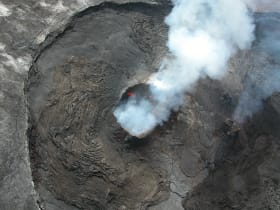
Hawaii Volcanoes National Park
25 miles away
Two of the world's most active volcanoes, Kilauea and Mauna Loa, still building the island of Hawaii.