
Jefferson Rock
723 Shenandoah St, Harpers Ferry, WV
Harpers Ferry, WV
The rock ledge where Thomas Jefferson stood and declared the view worth crossing the Atlantic to see, high above the meeting of two rivers.
Jefferson Rock is a small place with a large reputation. It is a slab of layered shale perched dramatically on the hillside above Harpers Ferry's Lower Town, reached by a short climb of stone steps. From beside it, the land falls away to reveal the point where the Potomac and Shenandoah rivers meet and cut a great gap through the Blue Ridge, one of the classic views of the eastern United States.
The rock takes its name from Thomas Jefferson, who stood here in 1783 and famously wrote that the scene was worth a voyage across the Atlantic to behold. His words helped make Harpers Ferry a landmark of the American imagination long before John Brown's raid, and the overlook remains a highlight of any visit to the town.
What Travelers Love
- The exact spot where Thomas Jefferson stood and praised the view in 1783
- A sweeping look at the meeting of the Potomac and Shenandoah rivers
- The short but rewarding climb up stone steps from the Lower Town
- Standing atop a dramatically balanced slab of layered shale
Worth Knowing
- The rock is reached by a short, steep climb of stone steps above the Lower Town
- It sits along the Appalachian Trail, which passes right through Harpers Ferry
- The balanced slab is supported and no longer safe to stand on, so admire it and the view from beside it
- Pair it with the museums and streets of the Lower Town for a full Harpers Ferry visit
Learn about Jefferson Rock
Jefferson's famous view
In 1783, Thomas Jefferson visited Harpers Ferry and climbed to this ledge, where the rivers and the mountain gap spread out below. In his Notes on the State of Virginia he described the scene in glowing terms, calling it one of the most stupendous in nature and declaring it worth a voyage across the Atlantic to witness. That endorsement, from a future president and famed observer of the American landscape, fixed the spot in the nation's imagination.
The view he praised is still there: the Potomac River sweeping in from the north, the Shenandoah joining from the south, and the combined waters slicing through the Blue Ridge in a broad water gap, with the borders of three states nearly meeting below. Standing where Jefferson stood, visitors can judge his praise for themselves.
The balanced rock
The rock itself is a striking natural feature, a large capstone of shale that appears to balance on a narrow base, layered like a stack of stone plates. It is composed of ancient sedimentary rock, tilted and folded by the same mountain-building forces that raised the Blue Ridge and carved the river gap below.
For generations visitors climbed atop the balanced slab, and in the nineteenth century supports were added to stabilize it against toppling. Today the rock is preserved for viewing rather than climbing, its precarious poise best appreciated from beside it, along with the river view that made it famous.
Part of a historic town
Jefferson Rock sits within Harpers Ferry National Historical Park, just above the preserved Lower Town where John Brown's 1859 raid on the federal armory helped ignite the road to the Civil War. The short trail to the rock passes historic Saint Peter's Church and other landmarks, tying the overlook into the town's deep and dramatic history.
The Appalachian Trail runs right past Jefferson Rock as it threads through Harpers Ferry, so hikers on the great footpath pause here at the same view Jefferson praised. A visit to the rock naturally pairs with the museums, streets, and stories of the Lower Town just below.
Rivers, mountains, and the older land
The setting is the whole point of Jefferson Rock. Harpers Ferry sits at the confluence of two rivers and the junction of three states, where the waters have cut a spectacular gap through the mountains. That geography drew Jefferson's eye, and it drew people here for far longer than any written history records.
This river junction was part of the ancestral homeland and shared hunting ground of the Shawnee, the Lenape, and other peoples, whose descendant nations continue today beyond West Virginia. Long before it bore a president's name, the ledge overlooked a landscape that Indigenous peoples knew and traveled, a crossroads of rivers and ridges at the edge of the mountains.
Closest Boutels
The closest Boutel™ stays, so you can turn this stop into an overnight. Each is a place we chose through independent editorial review, never a paid placement.
Details
Harpers Ferry, WV
Frequently asked questions
What is Jefferson Rock?
Jefferson Rock, in Harpers Ferry in eastern West Virginia, is a famous rock formation and scenic overlook perched on the hillside above the historic Lower Town, offering a stunning view of the confluence of the Potomac and Shenandoah rivers and the surrounding mountains. The rock is named for Thomas Jefferson, who stood here in the late eighteenth century and declared the view so magnificent that it was worth a voyage across the Atlantic to see. Reached by a short walk up historic stone steps, it remains a beloved viewpoint. With its historic overlook and breathtaking river view, Jefferson Rock offers a fascinating destination in West Virginia.
Why is it called Jefferson Rock?
Jefferson Rock is named for Thomas Jefferson, who visited Harpers Ferry in the late eighteenth century and was so struck by the view from this spot, overlooking the meeting of the Potomac and Shenandoah rivers as they cut through the mountains, that he famously wrote the scene was worth a voyage across the Atlantic to behold. His enthusiastic praise made the overlook a celebrated viewpoint, and it has borne his name ever since. This historic connection and the enduring beauty of the view make Jefferson Rock a beloved landmark in Harpers Ferry, West Virginia.
What can you do at Jefferson Rock?
You can walk up the historic stone steps through the Lower Town to reach Jefferson Rock, take in the breathtaking view of the confluence of the Potomac and Shenandoah rivers and the surrounding mountains, photograph the scenery Thomas Jefferson praised, and connect with the Appalachian Trail and the town's other historic sites nearby. The historic overlook and the stunning river view are the highlights, a short but rewarding climb. With its historic significance and beautiful vista, Jefferson Rock offers a memorable stop in Harpers Ferry, West Virginia.
What safety tips apply at Jefferson Rock?
The walk to Jefferson Rock climbs historic stone steps that can be uneven, worn, and slippery, so wear sturdy shoes and watch your footing, and near the rock and overlook, stay back from the edges and steep drop-offs, keeping children close. The rock itself should be viewed and enjoyed from safe positions, not climbed on where prohibited. Watching your footing on the steps and staying back from the edges ensure a safe visit to Jefferson Rock in Harpers Ferry, West Virginia.
What is near Jefferson Rock?
Jefferson Rock is in Harpers Ferry in eastern West Virginia, above the historic Lower Town, near The Point where the rivers meet, the Appalachian Trail, within reach of the Hollywood Casino at Charles Town Races and the eastern panhandle. That makes Jefferson Rock a fascinating stop to combine with Harpers Ferry Lower Town, The Point, and the other attractions of eastern West Virginia on a visit to the state.
Nearby
The Point at Harpers Ferry
0.1 miles away
For the classic Harpers Ferry view in just a few minutes, walk to the Point at the very tip of the lower town, where the Shenandoah River empties into the Potomac.

Appalachian Trail at Harpers Ferry
0.3 miles away
Harpers Ferry is the spiritual halfway house of the Appalachian Trail, and you can walk a piece of it easily.
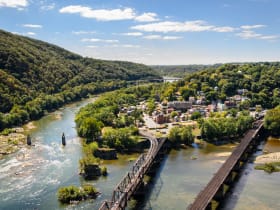
Harpers Ferry Lower Town
0.4 miles away
Harpers Ferry turns history into something kids can walk through.
Hollywood Casino at Charles Town Races
8.1 miles away
Live horse racing makes an unusual family outing, and Charles Town has run it since 1933.

Antietam National Battlefield
10 miles away
A battlefield can land hard with kids, and this one carries real weight: Antietam saw the bloodiest single day in American history. That makes it best for ages 9 and up who can take in the history.
Washington Monument State Park
14 miles away
A small monument with a big payoff for the effort. Local farmers built this squat stone tower on South Mountain in one day in 1827, the first completed monument to George Washington anywhere.

National Museum of Civil War Medicine
18 miles away
Frederick has a big Civil War story that has nothing to do with a battlefield.

Skyline Drive
38 miles away
The 105-mile scenic drive along the Blue Ridge crest through Shenandoah National Park, a National Historic Landmark with seventy-five overlooks and famous fall color.

Shenandoah National Park
67 miles away
Cascading waterfalls, blue-hazed ridges, and the 105-mile Skyline Drive along the Blue Ridge Mountains.