
Heavener Runestone State Park
711 Addison St, Heavener, OK
Heavener, OK
A great slab of stone deep in a wooded ravine, carved long ago with eight runic characters no one has ever fully explained.
Heavener Runestone Park protects one of Oklahoma's most intriguing curiosities: a great slab of stone, standing about twelve feet high, carved with a line of eight runic characters. Runes are the letters of an old Germanic and Norse alphabet, and how such carvings came to be on a stone in a wooded ravine in southeast Oklahoma has never been fully explained.
Some have argued the runes are evidence of Norse explorers reaching the American interior centuries before Columbus; others believe they are a later carving, perhaps by settlers or a hoaxer. The mystery has never been settled, and that uncertainty is much of the park's charm. Whatever their origin, the stone sits in a beautiful, shaded Ouachita ravine well worth the visit on its own.
What Travelers Love
- A genuine mystery: a large stone carved with runic letters, its origin still debated
- A cool, forested ravine with a boardwalk and trails through tall trees
- The quiet, atmospheric setting deep in the Ouachita Mountains
- Overlooks with views across the wooded valley below
Worth Knowing
- The runestone's origin is genuinely disputed; enjoy the mystery rather than expecting a settled answer
- The stone sits down in a ravine reached by trail and stairs, so wear good walking shoes
- Trails can be wet and slick after rain in the shaded ravine
- It is a small, peaceful park; pair it with the nearby Ouachita mountain scenery for a fuller day
Learn about Heavener Runestone State Park
The stone and its runes
The runestone is a large slab of native sandstone, roughly twelve feet tall and ten feet wide, set into the side of a wooded ravine on Poteau Mountain. Across its face runs a line of eight carved characters that resemble runes from old Norse and Germanic alphabets. Local settlers reportedly knew of the stone as far back as the 1800s, and it drew wider attention through the twentieth century.
Scholars have offered many readings and interpretations of the eight symbols, from a possible date to a claim of land, but none has won general acceptance. The characters do not translate cleanly into a known message, which keeps the debate alive and the stone shrouded in mystery. The park presents the various theories and lets visitors weigh them for themselves.
Vikings, settlers, or a hoax?
The most romantic theory holds that Norse explorers, the Vikings, somehow reached this far inland centuries before other Europeans and left the carving behind. Enthusiasts point to the runic forms and to Norse voyages known to have reached North America's coast. Mainstream archaeologists are highly skeptical, noting the lack of any other Norse evidence in the region.
Others suggest the runes were carved much later, perhaps by Scandinavian immigrants or someone familiar with runic alphabets in the 1800s or early 1900s, or as an outright hoax. Because the stone was documented before rigorous study was possible, the truth may never be known. The honest answer is that no one is certain, and the park embraces that ambiguity rather than claiming to resolve it.
The ravine and the walk
However the runes got there, the setting is genuinely lovely. The stone rests down in a cool, shaded ravine of tall hardwoods and mossy boulders, reached by a trail and stairway from the park above. A boardwalk and viewing area let visitors see the carving up close while protecting the fragile stone.
Above the ravine, the park offers picnic areas, short trails, and overlooks with views across the forested valley and the town of Heavener below. The tall trees, the rock, and the trickle of water make it a peaceful place to walk, and the mystery of the stone lends the whole spot a quiet, storybook atmosphere.
The Ouachita Mountains and Choctaw country
Heavener lies in the Ouachita Mountains, an ancient range that runs east and west across southeast Oklahoma and into Arkansas, unusually rugged and green for the state. This is Choctaw Nation country, part of the homeland the Choctaw rebuilt after their forced removal along the Trail of Tears in the 1830s.
The wider region rewards exploration, from the pine-clad ridges and the Talimena scenic drive to the clear rivers and lakes farther south. The runestone makes an intriguing anchor for a day in these mountains, combining a true unsolved mystery with some of the prettiest forest country in Oklahoma.
Closest Boutels
The closest Boutel™ stays, so you can turn this stop into an overnight. Each is a place we chose through independent editorial review, never a paid placement.
Details
Heavener, OK
Frequently asked questions
What is Heavener Runestone State Park?
Heavener Runestone State Park, near Heavener in southeastern Oklahoma, protects a large stone carved with mysterious runic characters, the subject of intriguing debate and legend, set in a beautiful wooded mountain ravine. The centerpiece is a great stone slab bearing carved runes, letters of an ancient alphabet, which some have suggested were left by Norse or Viking explorers long ago, though the origins remain debated and uncertain. Whatever their source, the runestone and its dramatic forested setting in a rocky ravine make for a fascinating and atmospheric destination, with trails and overlooks nearby. A mysterious and scenic site, it intrigues visitors. With its runestone, the park offers a compelling destination in Oklahoma.
What is the Heavener Runestone?
The Heavener Runestone is a large stone slab in southeastern Oklahoma carved with several runic characters, letters from an ancient runic alphabet, whose origins are debated and uncertain. Some have proposed that Norse or Viking explorers carved the runes long ago, sparking intriguing theories, while others question or dispute such origins, and the true source and meaning remain a mystery. This debate and mystery are part of what make the runestone so fascinating. The stone is best appreciated as an intriguing puzzle whose story is not fully known at Heavener Runestone State Park in Oklahoma.
What can you do at Heavener Runestone State Park?
You can view the mysterious runestone in its shelter, learn about the theories and debate surrounding its origins, hike the trails through the beautiful wooded ravine, enjoy overlooks of the surrounding mountains, and take in the atmospheric setting. The intriguing runestone, the scenic ravine and trails, the mountain overlooks, and the sense of mystery are the draws, making it a fascinating and peaceful destination. The combination of puzzle and scenery is the appeal. With its runestone and scenery, the park offers a rewarding experience in Oklahoma.
When is the best time to visit Heavener Runestone State Park?
The mild months of spring through fall are the most pleasant for viewing the runestone and hiking the wooded ravine and its overlooks, with fall especially beautiful as the surrounding mountains turn color. Because hours and access can vary, checking current information before you go is wise. For the loveliest scenery and pleasant hiking, aim for spring through fall, with fall a highlight, at Heavener Runestone State Park in Oklahoma.
What is near Heavener Runestone State Park?
Heavener Runestone State Park is near Heavener in southeastern Oklahoma, within reach of the Ouachita National Forest, the Talimena National Scenic Byway to the southwest, Robbers Cave State Park, and the Ouachita Mountains region. That makes Heavener Runestone State Park a compelling stop to combine with the Talimena National Scenic Byway and the other attractions of southeastern Oklahoma on a visit to the state.
Outside the Park

Talimena National Scenic Byway
13 miles away
Talimena Byway western trailhead: in Talihina, OK on US-271 at Talimena State Park (lat 34.739, lng -94.992). Free.
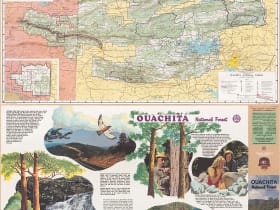
Ouachita National Forest
18 miles away
Talimena National Scenic Byway: US-271 from Talihina, OK to Mena, AR - 62 miles on a mountain ridgeline, free to drive, best in October.

Queen Wilhelmina State Park
20 miles away
Queen Wilhelmina sits atop Rich Mountain, the second-highest peak in Arkansas at nearly 2,700 feet, and the elevation changes everything: the air runs cooler, the views stretch for miles across parall...

Fort Smith Museum of History
35 miles away
The Fort Smith Museum of History has a secret weapon for winning over kids: a real working soda fountain from the early 1900s where you can order a phosphate or a float after touring the exhibits.