
Fort Churchill State Historic Park
10000 US-95A
Silver Springs, NV
The sun-bleached adobe ruins of a frontier army post, slowly melting back into the desert beside the Carson River and the Pony Express road.
Fort Churchill is a ghost of the frontier army, a set of roofless adobe buildings standing in the sagebrush beside the Carson River, their walls rounded and softened by more than a century and a half of desert weather. Built in 1861, it was the largest army post in Nevada, and its ruins are preserved not restored, left to melt slowly back into the ground in a state managers call arrested decay.
The fort sat at a crossroads of the early West, guarding the Overland Trail, the transcontinental telegraph, and the route of the Pony Express. Walking among its crumbling walls, with the cottonwoods rustling along the river, you feel the reach and the fragility of the young United States in this remote corner of the Great Basin.
What Travelers Love
- Wandering the roofless adobe ruins as they slowly return to the earth
- Standing on the actual Pony Express and Overland Trail route
- A shady cottonwood-lined stretch of the Carson River to walk and camp along
- How peaceful and uncrowded this pocket of frontier history feels
Worth Knowing
- The ruins are preserved as arrested decay, so they are fragile; look but do not climb on the walls
- There is a small visitor center and a campground among the cottonwoods by the river
- Summer is hot and open; spring and fall are the pleasant seasons here
- It connects by trail and road to Buckland Station and the Carson River corridor for a longer visit
Learn about Fort Churchill State Historic Park
Why the fort was built
Fort Churchill rose out of conflict. In 1860, tensions between settlers and the Northern Paiute erupted into the Pyramid Lake War, and in its aftermath the army built this post in 1861 to protect the emigrant road, the mail, and the mining settlements of the Comstock. The Paiute people whose homeland this is remain a living presence in the region today, in the Pyramid Lake and Walker River communities and beyond.
The timing placed the fort squarely in the Civil War years, and its garrison guarded the overland communication lines that tied California and its gold and silver to the Union. Soldiers here escorted mail, strung and protected telegraph wire, and patrolled the desert routes.
Rise and abandonment
At its height Fort Churchill was a substantial post, its adobe buildings arranged around a parade ground: barracks, officers' quarters, storehouses, and a hospital, home to hundreds of soldiers. It was a lifeline for travelers and a hub for the region.
But its usefulness was short. As the frontier moved on and the routes it guarded were replaced by the railroad, the army abandoned Fort Churchill in 1869, less than a decade after building it. The buildings were sold and salvaged, and the desert began to reclaim what remained.
In the 1930s, crews from the Civilian Conservation Corps stabilized the ruins and built a small museum, and the site became one of Nevada's first state parks, preserving the melting adobe as a window into the frontier era.
The Pony Express and Buckland Station
The famous Pony Express, the horse-relay mail service that briefly carried letters across the continent in 1860 and 1861, ran right past here, and nearby Buckland Station served as a stop on the line and later absorbed some of the fort's salvaged materials. The park protects this stretch of the route, so you can stand on the ground the riders galloped across.
That layering of stories, army fort, telegraph, Pony Express, and the river road, is what makes Fort Churchill more than a pile of old walls.
The river and its wildlife
The Carson River curls past the fort, lined with old cottonwoods that turn gold in autumn and shade a pleasant campground and picnic area. The green river corridor is a magnet for wildlife in this dry country, drawing songbirds, hawks, quail, deer, and beaver, and a riverside trail links the fort with Buckland Station.
The contrast between the shaded, living river and the sun-bleached ruins on the open flat is part of the park's quiet appeal.
When to go
Spring and fall are the best times, with mild temperatures and, in fall, the cottonwoods in color. Summer days are hot and bright, so plan to explore the exposed ruins in the morning or evening. Winter can be cold but clear and very quiet.
Give yourself time to walk the whole site, read the interpretive signs, and stroll the river before or after.
Closest Boutels
The closest Boutel™ stays, so you can turn this stop into an overnight. Each is a place we chose through independent editorial review, never a paid placement.
Details
Silver Springs, NV
Frequently asked questions
What is Fort Churchill State Historic Park?
Fort Churchill State Historic Park, near Silver Springs in western Nevada, preserves the atmospheric adobe ruins of a nineteenth-century United States Army fort along the Carson River. Built in the 1860s to protect settlers, travelers, and the Pony Express and telegraph routes, the fort was abandoned after little more than a decade, and its weathered adobe walls now stand as picturesque ruins in the high desert, interpreted by a visitor center. Along with the ruins, the park offers riverside trails, camping, and a link to the historic Pony Express trail, telling the story of the frontier West. With its historic fort ruins and river setting, Fort Churchill State Historic Park offers a fascinating destination in Nevada.
What can you do at Fort Churchill State Historic Park?
You can explore the atmospheric adobe ruins of the historic Army fort, learn its story and the history of the Pony Express and frontier era at the visitor center, walk the riverside trails along the Carson River, camp, and photograph the picturesque ruins in their desert setting. The evocative fort ruins, the frontier and Pony Express history, and the peaceful riverside trails are the draws, offering an engaging blend of history and nature. The ruins are especially photogenic in soft light. With its ruins and history, Fort Churchill State Historic Park offers a rewarding experience in Nevada.
What is the history of Fort Churchill?
Fort Churchill was built by the United States Army in the 1860s along the Carson River in what is now western Nevada to protect early settlers, travelers on the emigrant trails, and the Pony Express and telegraph lines during a period of conflict on the frontier. The fort operated for only about a decade before being abandoned as the need passed, and its adobe buildings gradually fell into the picturesque ruins seen today. Preserved as a state historic park, it tells the story of the frontier West. Understanding this history enriches a visit to Fort Churchill State Historic Park in Nevada.
When is the best time to visit Fort Churchill State Historic Park?
The cooler months of fall through spring offer the most comfortable weather for exploring the outdoor ruins and riverside trails, while summer brings desert heat, so early morning is best then and water is essential. The soft light of early morning and late afternoon is ideal for photographing the adobe ruins. Spring brings green along the river. For comfortable weather and beautiful light on the ruins, aim for fall through spring at Fort Churchill State Historic Park in Nevada.
What is near Fort Churchill State Historic Park?
Fort Churchill State Historic Park is near Silver Springs in western Nevada, along the Carson River, within reach of Carson City with the Nevada State Railroad Museum, Virginia City, Grimes Point petroglyphs to the east, and the Reno area. That makes Fort Churchill State Historic Park a fascinating stop to combine with the Carson City area, Virginia City, and the other attractions of western Nevada on a visit to the state.
Outside the Park

Virginia City
20 miles away
The silver city that helped bankroll the Union, gave Mark Twain his pen name, and never quite let go of its boomtown swagger.

Piper's Opera House
20 miles away
The grand 1885 music hall of the silver-boom Comstock, where Mark Twain lectured and Lily Langtry sang, with a springy old stage still standing.
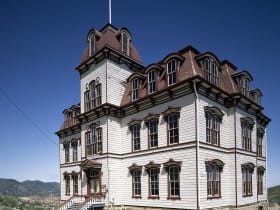
Fourth Ward School Museum
21 miles away
The last four-story wooden schoolhouse of its kind standing in America, built in 1876 at the height of the Comstock silver boom, anchors the south end of Virginia City's historic C Street.