

Upper Mesa Falls
Mesa Falls Scenic Byway, Ashton, ID
Ashton, ID
A wall of the Henrys Fork thundering 114 feet over volcanic rock, close enough that the spray hits your face, and never once dammed.
Upper Mesa Falls is one of the great waterfall surprises of the West, a broad, thundering drop of about a hundred and fourteen feet where the Henrys Fork pours off a cliff of ancient volcanic rock. A boardwalk and viewing platforms let you walk right out to the brink and down alongside the plunge, close enough that the mist drifts over the railing and the roar fills the canyon.
What sets it apart is not just its size but its wildness. Upper Mesa is often called the last major waterfall on the entire Columbia River system that has never been harnessed by a dam or diversion, a big, free-falling river left to do exactly what it has done for thousands of years.
What Travelers Love
- Standing on a boardwalk almost within reach of a 114-foot waterfall, close enough to feel the spray
- The rare sight of a big Western waterfall that has never been dammed or diverted
- The log Big Falls Inn perched above the river as a visitor center
- The drive down the Mesa Falls Scenic Byway through pine forest and past a second falls
Worth Knowing
- The viewing area is a boardwalk and platform system, so the falls are easy to reach on foot from the parking area
- The scenic byway to the falls is not plowed all winter, when the area becomes ski and snowmobile country
- Late spring and early summer bring the highest, loudest flows from snowmelt on the Henrys Fork
- The railing platforms get slick with mist, so hold on and watch small children near the edges
Learn about Upper Mesa Falls
A wall of water on the Henrys Fork
The Henrys Fork is a famous river, a wide, spring-fed trout stream that glides through the pine flats of eastern Idaho, and at Mesa Falls it briefly turns violent. The whole river gathers and drops over a rock lip in a single broad curtain, throwing up a permanent cloud of mist that catches rainbows on sunny mornings.
The Forest Service has built a boardwalk and a series of platforms that carry you from the rim down along the falls, so you experience it up close rather than from a distant pullout. A few miles downstream, a highway overlook gives a long view of Lower Mesa Falls, the river's second drop, from across the canyon.
Born from the Yellowstone hotspot
The rock the falls pour over tells a violent story. It is the Mesa Falls Tuff, a thick sheet of welded volcanic ash laid down about 1.3 million years ago in one of the enormous caldera eruptions of the Yellowstone hotspot, the second most recent of those cataclysms, which blasted out hundreds of cubic kilometers of material.
As the Henrys Fork later cut down through that hardened tuff, it reached a resistant ledge and began to plunge, carving the falls you see today. Standing at the base, you are looking at a river working on the bones of an ancient supervolcano, the same restless system that still powers the geysers of Yellowstone just up the road.
The Big Falls Inn
Perched above the falls is a handsome log building, the Big Falls Inn, raised in the early twentieth century by a power company that had eyed this drop for hydroelectricity. The dam never came, but the building found other lives, serving over the years as a hotel, a cafe, and a dance hall, and a way station for ranchers, sportsmen, and tourists traveling the old road toward Yellowstone. Sources differ on the exact year it went up, generally placing it between about 1907 and the mid-1910s.
After acquiring the inn in 1986, the Forest Service partnered with nearby Harriman State Park and other supporters to restore it, and today the old log lodge serves as the visitor center at the falls, a warm, historic anchor to a wild place.
The setting, wildlife, and seasons
This is the homeland of the Shoshone and Bannock peoples, whose descendants are enrolled today in the Shoshone-Bannock Tribes, and the Henrys Fork country has drawn people to its water and fish for a very long time. The falls sit in the Caribou-Targhee National Forest amid lodgepole pine, aspen, and huckleberry, home to moose, elk, deer, and the eagles and ospreys that hunt the river. The Henrys Fork itself is a legendary trout stream, though the falls are far too wild to fish.
Timing shapes the visit. Snowmelt in late spring and early summer sends the biggest, most deafening flows over the lip. Summer and fall bring easy access and golden aspens along the byway. In deep winter the scenic byway closes to cars beyond a point, and the falls become a reward for those who ski or ride in to watch the water steam and freeze at the edges.
Closest Boutels
The closest Boutel™ stays, so you can turn this stop into an overnight. Each is a place we chose through independent editorial review, never a paid placement.
Details
Ashton, ID
Frequently asked questions
What is Upper Mesa Falls?
Upper Mesa Falls, on the Henrys Fork of the Snake River in eastern Idaho near Ashton, is a spectacular waterfall where the river plunges over a wide, dramatic drop of more than a hundred feet, sending up mist and thundering into the canyon below. One of the last major undeveloped waterfalls in the region, it is beautifully accessible via a series of boardwalks and viewing platforms that bring visitors close to the powerful falls. A historic lodge and visitor area add to the experience. Set amid forest in the eastern Idaho high country, it is a breathtaking sight. With its powerful waterfall and boardwalk views, Upper Mesa Falls offers a spectacular destination in Idaho.
What can you do at Upper Mesa Falls?
You can walk the boardwalks and viewing platforms that lead close to the powerful waterfall, feel the mist and hear the thunder of the falls, take in the dramatic canyon and forest scenery, visit the historic lodge and visitor area, and photograph the spectacular cascade. The close-up boardwalk views of the powerful falls are the highlight, an accessible and awe-inspiring experience. Interpretive information explains the falls and area. With its dramatic waterfall, boardwalk views, and scenic setting, Upper Mesa Falls offers a rewarding stop near Ashton in eastern Idaho.
What safety tips apply at Upper Mesa Falls?
Stay on the boardwalks, platforms, and designated paths, keep behind railings, and do not climb over barriers or onto the rocks near the falls, as the powerful current, wet surfaces, and steep drops are dangerous. Watch children closely near the railings, and be aware that boardwalks can be slippery when wet or icy. The mist can make surfaces damp. Staying on the boardwalks, keeping behind railings, and supervising children ensure a safe visit to Upper Mesa Falls in eastern Idaho.
When is the best time to visit Upper Mesa Falls?
Late spring through fall is the best time, with late spring and early summer bringing the most powerful flow from snowmelt, summer offering pleasant weather and full access, and fall bringing beautiful color to the surrounding forest. The access road and site may be snowbound in winter. The falls are dramatic throughout the warm season. For the most powerful falls aim for late spring, and for pleasant weather and color, summer through fall, at Upper Mesa Falls near Ashton in eastern Idaho.
What is near Upper Mesa Falls?
Upper Mesa Falls is on the Henrys Fork near Ashton in eastern Idaho, along the Mesa Falls Scenic Byway near Lower Mesa Falls, within reach of the Island Park caldera, Harriman State Park, and the route toward Yellowstone and the Idaho Falls area. That makes Upper Mesa Falls a spectacular stop to combine with the Mesa Falls Scenic Area, Harriman State Park, and the other attractions of eastern Idaho on a visit to the state.
Nearby
Mesa Falls Scenic Area
3.2 miles away
Mesa Falls is a two-tiered waterfall on Henry's Fork of the Snake River in Fremont County, the last major undisturbed waterfall in the Columbia River drainage.

Island Park Caldera
6.3 miles away
The Island Park Caldera formed when a supervolcanic eruption approximately 1.3 million years ago ejected so much material that the overlying ground collapsed into the magma chamber.
Harriman State Park Wildlife Walk
12 miles away
Harriman State Park was the private railroad retreat of Union Pacific executives until it was donated to Idaho in 1977.

Yellowstone National Park
26 miles away
The world's first national park, sitting atop a supervolcano of geysers, hot springs, and vast wildlife herds.
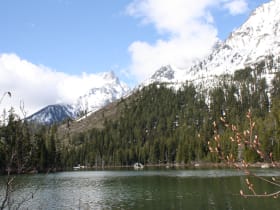
Grand Teton National Park
65 miles away
Jagged peaks rising straight from the valley floor, mirrored in the string of lakes at their base.