

Tubac Presidio State Historic Park
1 Burruel St, Tubac, AZ
Tubac, AZ
The ground where a Spanish fort once guarded the northern edge of an empire, now a quiet park beside an artists' village in the green Santa Cruz Valley.
Tubac Presidio State Historic Park protects one of the oldest sites of European settlement in Arizona, the ground where Spain built a walled fort, or presidio, in 1752 to guard the northern frontier of its empire. Established in 1958, it was the first state park in Arizona, and it preserves layers of history stacked on a single patch of the Santa Cruz Valley: a Spanish garrison, a Mexican town, a territorial American village, and one of the earliest schoolhouses in the region.
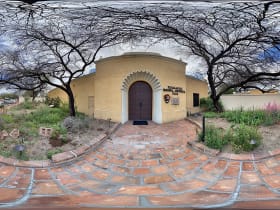
The centerpiece is an unusual one. Archaeologists dug down through the layers and left the excavation open, so visitors descend a stairway into a covered pit and stand looking at the actual adobe foundations and floor of the eighteenth-century presidio, the walls that once faced the Apache frontier. Above ground, an 1885 schoolhouse, a small museum, and shaded grounds tell the rest of the story, and the whole thing sits at the doorstep of Tubac's well-known artists' colony.
What Travelers Love
- Descending into the covered excavation to see the actual foundations of the 1750s presidio
- The 1885 schoolhouse, one of the oldest in Arizona, still furnished with its slate and desks
- Browsing the galleries and adobe shops of the Tubac arts village next door
- The green cottonwood corridor of the Santa Cruz River and the Anza trail along it
Worth Knowing
- The site is small and history-focused, best paired with the Tubac village and the nearby Tumacacori mission for a full day
- Summer afternoons are hot; mornings and the cooler months are the most pleasant
- Much of the story is told through the museum and the underground exhibit, so allow time to read and look closely
- The riverside Anza trail is unpaved and can be muddy after rain
Learn about Tubac Presidio State Historic Park
A fort on the edge of empire
This valley was long the homeland of the O'odham peoples, and the Santa Cruz River made it a corridor of farms and villages for centuries. In the late 1600s the Jesuit missionary Father Eusebio Kino traveled the valley, and Spanish settlement followed. After an O'odham uprising in 1751, Spain established the Tubac presidio the next year, a garrison of soldiers meant to protect settlers and missions along the frontier and to guard against Apache raids.
From Tubac in 1775 and 1776, the captain Juan Bautista de Anza led an expedition of soldiers, settlers, and livestock all the way overland to the coast of California, where the group would go on to found San Francisco. That route is remembered today as the Anza National Historic Trail, part of which runs right along the river below the park. Tubac passed from Spanish to Mexican to American hands, boomed briefly with silver mining, and settled into the quiet valley town it is now, but the presidio ground remains its oldest and deepest layer.
Digging down into the past
The park's most memorable feature is underground. Rather than simply describe the vanished fort, archaeologists excavated a section of it and built a shelter over the dig, so visitors walk down into the earth to see the real foundations of the presidio, the adobe wall bases and packed floor laid by Spanish soldiers more than two and a half centuries ago. It is a rare chance to look at the actual bones of an eighteenth-century frontier fort rather than a reconstruction.
Above ground the story continues in a museum housed in part in historic buildings, with exhibits on the Spanish, Mexican, and territorial eras and a print of an early Arizona printing press. Nearby stands the 1885 territorial schoolhouse, one of the oldest surviving in Arizona, still fitted with its wooden desks, slates, and potbellied stove, a vivid picture of frontier education. The shaded grounds tie it all together in an easy, unhurried visit.
The Tubac arts village
Just beyond the park gate lies the reason many people come to Tubac at all: a village of galleries, studios, and adobe shops that has grown into one of the Southwest's best-known small arts colonies. Painters, potters, weavers, and metalworkers fill the historic streets, and the mix of Spanish colonial and Southwestern styles gives the place a distinctive, low-slung charm. The park and the village complement each other, one the deep history and the other the living culture that grew from it.
The setting helps. Tubac sits in the green heart of the Santa Cruz Valley, where the river supports a corridor of cottonwoods and willows unusual in the desert. Walking the streets between adobe walls, with the Santa Rita Mountains rising to the east, it is easy to feel the long continuity of this place, a valley that has been farmed, defended, painted, and loved for a very long time.
The river valley and its wildlife
The Santa Cruz River, though often quiet, sustains a rare ribbon of riparian habitat through the desert, and the Anza trail along it is a favorite of birders. The cottonwood galleries draw a remarkable variety of birds, including vermilion flycatchers flashing scarlet in the branches, gray hawks that nest in the tall trees, and a wealth of migrants passing through in spring and fall. Deer and javelina move through the brush, and the river bottom is cool and green even when the surrounding hills are parched.
The mildest and best months run from fall through spring, when the valley is comfortable and the birding is at its peak. Summer brings the monsoon storms that green the desert and swell the river, though the afternoons turn hot. Whatever the season, the pairing of deep history, living art, and green river valley makes Tubac feel like a place where several Arizonas overlap in one small, walkable spot.
Closest Boutels
The closest Boutel™ stays, so you can turn this stop into an overnight. Each is a place we chose through independent editorial review, never a paid placement.
Details
Tubac, AZ
Frequently asked questions
What is Tubac Presidio State Historic Park?
Tubac Presidio State Historic Park, in the artistic village of Tubac south of Tucson, Arizona, preserves the site of a Spanish colonial fort, or presidio, established in the mid-eighteenth century, making it one of the oldest European settlement sites in the state. As Arizona's first state park, it protects the presidio ruins, a historic schoolhouse, a museum, and an underground archaeological display, telling the story of Spanish, Native, and later settlers in the Santa Cruz valley. It offers a fascinating look at the region's deep colonial and frontier history.
What can you see at Tubac Presidio State Historic Park?
You can view the ruins and foundations of the Spanish presidio, including an underground exhibit revealing original excavated walls, tour a museum with artifacts and exhibits on the area's Spanish, Native, and pioneer history, visit a historic nineteenth-century schoolhouse, and explore the grounds. The park also connects to a scenic trail linking Tubac and the nearby Tumacacori mission. Together these offer a rich window into the layered history of one of Arizona's earliest settlements, set in a charming village known for its arts.
Why is Tubac historically significant?
Tubac is significant as the site of an early Spanish presidio founded in the mid-1700s, one of the first European military and settlement outposts in what is now Arizona, and a key point in the region's colonial history and frontier expansion, including expeditions that helped found San Francisco. Its long history spans Native peoples, Spanish colonists, Mexican rule, and American settlers. Today the historic park preserves this heritage while the surrounding village thrives as an arts colony, blending deep history with a vibrant creative present.
When is the best time to visit Tubac Presidio State Historic Park?
The cooler months from fall through spring are most comfortable for exploring the grounds and outdoor ruins, while summer in this southern desert valley is hot, so morning visits are best then. Tubac's arts scene and events, including a popular festival in the cooler season, can add to a visit, so checking the schedule is worthwhile. A visit to the park takes about an hour or two. The milder months offer the most pleasant experience of the history and the surrounding village.
What is near Tubac Presidio State Historic Park?
The park is in the village of Tubac, known for its many art galleries and shops, near the historic Tumacacori mission just to the south, the wine country and border town of Nogales, and the attractions of Tucson to the north, including the Titan Missile Museum and Saguaro National Park. That makes Tubac Presidio an easy and enriching stop to combine with Tubac's arts, the nearby mission, the region's wineries, and the attractions of southern Arizona's Santa Cruz valley and Tucson area.
Outside the Park
Tumacacori National Historical Park
8.4 miles away
Tumacacori preserves the eroded adobe church of a Spanish colonial mission on the Santa Cruz River, its unfinished bell tower and worn sanctuary left much as time shaped them.
Titan Missile Museum
15 miles away
Titan Missile Museum is the only preserved Titan II ICBM launch facility open to the public in the United States. Guided tours descend into the concrete launch control room and silo.
Colossal Cave Mountain Park
33 miles away
Colossal Cave is a large dry limestone cavern in the Rincon Mountains southeast of Tucson and has been a tourist destination since the 1920s.

Gates Pass
37 miles away
Gates Pass cuts through the Tucson Mountains on Gates Pass Road west of Tucson on the approach to Saguaro National Park West and the Arizona-Sonora Desert Museum.

Saguaro National Park
38 miles away
Forests of the giant saguaro cactus, symbol of the American West, on both sides of Tucson.