

Taughannock Falls State Park
22 Taughannock State Park Access Rd
Trumansburg, NY
A single ribbon of water dropping straight off a rock rim into a deep stone amphitheater, higher in a single plunge than Niagara.
Taughannock Falls drops in a single unbroken plunge of about 215 feet, which makes it taller in one fall than Niagara and one of the highest single-drop waterfalls east of the Rocky Mountains. The water pours off a flat rock rim into a broad, curving amphitheater of stone that the creek has carved over many thousands of years, and a nearly level trail leads visitors right up to the pool at its foot.
The name comes from the Native peoples of the region, and the gorge itself tells a long story written in stone. Layer upon layer of ancient sea-bottom rock stands exposed in the walls, and the creek is still slowly cutting the whole amphitheater deeper. Rim trails high above give a bird's-eye view, while the gorge trail below puts you in the cool, echoing space beneath the falls.
What Travelers Love
- The easy, mostly level gorge trail that leads right to the base of the falls
- Standing in a stone amphitheater as the water free-falls off the rim above
- The rim trails that look down on the gorge from both sides
- A swimming and picnic area down on Cayuga Lake in warm months
Worth Knowing
- The gorge trail runs along a creek bed and can be wet and rocky, so wear grippy shoes
- Flow is highest in spring and after rain; late summer can slow the falls to a thin veil
- Winter can close or ice over the gorge trail, though the frozen falls are a sight from the overlook
- The overlook off the highway gives a full head-on view without the walk
Learn about Taughannock Falls State Park
The Cayuga homeland and the name
This is the homeland of the Cayuga Nation, one of the Six Nations of the Haudenosaunee, whose villages ringed the long finger lakes for centuries. Cayuga Lake carries their name, and the Cayuga people remain a living nation today, working to reclaim and steward land in their traditional territory around the lake.
The falls have carried the name Taughannock for generations, a word tied to the region's Native and early frontier history. As with many place names in the Finger Lakes, its exact origin is debated, but the sound of it has stuck to this gorge for as long as records reach back, and it remains one of the most recognizable names in the region.
How the gorge and its great falls formed
The rock here is sedimentary, laid down more than 350 million years ago when a shallow sea covered this part of the continent. Layers of harder sandstone and softer shale stacked up on the sea floor and hardened into the banded gray walls you see today. When the last glaciers retreated, meltwater and Taughannock Creek began cutting down through those layers toward Cayuga Lake.
The falls formed and keeps growing because of the difference between those rock layers. Water pours over a resistant cap of sandstone and undercuts the weaker shale beneath, so the softer rock crumbles away and the rim retreats upstream, leaving the tall, straight drop and the deep curved bowl below. The whole amphitheater is a record of that slow, steady retreat, and the process continues to this day.
Trails, the lake, and the falls up close
The classic walk is the gorge trail, a mostly gentle path that follows the creek back into the amphitheater and ends at an overlook facing the base of the falls. It is one of the more accessible waterfall walks in the region, rewarding a modest effort with a full, head-on view of the plunge and its pool.
For a different angle, the north and south rim trails climb to the top edge of the gorge and look down its full depth. Down at Cayuga Lake, the park has a beach, a boat launch, picnic lawns, and a marina, so a visit can pair a short hike with a swim or a lakeside lunch in the warm months.
Wildlife, seasons, and the light
The gorge is a shaded, damp world of hemlock and mixed hardwood, with ferns and moss on the cool north-facing walls. Watch for great blue herons and kingfishers along the creek, hawks and turkey vultures riding the thermals over the rim, and white-tailed deer in the wooded flats near the lake.
Spring runs highest, fed by snowmelt, and the falls thunder. Summer is warm and busy, with the lakeshore beach at its best even as the falls thin in dry stretches. Fall lights the gorge with maple and oak color. Winter can freeze the falls into a great column of ice, striking from the overlook, though the gorge trail may close when it turns icy.
Closest Boutels
The closest Boutel™ stays, so you can turn this stop into an overnight. Each is a place we chose through independent editorial review, never a paid placement.
Details
Trumansburg, NY
Frequently asked questions
What is special about Taughannock Falls?
Taughannock is a single-drop waterfall of about 215 feet, the tallest single plunge in the Northeast and actually taller than Niagara, set at the head of a wide, wooded gorge near Ithaca in the Finger Lakes. Water free-falls from the rim into a deep amphitheater of layered rock, a genuinely awe-inspiring sight. An easy walk leads right to a viewpoint at its base, making it one of the most impressive and accessible falls in New York.
How hard is the hike at Taughannock Falls?
The Gorge Trail is refreshingly easy, a relatively flat, wide path of roughly a mile and a half round trip that leads to a viewing area at the base of the falls, doable in under an hour and friendly for all ages, with the paved lower section generally wheelchair accessible. For a different perspective, the Rim Trail loops high along both sides of the gorge with dramatic overlooks down into the canyon and of the falls.
Can you swim at Taughannock Falls?
Not at the falls themselves; swimming or jumping into the pool below the waterfall and at the Little Falls area is prohibited for safety. However, the park has a separate lakeside section on Cayuga Lake with a designated swimming beach, picnic areas, a playground, and camping. So you can still cool off, just at the lake rather than in the gorge. Stay on the trails and behind barriers when viewing the falls.
When is the best time to visit Taughannock Falls?
The falls flow year-round and the park is open dawn to dusk every day, but spring brings the fullest, most thunderous flow from snowmelt and rain, while fall dresses the gorge in color. Summer is popular and the lake beach is open, so arrive early on warm weekends for parking. The easy gorge walk is enjoyable in any season, though winter ice may limit access.
What else is nearby to combine with Taughannock Falls?
It is part of a famous trio of Ithaca-area waterfall parks. Nearby Buttermilk Falls and Robert H. Treman State Parks each offer their own gorges, cascades, and swimming holes, so you can easily string together a memorable waterfall tour around Ithaca and the southern Finger Lakes. A practical note: vehicle break-ins have been reported at area trailheads, so do not leave valuables visible in your car.
Outside the Park

Cayuga Lake
7.7 miles away
The longest of New York's Finger Lakes, a glacier-carved ribbon of water nearly forty miles long stretching north from Ithaca, deep, cold, and ringed by gorges and waterfalls.
Sciencenter
8.6 miles away
Ithaca made its science museum part of the city itself. Inside the Sciencenter, kids work more than 250 hands-on exhibits, from a water table to a walk-in camera, plus an outdoor science playground in...
Robert H. Treman State Park
10 miles away
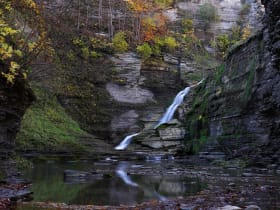
A mile-long gorge of about a dozen waterfalls just south of Ithaca, led by 115-foot Lucifer Falls, which you can view from both the canyon floor and the rim above.

Buttermilk Falls State Park
10 miles away
A Finger Lakes gorge that drops six hundred feet past ten waterfalls, with a rare natural swimming hole right at the base of the main cascade, deepened each summer by a removable dam.

Watkins Glen State Park
18 miles away
This is the gorge that defines the region. Glen Creek carved a slot canyon into layered shale and sandstone at the south end of Seneca Lake, and the Gorge Trail runs right through it, up stone stairs...