
Hovenweep National Monument
Hovenweep National Monument, Utah-Colorado border
Bluff, UT
Ancient stone towers built centuries ago by the Ancestral Puebloan people, standing in the high desert far from any city under one of the darkest skies in the country.
Hovenweep National Monument protects a set of remarkable stone villages built long ago by the Ancestral Puebloan people, on the high desert where Utah meets Colorado. Their square, round, and D-shaped towers rise from the rims and floors of shallow canyons, some still standing two or three stories tall after seven or eight hundred years. The most accessible group, the Square Tower Group, gathers around a small canyon you can walk in a couple of miles, coming within a few feet of the ancient walls.
The monument is also a certified Dark Sky Park, and with no town glow for miles the night here is extraordinary. Stargazers rate darkness on a scale from 1 to 9 called the Bortle scale, where a bright city is a 9 and this remote spot is about a 2, among the darkest skies there are. Thousands of stars and the glowing Milky Way, the cloudy band of our own galaxy, blaze over the ruins. The amazing part is that the very same stars now shining down were watched by the people who built these towers all those centuries ago.
What Travelers Love
- Ancient stone towers built by the Ancestral Puebloan people hundreds of years ago
- One of the darkest certified skies in the country, blazing with stars over the ruins
- The deep quiet and solitude of a remote high-desert monument off the beaten path
- The wonder of standing beneath the same stars the tower builders once watched
Worth Knowing
- This is a remote monument reached largely by gravel roads that can be rough in bad weather
- Summers are very hot and there is little shade, so bring plenty of water and sun protection
- The ruins are fragile and precious; stay on trails and do not climb on or touch the walls
- Services are limited, so come with a full tank of gas and everything you need for the day
Learn about Hovenweep National Monument
The people who built the towers
The stone villages at Hovenweep were built by the Ancestral Puebloan people, farmers who lived across this region for many centuries. They raised most of these structures in the 1200s, shaping local sandstone by hand into towers, houses, and ceremonial rooms, fitting the stones together with remarkable skill. Some towers may have served for defense or storage, and some seem lined up with the movements of the sun, suggesting the builders watched the sky closely.
By around the year 1300 the people had left, moving south to join other Pueblo communities whose descendants live in the Southwest today. The place lay quiet for centuries, and the name Hovenweep comes from a Ute and Paiute word meaning deserted valley. It became a national monument in 1923 so that these fragile works of stone would be protected and remembered.
A desert of stone and hidden springs
Hovenweep sits on Cajon Mesa, a broad, gently tilting shelf of high desert covered in sagebrush and dotted with juniper. The building stone is a hard sandstone laid down about a hundred million years ago along the shore of an ancient sea, and it is the same stone the villages are made of.
The reason the villages sit where they do is water. Rain and snowmelt soak down through the porous sandstone until they hit a layer of harder rock, then flow sideways and seep out as small springs at the heads of the canyons. Those hidden springs gave the Ancestral Puebloans the water they needed, which is why their towers cluster right at the canyon heads.
Six villages across the mesa
Hovenweep is not a single site but six separate village groups scattered across the mesa, some in Utah and some in Colorado. The largest and easiest to reach is the Square Tower Group, gathered around Little Ruin Canyon near the visitor center, where a loop trail leads past tower after tower.
The other five groups, with names like Holly, Horseshoe, Hackberry, Cutthroat Castle, and Cajon, lie farther out along the mesa and generally take a sturdier vehicle and rougher roads to reach. Visiting them rewards the effort with even greater solitude, standing among ancient walls with no one else around for miles.
The Four Corners country around
Hovenweep sits in the heart of the Four Corners, a region rich with the remains of the Ancestral Puebloan world. Just to the east, across the Colorado line, lies Mesa Verde National Park, famous for its dramatic cliff dwellings tucked into canyon alcoves, a natural companion to Hovenweep's canyon-head towers.
The surrounding land, much of it the Canyons of the Ancients, holds thousands more archaeological sites, and the small town of Cortez, Colorado, offers services and museums that help tell the region's story. To the west, the historic river town of Bluff, Utah, sits on the San Juan River and makes a good base for exploring this quiet, ancient corner of the desert.
Closest Boutels
The closest Boutel™ stays, so you can turn this stop into an overnight. Each is a place we chose through independent editorial review, never a paid placement.
Details
Bluff, UT
Frequently asked questions
What is Hovenweep National Monument?
Hovenweep is a remote national monument straddling the Utah-Colorado border, protecting a striking collection of Ancestral Puebloan stone towers, dwellings, and ceremonial kivas built around 1200 to 1300 CE. Many of these square and circular towers have stood for over seven hundred years, perched dramatically along the rims of a small canyon. Quiet and far off the beaten path, it offers an intimate, atmospheric encounter with ancient architecture, along with some of the darkest night skies anywhere.
What can you see at Hovenweep?
The main attraction is the Square Tower Group, seen on a loop trail of about a mile and a half behind the visitor center, which passes roughly a dozen well-preserved towers and structures set around the canyon head. Additional short trails lead to other tower groups. Walking among these ancient stone buildings, marveling at their craftsmanship and canyon-rim settings, is the heart of a visit, and it takes only an hour or two to see the main sites.
Why is Hovenweep good for stargazing?
Hovenweep is a certified International Dark Sky Park, and its extreme remoteness means almost no light pollution, so on a clear night the stars and Milky Way are breathtaking. The monument offers seasonal ranger-led night-sky programs, and camping overnight lets you experience the ancient towers under a brilliant canopy of stars, a magical pairing of human history and the cosmos. For astronomy lovers, it is a standout destination.
What should I know before visiting Hovenweep?
There is no entrance fee and it is open year-round, but the monument is very isolated, with most services around forty miles away, so stock up on gas, water, and food before you arrive. Bring water, a hat, and sturdy shoes for the trails, since the high desert is exposed. Spring and fall offer the most comfortable temperatures, as summers are very hot and winters cold. Respect the fragile structures by not touching or climbing on them.
What is near Hovenweep National Monument?
Hovenweep sits in the Four Corners region, within reach of other great archaeological sites, most notably Mesa Verde National Park across the line in Colorado, as well as the vast Bears Ears country to the west. The whole area is rich in Ancestral Puebloan history and dramatic canyon scenery. Because services are sparse, it rewards a well-planned road trip exploring the ancient cultures and landscapes of the Four Corners.
Nearby

Four Corners Monument
27 miles away
Four Corners is exactly what it sounds like: a brass cap in the ground where four states touch. You straddle it, take the photo, and leave.
San Juan Skyway
28 miles away
The San Juan Skyway (US-550, US-160, CO-62, CO-145) is a 236-mile loop through the San Juan Mountains, including the 25-mile Million Dollar Highway between Ouray and Silverton - a series of cliff-edge...
Canyons of the Ancients National Monument
30 miles away
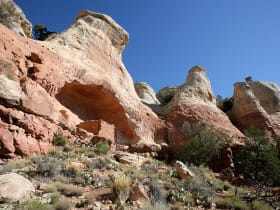
Just west of Mesa Verde lies the densest concentration of archaeological sites in the country, over 8,500 Ancestral Puebloan ruins across 176,000 acres of quiet high desert.

Mesa Verde National Park
35 miles away
Cliff dwellings built into canyon walls by Ancestral Puebloans more than seven centuries ago.
Mesa Verde Cliff Palace and Junior Ranger
36 miles away
Mesa Verde National Park's Junior Ranger program is one of the most substantive in the National Park System, with activity books covering Ancestral Puebloan daily life, architecture, and the mystery o...