

Historic General Dodge House
605 S 3rd St, Council Bluffs, IA
Council Bluffs, IA
The elegant hilltop mansion of the general who helped push the first transcontinental railroad across the West.
The Historic General Dodge House is the grand Victorian mansion built in Council Bluffs by Grenville Mellen Dodge, a Civil War general who became one of the most important railroad builders in American history. Perched on a bluff overlooking the Missouri River valley, the elaborately restored home showcases the craftsmanship and comfort of a wealthy Gilded Age family, from carved woodwork to period furnishings, and stands as a monument to Council Bluffs' role in opening the West.
Dodge is best remembered as the chief engineer of the Union Pacific Railroad, the company that built the eastern half of the first transcontinental railroad, and his choice of Council Bluffs and neighboring Omaha as the railroad's launching point shaped the whole region. His mansion, saved from demolition and carefully restored, lets visitors step into the world of the man who helped stitch the country together with rails.
What Travelers Love
- Touring a lavishly restored Victorian mansion with its period furnishings
- The story of Grenville Dodge and the building of the transcontinental railroad
- The fine craftsmanship, woodwork, and details of a Gilded Age home
- The hilltop setting with views over the Missouri River valley
Worth Knowing
- The house is seen by guided tour, so plan around tour times
- It is a preserved historic home, so look but handle nothing
- The mansion tells both a family story and a national railroad story
- Council Bluffs pairs easily with Omaha, just across the river
Learn about Historic General Dodge House
The general who built railroads
Grenville Dodge rose to prominence first as a Union general in the Civil War, where he directed the building and repair of railroads and bridges that kept armies supplied, and ran an intelligence network as well. That wartime experience made him one of the country's foremost railroad engineers, and after the war he became chief engineer of the Union Pacific, the company charged with building west from the Missouri River.
Council Bluffs and Omaha, facing each other across the river, became the eastern anchor of the transcontinental railroad, and Dodge's work helped drive the rails across the plains and mountains until they met the line building east from California. His life spanned soldiering, surveying, business, and politics, and his fingerprints are on the map of the American West.
A mansion on the bluff
In the late 1860s Dodge built a large and elegant home on a bluff in Council Bluffs, a fashionable Victorian mansion that reflected his wealth and standing. Built with fine materials and up-to-date conveniences for its day, it was a showplace, and it hosted the family and their many notable guests over the years.
By the mid-1900s the house faced possible demolition, as so many grand old homes did, but a preservation effort saved it and restored it to its Gilded Age appearance. Today it is furnished with period pieces and shown by guided tour, giving visitors a vivid picture of upper-class life in the railroad era and of the family that lived there.
Council Bluffs and the gateway west
Council Bluffs sits on the east bank of the Missouri River, and its position made it a natural gateway for people and goods heading west. Emigrants on the overland trails, Mormon travelers on their way to Utah, and later the railroads all passed through or launched from here. The city's very name recalls a council held nearby between explorers Lewis and Clark and Native leaders.
The Dodge House is one of several historic sites that recall this heritage, alongside museums devoted to the railroads that made the city a hub. Together they tell the story of a place that, for a time, stood at the very edge of the settled country, the last stop before the long journey into the West.
The river and its first peoples
The Missouri River valley here lies within the historic homelands of the Ioway, for whom the state is named, and other peoples of the region, whose communities lived and traded along the great river long before the trails and railroads came. The council that gave Council Bluffs its name was one moment in a long history of Native presence on this stretch of the Missouri.
The river shaped everything about the place, from the trails that followed it to the railroads that had to cross it. The wide, muddy Missouri and the bluffs that rise above it, one of which the Dodge mansion crowns, remain the defining features of a region that served as a doorway between the settled East and the open West.
Closest Boutels
The closest Boutel™ stays, so you can turn this stop into an overnight. Each is a place we chose through independent editorial review, never a paid placement.
Details
Council Bluffs, IA
Frequently asked questions
What is the Historic General Dodge House?
The Historic General Dodge House, in Council Bluffs in southwestern Iowa, is a grand Victorian mansion built in the late nineteenth century as the home of General Grenville Dodge, a Civil War general and one of the most important railroad engineers in American history, who helped build the transcontinental railroad. The beautifully preserved home, a National Historic Landmark, showcases opulent Victorian architecture, period furnishings, and the story of Dodge's remarkable life. Visitors tour its elegant rooms and learn about the man behind the great railroad. With its stately Victorian architecture, period interiors, and rich history, the Historic General Dodge House offers a fascinating destination in Council Bluffs, Iowa.
Who was General Grenville Dodge?
General Grenville Dodge was a prominent nineteenth-century figure who served as a Union general in the Civil War and went on to become one of the most influential railroad engineers in American history, playing a key role in surveying and building the transcontinental railroad that linked the nation. Based in Council Bluffs, a gateway to the West, he built his grand mansion there. His work helped shape the growth of the American West. Learning his story, from soldier to railroad builder, is central to a visit to the Historic General Dodge House in Council Bluffs, Iowa.
What can you see at the Historic General Dodge House?
You can tour the grand Victorian mansion's elegant rooms, admire the opulent architecture with its fine woodwork, period furnishings, and craftsmanship of the late nineteenth century, and learn about the life and achievements of General Grenville Dodge, from his Civil War service to his pivotal role in building the transcontinental railroad. Guided tours share the home's history and stories. The mansion's beauty and Dodge's remarkable life are highlights. With its preserved Victorian interiors and rich history, the Historic General Dodge House offers an engaging and elegant visit in Council Bluffs, southwestern Iowa.
When is the best time to visit the Historic General Dodge House?
As an indoor historic house museum, the General Dodge House is enjoyable year-round in any weather, though it is typically seen by guided tour, so checking current days, hours, and tour times before you go is wise, as they can vary seasonally, and the home often features special holiday tours and events at certain times of year. Summer is a pleasant time to combine it with other Council Bluffs attractions. Because it is indoors and toured, the Historic General Dodge House makes a reliable and rewarding stop any time of year in Council Bluffs, Iowa.
What is near the Historic General Dodge House?
The Historic General Dodge House is in Council Bluffs in southwestern Iowa, near the Historic Squirrel Cage Jail, the Union Pacific Railroad Museum, the Loess Hills country with Hitchcock Nature Center, and within reach of the Missouri River and the Omaha area across the river. That makes the Historic General Dodge House a fascinating stop to combine with the Union Pacific Railroad Museum, the Squirrel Cage Jail, and the other attractions of Council Bluffs and southwestern Iowa on a visit to the state.
Nearby

Loess Hills Scenic Byway
0.3 miles away
The Loess Hills run in a narrow band along Iowas western edge, steep ridges of wind-deposited silt so deep and rugged that this landform reaches comparable scale in only one other place on earth.
Lincoln Highway Heritage Byway
0.4 miles away
Iowa's stretch of the Lincoln Highway, America's first coast-to-coast road, laid out in 1913 and now a marked heritage byway.
Union Pacific Railroad Museum
0.4 miles away
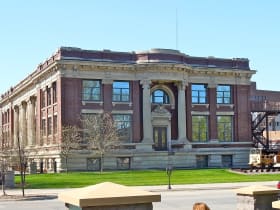
The Union Pacific Railroad Museum is in downtown Council Bluffs, in a 1905 Carnegie library. Admission is free.
Historic Squirrel Cage Jail
0.7 miles away
The Historic Squirrel Cage Jail sits in downtown Council Bluffs.

Henry Doorly Zoo and Aquarium
4.5 miles away
Henry Doorly Zoo and Aquarium: just south of downtown Omaha off Interstate 80 (13th Street exit). Admission charged; parking fee. Plan on most of a day.

Joslyn Art Museum
5.2 miles away
Joslyn Art Museum: 2200 Dodge Street, downtown Omaha. General admission is free; some special exhibitions ticketed.

Mormon Trail Center at Historic Winter Quarters
7.6 miles away
Mormon Trail Center at Winter Quarters: on State Street in the Florence area of north Omaha, across from the Mormon Pioneer Cemetery.

Hitchcock Nature Center
10 miles away
Hitchcock Nature Center sits in the Loess Hills north of Council Bluffs. The ridges here are steep wind-built silt, and restored hilltop prairie is slowly returning across the preserve.